Suñer Clara, Coma Ermengol, Ouchi Dan, Hermosilla Eduardo, Baro Bàrbara, Rodríguez-Arias Miquel Àngel, Puig Jordi, Clotet Bonaventura, Medina Manuel, Mitjà Oriol
Fight AIDS and Infectious Diseases Foundation, Badalona, Badalona, Spain.
Sistemes d'Informació dels Serveis d'Atenció Primària (SISAP), Institut Català de la Salut (ICS), Gran Via de Les Corts Catalanes, 587, 08007, Barcelona, Spain.
Lancet Reg Health Eur. 2022 Feb 28;15:100337. doi: 10.1016/j.lanepe.2022.100337. eCollection 2022 Apr.
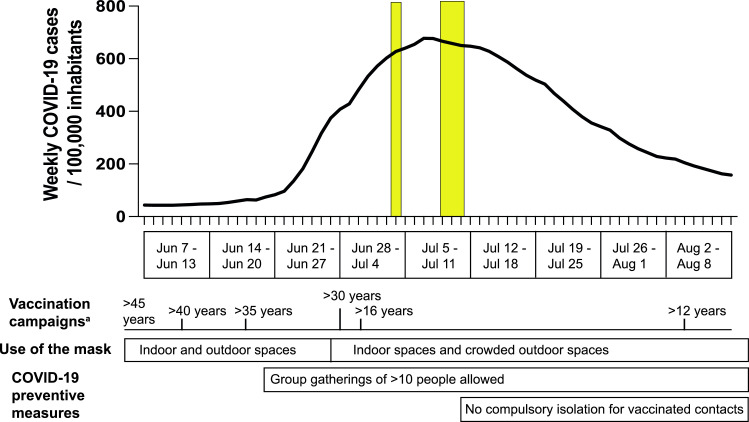
Many countries have resumed mass-gathering events like music festivals, despite the risk of severe acute respiratory syndrome coronavirus 2 (SARS-CoV-2) spreading. In this study, we aimed to assess the effect of two mass-gathering outdoor events, held during a peak of SARS-CoV-2 transmission, on COVID-19 incidence.
This was a retrospective, population-based control-matched analysis. The study population included attendees to two outdoor music festivals held in Catalonia (North-East Spain). The primary objective was to compare the incidence of COVID-19 within the 3-to-10 days following the event between attendees and a population-based control group.
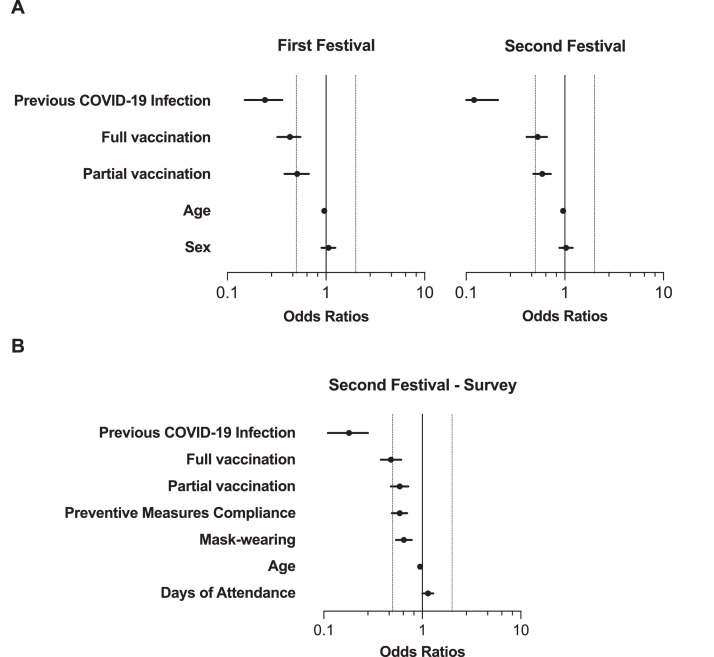
The analysis included 18,275 and 27,347 attendees to the first and second festivals, respectively, and their corresponding controls. The post-festival 7-day cumulative COVID-19 incidence among attendees and controls was 4.14% (95% CI 3.86-4.44) vs. 1.69% (1.51-1.88) for the first festival (RR 2.46; 2.16-2.80), and 2.42% (2.35-2.61) and 1.10% (0.99-1.2) for the second festival (RR 2.19; 1.92-2.51). COVID-19 incidence among immunized individuals was also two-fold higher in attendees than in controls. Previous COVID-19 infection, vaccination, and adequate mask-wearing were significantly associated with a lower risk of COVID-19 infection after the events.
Despite the proven effectiveness of preventive measures such as Ag-RDT screening, mask-wearing and vaccination, caution should be taken when holding these events during a period of high community SARS-CoV-2 transmission.
Crowdfunding campaign YoMeCorono (https://www.yomecorono.com/) and the Generalitat de Catalunya.
尽管存在严重急性呼吸综合征冠状病毒2(SARS-CoV-2)传播的风险,但许多国家已恢复举办音乐节等大型聚集活动。在本研究中,我们旨在评估在SARS-CoV-2传播高峰期举行的两场户外大型聚集活动对新冠病毒病(COVID-19)发病率的影响。
这是一项基于人群的回顾性对照匹配分析。研究人群包括在加泰罗尼亚(西班牙东北部)举行的两场户外音乐节的参与者。主要目的是比较活动后3至10天内参与者与基于人群的对照组中COVID-19的发病率。
分析分别纳入了第一场和第二场音乐节的18275名和27347名参与者及其相应的对照组。第一场音乐节参与者和对照组节后7天COVID-19累积发病率分别为4.14%(95%CI 3.86 - 4.44)和1.69%(1.51 - 1.88)(相对风险2.46;2.16 - 2.80),第二场音乐节分别为2.42%(2.35 - 2.61)和1.10%(0.99 - 1.2)(相对风险2.19;1.92 - 2.51)。免疫个体中,参与者的COVID-19发病率也比对照组高两倍。既往COVID-19感染、接种疫苗和正确佩戴口罩与活动后较低的COVID-19感染风险显著相关。
尽管抗原快速检测筛查、佩戴口罩和接种疫苗等预防措施已被证明有效,但在社区SARS-CoV-2传播高发期举办这些活动时仍应谨慎。
众筹活动YoMeCorono(https://www.yomecorono.com/)和加泰罗尼亚自治区政府。