Centre for Addiction and Mental Health, 100 Stokes St, Toronto, Ontario, M6J 1H4, Canada.
Department of Family and Community Medicine, University of Toronto, Toronto, Ontario, Canada.
Curr Obes Rep. 2022 Mar;11(1):23-31. doi: 10.1007/s13679-021-00466-6. Epub 2022 Mar 7.
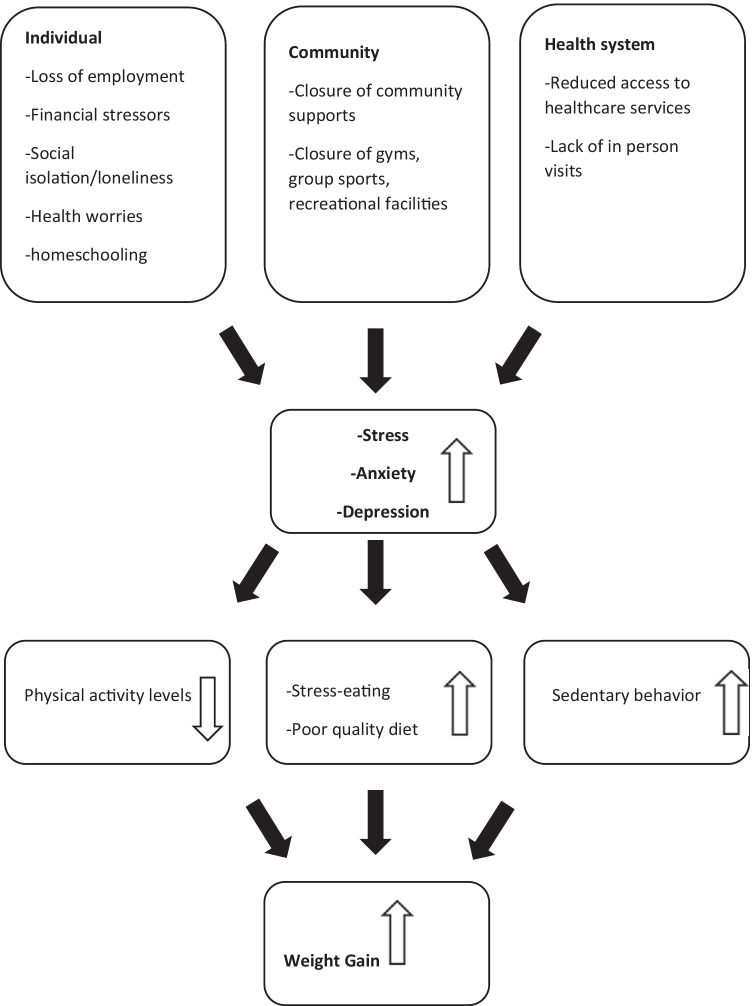
The COVID-19 pandemic is associated with increased levels of stress, anxiety and depression in the population. These are associated with unhealthy eating patterns and sedentary behaviour. In turn, this may increase risk of obesity or aggravate it. This narrative review discusses the link between adverse mental health states and weight related behaviours. We present emerging evidence for this phenomenon during the COVID-19 pandemic in individuals with and without pre-existing obesity.
A sizeable proportion of the population exhibits deterioration in mental health during the pandemic and those affected often report unhealthy weight-related behaviours such as "junk food" consumption and physical inactivity. Women, individuals with obesity, and those with pre-existing mental health conditions seem to be particularly at risk for overeating in response to stress (i.e. emotional eating). A number of psychological interventions including cognitive behavioural therapy and self-compassion may be effective in improving mental health and emotional eating patterns among the general population and particularly in individuals living with obesity. There is a need to complement efforts to improve mental health in the general population during the COVID-19 pandemic with targeted action to improve physical activity levels and healthy eating particularly among groups at-risk. This may be achieved by reducing disruptions to specialist and primary healthcare services and facilitating access to psychological interventions that address stress-related eating behaviours. Additional studies that examine such interventions, especially those that are delivered remotely, are urgently needed.
COVID-19 大流行导致人群中压力、焦虑和抑郁水平升高。这些与不健康的饮食模式和久坐行为有关。反过来,这可能会增加肥胖的风险或使其恶化。本综述讨论了不良心理健康状态与体重相关行为之间的联系。我们提出了在 COVID-19 大流行期间,肥胖和非肥胖个体中出现的这种现象的新证据。
相当一部分人在大流行期间心理健康恶化,受影响的人经常报告不健康的与体重相关的行为,如“垃圾食品”消费和缺乏身体活动。女性、肥胖者和有先前心理健康状况的人似乎特别容易因压力而过度进食(即情绪性进食)。一些心理干预措施,包括认知行为疗法和自我同情,可能对改善普通人群的心理健康和情绪性进食模式有效,特别是对肥胖者。在 COVID-19 大流行期间,需要在改善普通人群心理健康方面做出努力,并针对特定群体采取行动,以提高身体活动水平和健康饮食,特别是在高风险群体中。这可以通过减少对专科和初级保健服务的干扰以及促进获得解决与压力相关的进食行为的心理干预措施来实现。迫切需要开展更多研究来检验这些干预措施,特别是那些远程提供的干预措施。