Rissanen J, Walker S, Pareja-Blanco F, Häkkinen K
NeuroMuscular Research Center, Faculty of Sport and Health Sciences, University of Jyväskylä, Room VIV225, 40014, Jyväskylä, Finland.
Department of Sports and Computer Sciences, Physical Performance and Sports Research Center, Universidad Pablo de Olavide, Seville, Spain.
Eur J Appl Physiol. 2022 May;122(5):1269-1280. doi: 10.1007/s00421-022-04925-3. Epub 2022 Mar 8.
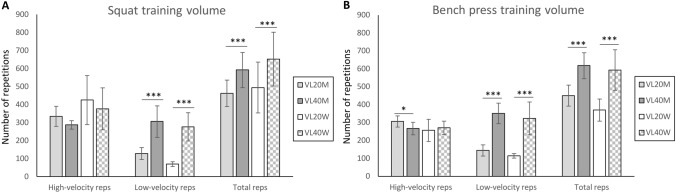
Men and women typically display different neuromuscular characteristics, force-velocity relationships, and differing strength deficit (upper vs. lower body). Thus, it is not clear how previous recommendations for training with velocity-loss resistance training based on data in men will apply to women. This study examined the inter-sex differences in neuromuscular adaptations using 20% and 40% velocity-loss protocols in back squat and bench press exercises.
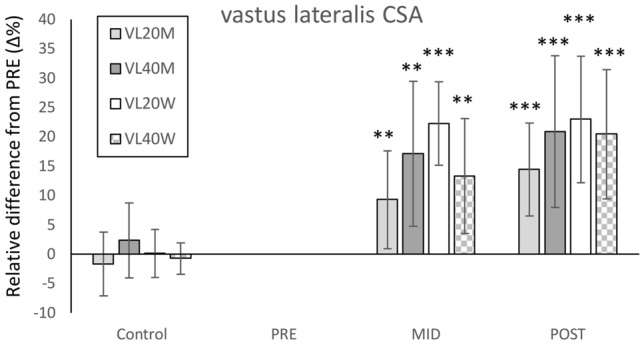
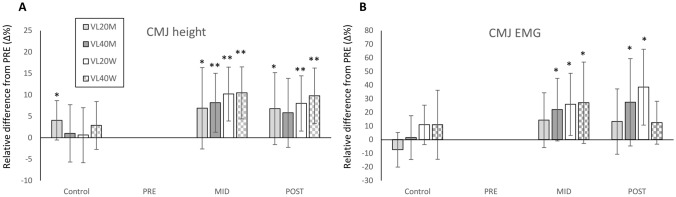
The present study employed an 8-week intervention (2 × week) comparing 20% vs. 40% velocity-loss resistance training in the back squat and bench press exercises in young men and women (~ 26 years). Maximum strength (1-RM) and submaximal-load mean propulsive velocity (MPV) for low- and high-velocity lifts in squat and bench press, countermovement jump and vastus lateralis cross-sectional area were measured at pre-, mid-, and post-training. Surface EMG of quadriceps measured muscle activity during performance tests.
All groups increased 1-RM strength in squat and bench press exercises, as well as MPV using submaximal loads and countermovement jump height (P < 0.05). No statistically significant between-group differences were observed, but higher magnitudes following 40% velocity loss in 1-RM (g = 0.60) and in low- (g = 1.42) and high-velocity (g = 0.98) lifts occurred in women. Training-induced improvements were accompanied by increases in surface EMG amplitude and vastus lateralis cross-sectional area.
Similar increases in strength and power performance were observed in men and women over 8 weeks of velocity-based resistance training. However, some results suggest that strength and power gains favor using 40% rather than 20% velocity loss in women.
男性和女性通常表现出不同的神经肌肉特征、力量-速度关系以及不同的力量缺陷(上身与下身)。因此,基于男性数据的先前关于速度损失阻力训练的建议如何适用于女性尚不清楚。本研究使用深蹲和卧推练习中20%和40%速度损失方案,研究神经肌肉适应的性别差异。
本研究采用为期8周的干预(每周2次),比较年轻男性和女性(约26岁)在深蹲和卧推练习中20%与40%速度损失阻力训练的效果。在训练前、训练中期和训练后测量深蹲和卧推中低速和高速举重的最大力量(1-RM)和次最大负荷平均推进速度(MPV)、反向运动跳跃以及股外侧肌横截面积。在性能测试期间,股四头肌的表面肌电图测量肌肉活动。
所有组在深蹲和卧推练习中的1-RM力量、使用次最大负荷的MPV以及反向运动跳跃高度均有所增加(P<0.05)。未观察到组间有统计学意义的差异,但女性在1-RM(g=0.60)以及低速(g=1.42)和高速(g=0.98)举重中40%速度损失后的增加幅度更大。训练引起的改善伴随着表面肌电图振幅和股外侧肌横截面积的增加。
在为期8周的基于速度的阻力训练中,男性和女性的力量和功率表现均有类似增加。然而,一些结果表明,女性在力量和功率增长方面更倾向于使用40%而非20%的速度损失。