Department of Family and Community Medicine and Behavioural Science, College of Medicine, University of Sharjah, Sharjah, United Arab Emirates.
Baker/ IDI Heart and Diabetes Institute, 75 Commercial Road, Melbourne, VIC, 3004, Australia.
BMC Med Educ. 2022 Mar 8;22(1):156. doi: 10.1186/s12909-022-03218-9.
The outbreak of coronavirus disease 2019 (COVID-19) and its quick progression to a global pandemic has urged medical schools to shift from didactic to distance learning and assessment approaches. The quality of clinical training and assessment have been jeopardized due to the regulatory restrictions and potential hazards to human lives. The aim of this paper is to evaluate the utility and efficacy of an electronic Objective Structured Clinical Examination (e-OSCE), which attempted to transform the format of a face-to-face OSCE to an e-OSCE.
We conducted three end of clerkship e-OSCEs for final year medical students in Surgery, Medicine and Family Medicine using the teleconferencing application of Microsoft Teams (MST). The e-OSCE blueprint included the assessment of all clinical skills except physical examination and procedural skills. Examiners supervised e-OSCE from the college campus, while all students were remotely assessed through the MST channels. During the exam, the students stayed in their specified MST channel and examiners rotated across all students. The utility and efficacy of e-OSCE was evaluated using a self-administered questionnaire for students, examiners and e-OSCE team.
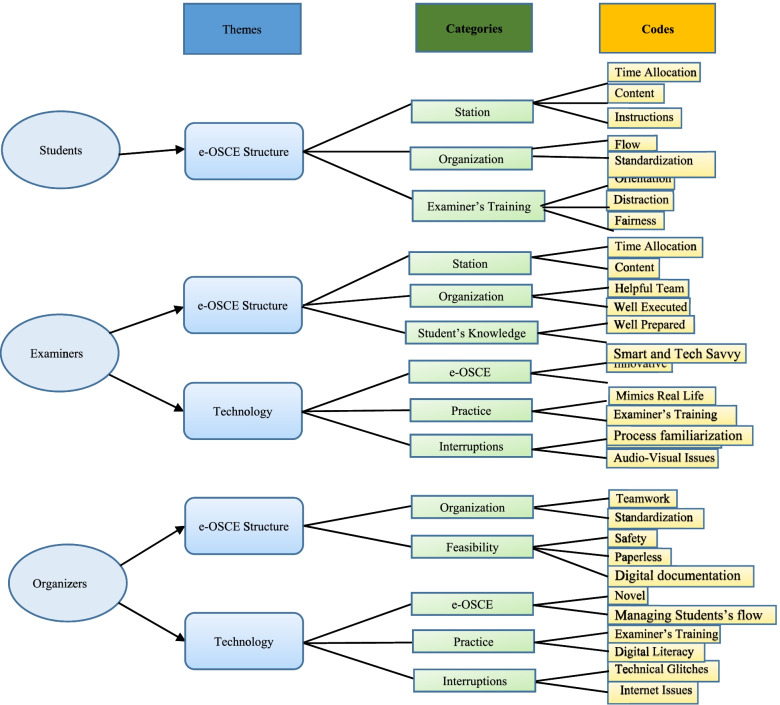
The data analysis showed that 93.4% students and 92.2% examiners agreed with the quality and process of e-OSCE. Similarly, 83.6% students and 98% examiners agreed with the seamless organization of e-OSCE. As many as 45.9% students and 74.5% examiners agreed that e-OSCE was close to real life practice. Approximately one fifth of students and one third of examiners preferred e-OSCE over the face-to-face OSCE. The analysis of qualitative data generated the themes of e-OSCE structure and technology. While majority of participants were satisfied with e-OSCE, students were concerned about examiners' training and e-OSCE contents. Examiners and e-OSCE team recognized the paper-less, tech-savy, fast and reliable format of e-OSCE.
During and beyond COVID- 19 era, e-OSCE is a strong substitute to standard OSCE for assessing clinical competence except for physical examination and procedural skills. The planning and implementation of e-OSCE reflects an ingenuity in the assessment of clinical competencies of medical students.
2019 年冠状病毒病(COVID-19)的爆发及其迅速蔓延成为全球大流行,促使医学院将教学方法从课堂教学转变为远程学习和评估方法。由于监管限制以及对人类生命的潜在危害,临床培训和评估的质量受到了威胁。本文旨在评估电子客观结构化临床考试(e-OSCE)的实用性和效果,该考试试图将面对面 OSCE 转变为 e-OSCE。
我们使用 Microsoft Teams(MST)的视频会议应用程序为外科、内科和家庭医学专业的最后一年医学生进行了三次期末电子 OSCE。电子 OSCE 蓝图包括除体检和程序技能外的所有临床技能评估。考官在大学校园里监督电子 OSCE,而所有学生都通过 MST 频道远程评估。考试期间,学生留在指定的 MST 频道,考官在所有学生之间轮流。学生、考官和电子 OSCE 团队通过自我管理的问卷对电子 OSCE 的实用性和效果进行了评估。
数据分析显示,93.4%的学生和 92.2%的考官对电子 OSCE 的质量和流程表示认可。同样,83.6%的学生和 98%的考官对电子 OSCE 的无缝组织表示认可。多达 45.9%的学生和 74.5%的考官认为电子 OSCE 更接近现实生活实践。大约五分之一的学生和三分之一的考官更喜欢电子 OSCE 而不是面对面的 OSCE。定性数据分析生成了电子 OSCE 结构和技术的主题。虽然大多数参与者对电子 OSCE 表示满意,但学生对考官的培训和电子 OSCE 的内容表示关注。考官和电子 OSCE 团队认识到电子 OSCE 的无纸化、技术先进、快速可靠的格式。
在 COVID-19 期间和之后,电子 OSCE 是评估临床能力的标准 OSCE 的有力替代品,除了体检和程序技能外。电子 OSCE 的规划和实施反映了对医学生临床能力评估的创新性。