Department of Cardiovascular Surgery, Union Hospital, Tongji Medical College, Huazhong University of Science and Technology, Wuhan, 430022, China.
Department of Emergency Medicine, Union Hospital, Tongji Medical College, Huazhong University of Science and Technology, Wuhan, 430022, China.
BMC Cardiovasc Disord. 2022 Mar 9;22(1):94. doi: 10.1186/s12872-022-02538-4.
Despite surgical advances, acute type A aortic dissection remains a life-threatening disease with high mortality and morbidity. Tracheostomy is usually used for patients who need prolonged mechanical ventilation in the intensive care unit (ICU). However, data on the risk factors for requiring tracheostomy and the impact of tracheostomy on outcomes in patients after Stanford type A acute aortic dissection surgery (AADS) are limited.
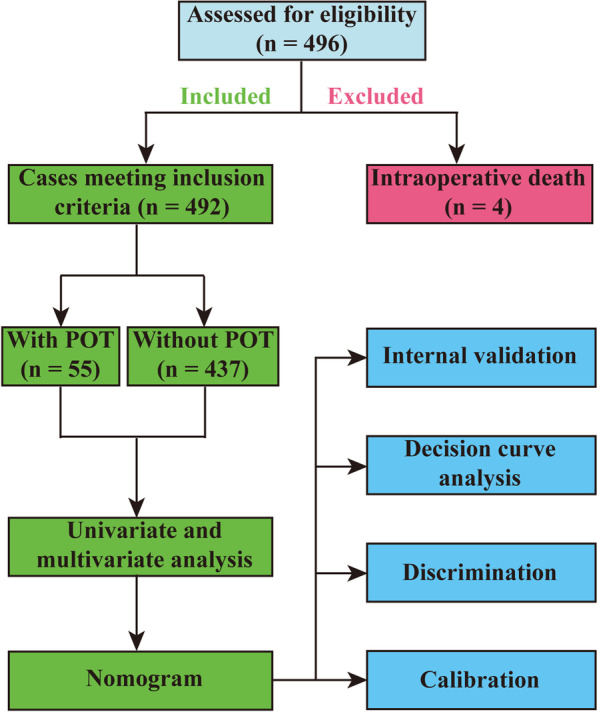
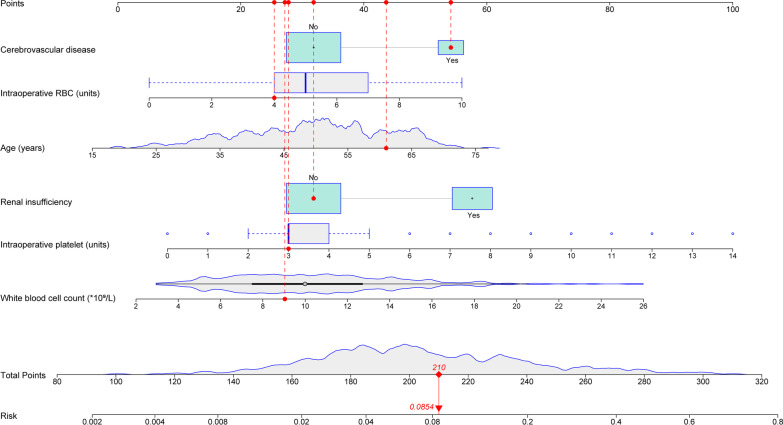
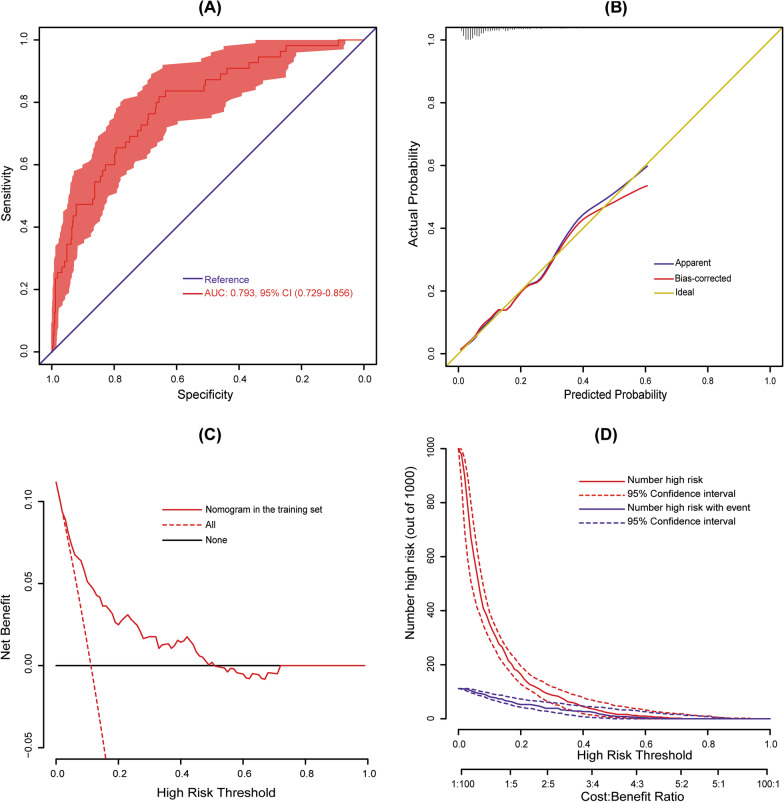
A retrospective single-institutional study including consecutive patients who underwent AADS between January 2016 and December 2019 was conducted. Patients who died intraoperatively were excluded. Univariate analysis and multivariate logistic regression analysis were used to identify independent risk factors for postoperative tracheostomy (POT). A nomogram to predict the probability of POT was constructed based on independent predictors and their beta-coefficients. The area under the receiver operating characteristic curve (AUC) was performed to assess the discrimination of the model. Calibration plots and the Hosmer-Lemeshow test were used to evaluate calibration. Clinical usefulness of the nomogram was assessed by decision curve analysis. Propensity score matching analysis was used to analyze the correlation between requiring tracheostomy and clinical prognosis.
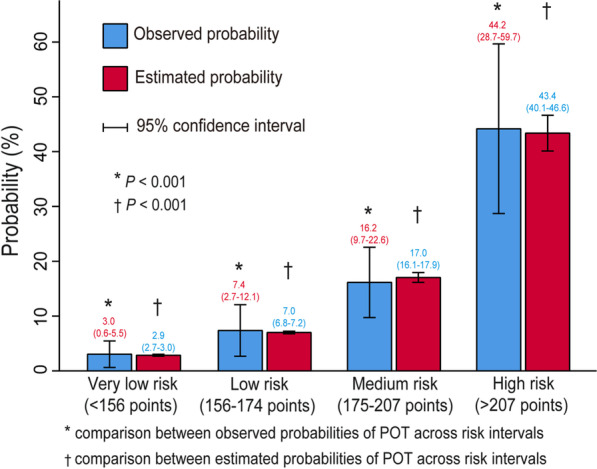
There were 492 patients included in this study for analysis, including 55 patients (11.2%) requiring tracheostomy after AADS. Compared with patients without POT, patients with POT experienced longer ICU and hospital stay and higher mortality. Age, cerebrovascular disease history, preoperative white blood cell (WBC) count and renal insufficiency, intraoperative amount of red blood cell (RBC) transfusion and platelet transfusion were identified as independent risk factors for POT. Our constructed nomogram had good discrimination with an AUC = 0.793 (0.729-0.856). Good calibration and clinical utility were observed through the calibration and decision curves, respectively. For better clinical application, we defined four intervals that stratified patients from very low to high risk for occurrence of POT.
Our study identified preoperative and intraoperative risk factors for POT and found that requiring tracheostomy was related to the poor outcomes in patients undergoing AADS. The established prediction model was validated with well predictive performance and clinical utility, and it may be useful for individual risk assessment and early clinical decision-making to reduce the incidence of tracheostomy.
尽管外科技术取得了进步,但急性 A 型主动脉夹层仍然是一种致命性疾病,具有较高的死亡率和发病率。气管切开术通常用于需要在重症监护病房(ICU)长时间机械通气的患者。然而,关于需要气管切开术的风险因素以及 Stanford A 型急性主动脉夹层手术后(AADS)患者气管切开术对结局影响的数据有限。
进行了一项回顾性单中心研究,纳入 2016 年 1 月至 2019 年 12 月期间接受 AADS 的连续患者。排除术中死亡的患者。使用单因素分析和多因素逻辑回归分析确定术后气管切开术(POT)的独立危险因素。根据独立预测因子及其β系数构建预测 POT 概率的列线图。使用接收者操作特征曲线(ROC)下面积评估模型的鉴别能力。校准图和 Hosmer-Lemeshow 检验用于评估校准。通过决策曲线分析评估列线图的临床实用性。使用倾向评分匹配分析来分析需要气管切开术与临床预后之间的相关性。
本研究共纳入 492 例患者进行分析,其中 55 例(11.2%)患者在 AADS 后需要气管切开术。与没有 POT 的患者相比,有 POT 的患者 ICU 和住院时间更长,死亡率更高。年龄、脑血管病史、术前白细胞(WBC)计数和肾功能不全、术中红细胞(RBC)和血小板输血量被确定为 POT 的独立危险因素。我们构建的列线图具有良好的鉴别能力,AUC 为 0.793(0.729-0.856)。通过校准和决策曲线分别观察到良好的校准和临床实用性。为了更好的临床应用,我们定义了四个间隔,将患者分为发生 POT 的极低到高风险。
我们的研究确定了 POT 的术前和术中危险因素,并发现气管切开术与 AADS 患者的不良结局有关。所建立的预测模型具有良好的预测性能和临床实用性,可能有助于个体风险评估和早期临床决策,以降低气管切开术的发生率。