Davari Niyousha, Bakhtiary Negar, Khajehmohammadi Mehran, Sarkari Soulmaz, Tolabi Hamidreza, Ghorbani Farnaz, Ghalandari Behafarid
Department of Life Science Engineering, Faculty of New Sciences and Technologies, University of Tehran, Tehran 143951561, Iran.
Burn Research Center, Iran University of Medical Sciences, Tehran 1449614535, Iran.
Polymers (Basel). 2022 Feb 28;14(5):986. doi: 10.3390/polym14050986.
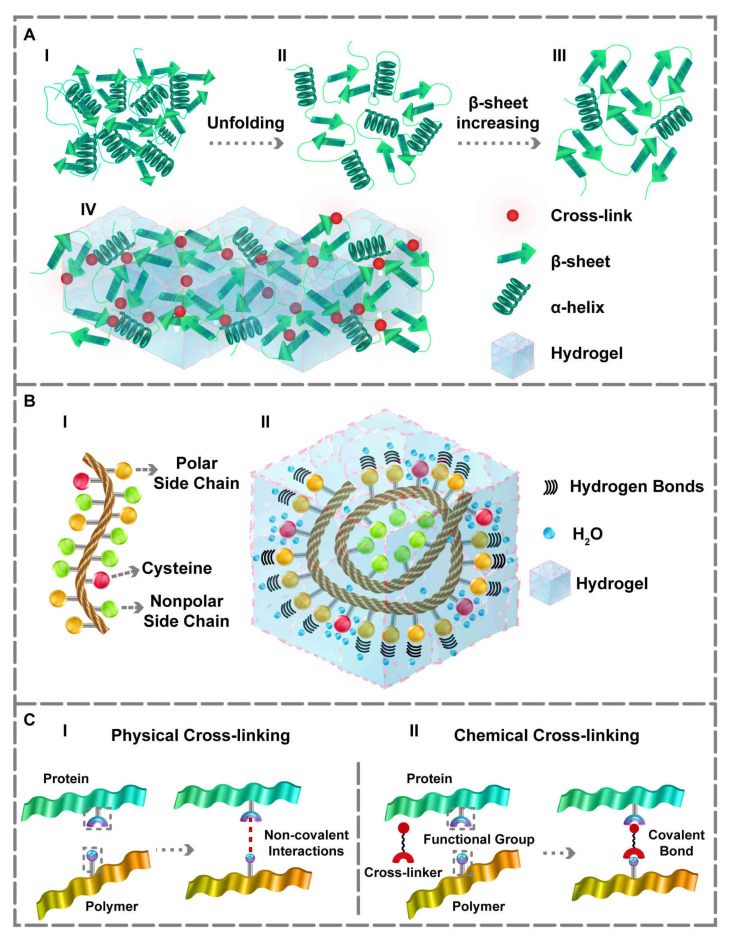
The successful design of a hydrogel for tissue engineering requires a profound understanding of its constituents' structural and molecular properties, as well as the proper selection of components. If the engineered processes are in line with the procedures that natural materials undergo to achieve the best network structure necessary for the formation of the hydrogel with desired properties, the failure rate of tissue engineering projects will be significantly reduced. In this review, we examine the behavior of proteins as an essential and effective component of hydrogels, and describe the factors that can enhance the protein-based hydrogels' structure. Furthermore, we outline the fabrication route of protein-based hydrogels from protein microstructure and the selection of appropriate materials according to recent research to growth factors, crucial members of the protein family, and their delivery approaches. Finally, the unmet needs and current challenges in developing the ideal biomaterials for protein-based hydrogels are discussed, and emerging strategies in this area are highlighted.
用于组织工程的水凝胶的成功设计需要深刻理解其成分的结构和分子特性,以及对组分的恰当选择。如果工程过程符合天然材料为形成具有所需特性的水凝胶而实现最佳网络结构所经历的程序,那么组织工程项目的失败率将显著降低。在本综述中,我们研究了蛋白质作为水凝胶的一种基本且有效的成分的行为,并描述了可增强基于蛋白质的水凝胶结构的因素。此外,我们根据近期研究,从蛋白质微观结构以及从生长因子、蛋白质家族的关键成员及其递送方法中选择合适材料的角度,概述了基于蛋白质的水凝胶的制备途径。最后,讨论了开发用于基于蛋白质的水凝胶的理想生物材料方面未满足的需求和当前面临的挑战,并强调了该领域的新兴策略。