State Key Laboratory for Biocontrol, Southern Marine Science and Engineering Guangdong Laboratory (Zhuhai), School of Marine Sciences, Sun Yat-sen University, Zhuhai, 519000, China.
College of Life Sciences, Nanjing Normal University, Nanjing, 210023, China.
Commun Biol. 2022 Mar 10;5(1):224. doi: 10.1038/s42003-022-03176-4.
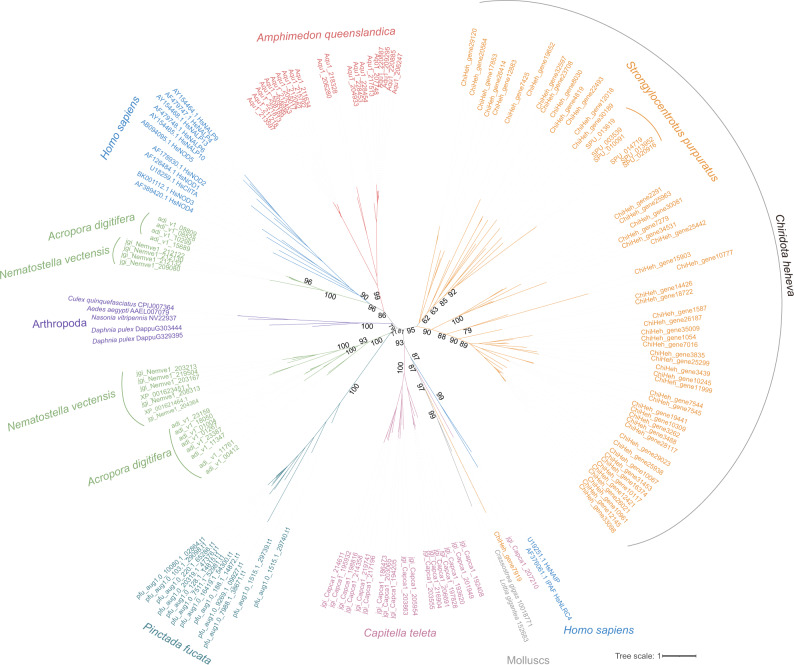
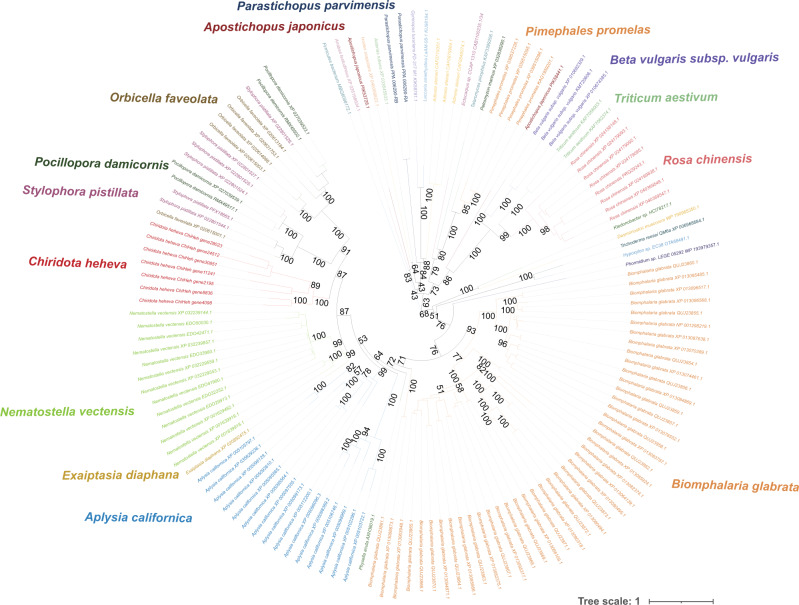
Cold seeps and hydrothermal vents are deep-sea reducing environments that are characterized by lacking oxygen and photosynthesis-derived nutrients. Most animals acquire nutrition in cold seeps or hydrothermal vents by maintaining epi- or endosymbiotic relationship with chemoautotrophic microorganisms. Although several seep- and vent-dwelling animals hosting symbiotic microbes have been well-studied, the genomic basis of adaptation to deep-sea reducing environment in nonsymbiotic animals is still lacking. Here, we report a high-quality genome of Chiridota heheva Pawson & Vance, 2004, which thrives by extracting organic components from sediment detritus and suspended material, as a reference for nonsymbiotic animal's adaptation to deep-sea reducing environments. The expansion of the aerolysin-like protein family in C. heheva compared with other echinoderms might be involved in the disintegration of microbes during digestion. Moreover, several hypoxia-related genes (Pyruvate Kinase M2, PKM2; Phospholysine Phosphohistidine Inorganic Pyrophosphate Phosphatase, LHPP; Poly(A)-specific Ribonuclease Subunit PAN2, PAN2; and Ribosomal RNA Processing 9, RRP9) were subject to positive selection in the genome of C. heheva, which contributes to their adaptation to hypoxic environments.
冷渗口和热液喷口是深海还原环境,其特征是缺乏氧气和光合作用衍生的营养物质。大多数动物通过与化能自养微生物维持表共生或内共生关系来获取冷渗口或热液喷口的营养。虽然已经对几种居住在渗口和喷口的动物及其共生微生物进行了广泛研究,但非共生动物适应深海还原环境的基因组基础仍不清楚。在这里,我们报告了 Chiridota heheva Pawson & Vance, 2004 的高质量基因组,它通过从沉积物碎屑和悬浮物质中提取有机成分而茁壮成长,为非共生动物适应深海还原环境提供了参考。与其他棘皮动物相比,C. heheva 中 aerolysin 样蛋白家族的扩张可能与消化过程中微生物的解体有关。此外,几种与缺氧相关的基因(丙酮酸激酶 M2、PKM2;磷酸丝氨酸磷酸组氨酸无机焦磷酸磷酸酶、LHPP;聚(A)特异性核糖核酸酶亚基 PAN2、PAN2;和核糖体 RNA 加工 9、RRP9)在 C. heheva 的基因组中受到正选择,这有助于它们适应缺氧环境。