Eriksrud Ola, Ahlbeck Fredrik, Harper Damian, Gløersen Øyvind
Department of Physical Performance, Norwegian School of Sport Sciences, Oslo, Norway.
School of Sport and Health Sciences, Institute of Coaching and Performance, University of Central Lancashire, Preston, United Kingdom.
Front Physiol. 2022 Feb 24;13:824606. doi: 10.3389/fphys.2022.824606. eCollection 2022.
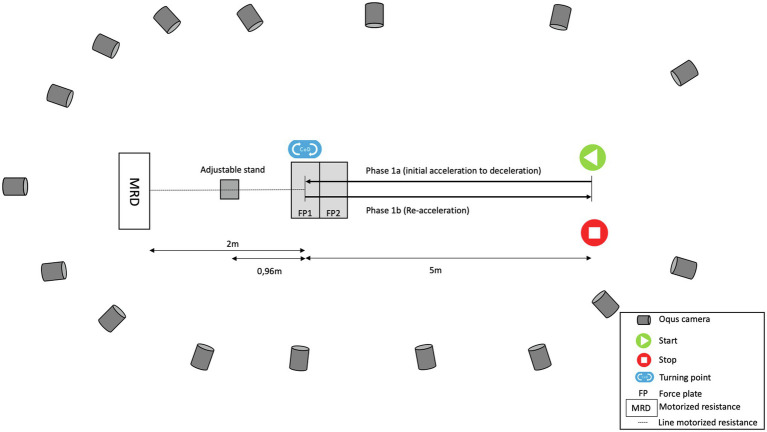
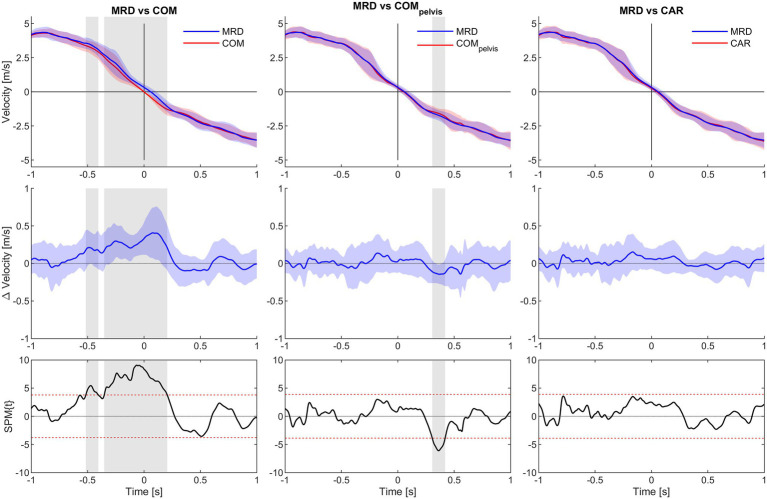
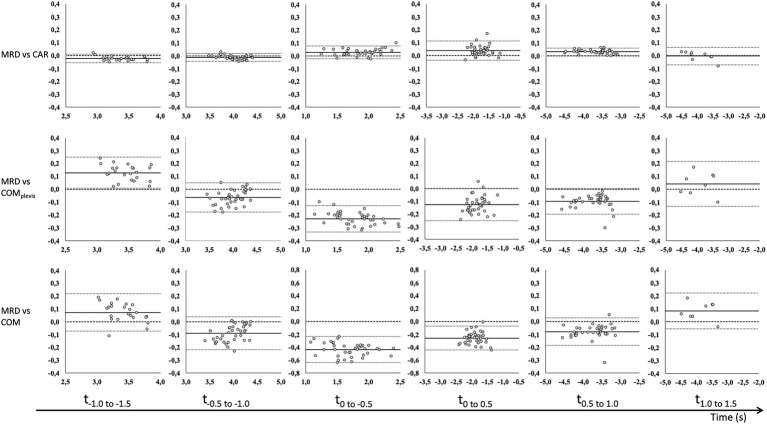
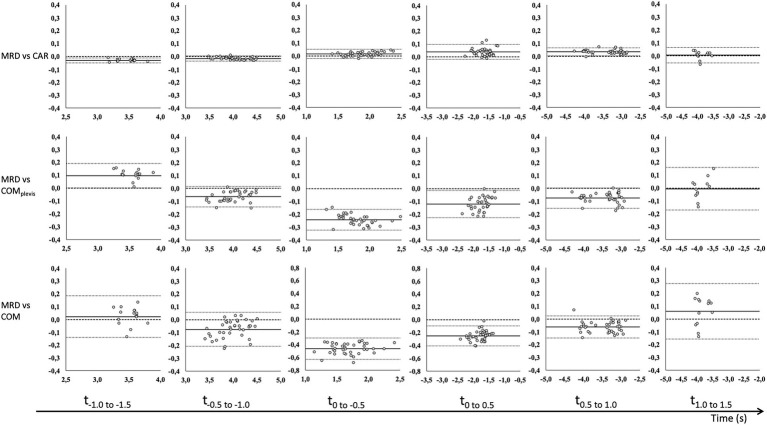
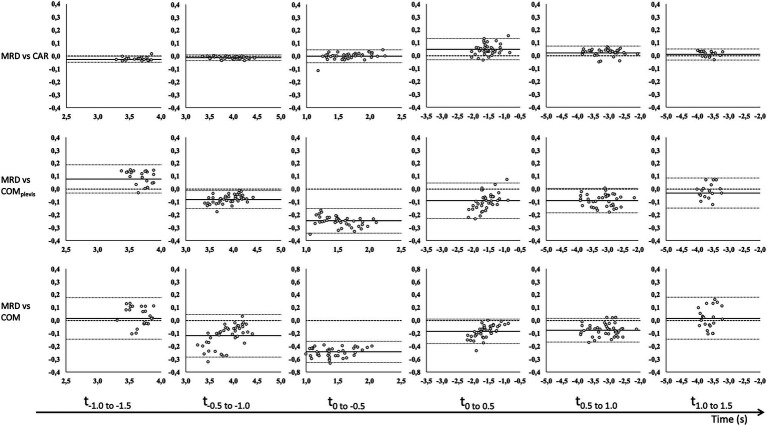
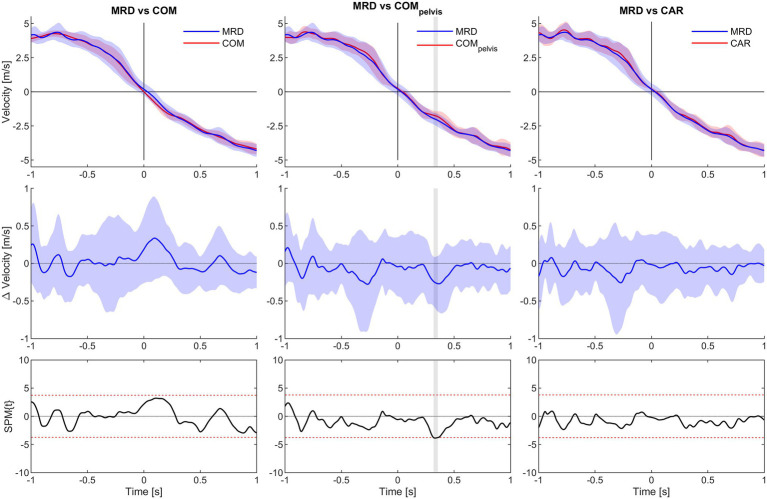
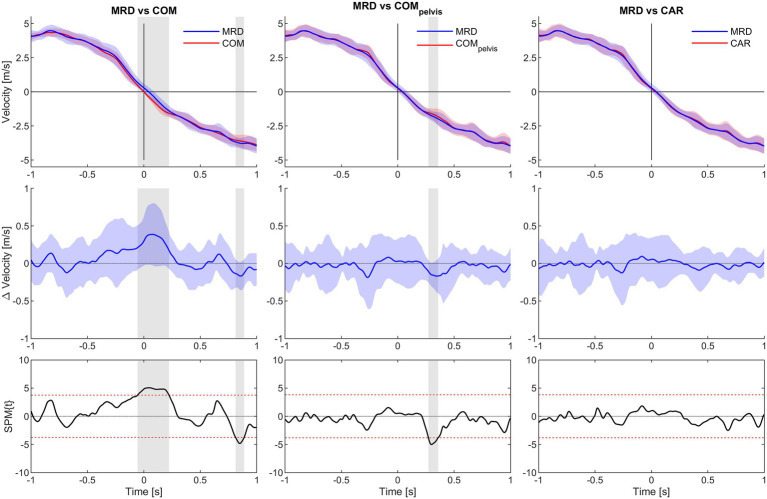
The aim of this study was to determine validity of velocity measurements of a motorized resistance device (MRD) during change of direction (CoD). Eight male (age: 22.1 ± 4.2 yrs; weight: 83.3 ± 17.1 kg; height: 181.6 ± 12.6 cm) and three female participants (age: 21.7 ± 1.5 yrs; mass: 69.7 ± 2.4 kg; height: 167.0 ± 3.6 cm) completed the modified 505 CoD test (m505) with turning off the left and right foot while exposed to external loads (3, 6, and 9 kg) provided by the MRD. Three-dimensional kinematic data were measured (200 Hz) for all tests using a full-body marker set with an additional marker placed on the pulley used to attach the carabiner (CAR) at the end of the line from the MRD to the participant. Average velocity of overall center of mass (COM), pelvis (COM), and pulley (CAR) was then calculated and compared to the velocity measured by MRD (MRD) in 0.5 s intervals 1.5 s before and after CoD. Average velocities from these intervals were then compared using correlational, Bland-Altman analysis, coefficient of variation (CV), and statistical parametric mapping (SPM). Mostly, excellent correlations were observed and ranged from 0.93 to 1.00, 0.53 to 1.00 and 0.93 to 1.00 for the 3, 6, and 9 kg load conditions, respectively. CV values ranged from 0.3 to 3.2%, 0.8 to 4.3%, and 1.5 to 7.7% for the CAR, COM, and COM comparisons, respectively. The biases for CAR comparisons ranged from -0.027 to 0.05 m/s, -0.246 to 0.128 m/s and -0.486 to 0.082 m/s across all load conditions and time intervals for the CAR COM, and COM comparisons, respectively. SPM analysis indicated significant differences between MRD and COM and COM over short time periods during the CoD, but no difference between MRD and CAR. The velocity measurements obtained by a MRD during a m505 test are valid as low biases, low CV's, and high correlations are observed for the MRD to CAR comparison. As single points of measurement (i.e., laser) has been proven useful to assess other athletic tasks (i.e., sprint running), the single point CAR comparison is an appropriate comparison for validating MRD measurements during the m505 test.
本研究的目的是确定电动阻力装置(MRD)在变向(CoD)过程中速度测量的有效性。八名男性(年龄:22.1±4.2岁;体重:83.3±17.1千克;身高:181.6±12.6厘米)和三名女性参与者(年龄:21.7±1.5岁;体重:69.7±2.4千克;身高:167.0±3.6厘米)在关闭左右脚的情况下,在承受MRD提供的外部负荷(3千克、6千克和9千克)时完成了改良的505变向测试(m505)。使用全身标记集对所有测试进行三维运动学数据测量(200赫兹),并在用于连接从MRD到参与者的绳索末端的滑轮上额外放置一个标记。然后计算整体质心(COM)、骨盆(COM)和滑轮(CAR)的平均速度,并与CoD前后1.5秒内以0.5秒为间隔的MRD(MRD)测量速度进行比较。然后使用相关性分析、布兰德-奥特曼分析、变异系数(CV)和统计参数映射(SPM)对这些间隔的平均速度进行比较。在3千克、6千克和9千克负荷条件下,大多观察到了极好的相关性,分别为0.93至1.00、0.53至1.00和0.93至1.00。CAR、COM和COM比较的CV值分别为0.3%至3.2%、0.8%至4.3%和1.5%至7.7%。CAR比较的偏差在所有负荷条件和时间间隔下,CAR与COM、COM与COM比较分别为-0.027至0.05米/秒、-0.246至0.128米/秒和-0.486至0.082米/秒。SPM分析表明,在CoD期间的短时间内,MRD与COM和COM之间存在显著差异,但MRD与CAR之间没有差异。在m505测试中,MRD获得的速度测量是有效的,因为在MRD与CAR的比较中观察到了低偏差、低CV值和高相关性。由于单点测量(即激光)已被证明对评估其他运动任务(即短跑)有用,因此单点CAR比较是验证m505测试期间MRD测量的合适比较方法。