Institute of Coaching and Performance, School of Sport and Health Sciences, University of Central Lancashire, Fylde Road, Preston, PR1 2HE, UK.
Department of Football Medicine and Science, Manchester United Football Club, AON Training Complex, Manchester, UK.
Sports Med. 2022 Oct;52(10):2321-2354. doi: 10.1007/s40279-022-01693-0. Epub 2022 May 29.
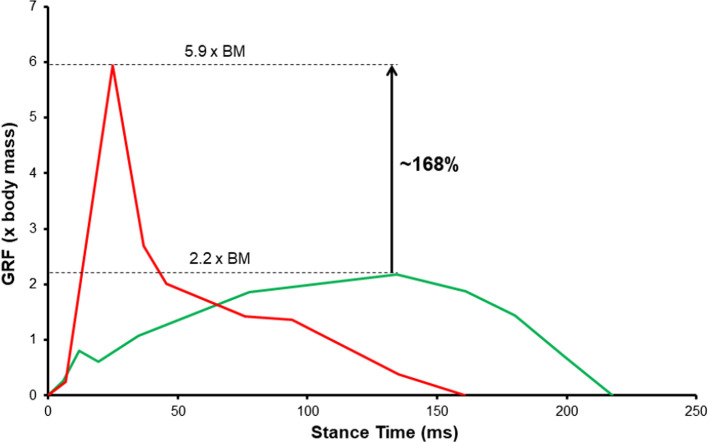
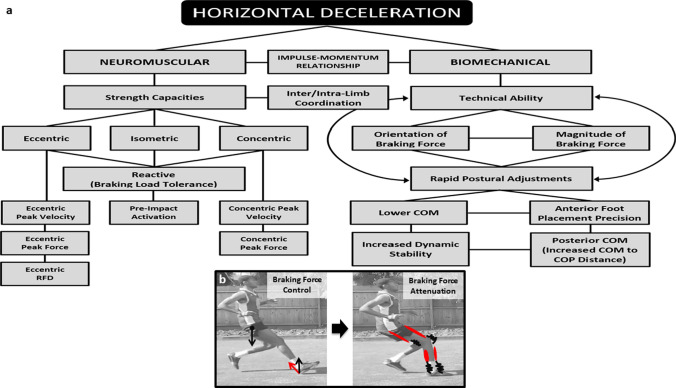
Rapid horizontal accelerations and decelerations are crucial events enabling the changes of velocity and direction integral to sports involving random intermittent multi-directional movements. However, relative to horizontal acceleration, there have been considerably fewer scientific investigations into the biomechanical and neuromuscular demands of horizontal deceleration and the qualities underpinning horizontal deceleration performance. Accordingly, the aims of this review article are to: (1) conduct an evidence-based review of the biomechanical demands of horizontal deceleration and (2) identify biomechanical and neuromuscular performance determinants of horizontal deceleration, with the aim of outlining relevant performance implications for random intermittent multi-directional sports. We highlight that horizontal decelerations have a unique ground reaction force profile, characterised by high-impact peak forces and loading rates. The highest magnitude of these forces occurs during the early stance phase (< 50 ms) and is shown to be up to 2.7 times greater than those seen during the first steps of a maximal horizontal acceleration. As such, inability for either limb to tolerate these forces may result in a diminished ability to brake, subsequently reducing deceleration capacity, and increasing vulnerability to excessive forces that could heighten injury risk and severity of muscle damage. Two factors are highlighted as especially important for enhancing horizontal deceleration ability: (1) braking force control and (2) braking force attenuation. Whilst various eccentric strength qualities have been reported to be important for achieving these purposes, the potential importance of concentric, isometric and reactive strength, in addition to an enhanced technical ability to apply braking force is also highlighted. Last, the review provides recommended research directions to enhance future understanding of horizontal deceleration ability.
快速的水平加速和减速是随机间歇性多方向运动的关键事件,使速度和方向的变化成为可能。然而,相对于水平加速度,对于水平减速的生物力学和神经肌肉需求以及支撑水平减速性能的质量,科学界的研究要少得多。因此,本文的目的是:(1)对水平减速的生物力学需求进行基于证据的综述;(2)确定水平减速的生物力学和神经肌肉性能决定因素,旨在为随机间歇性多方向运动概述相关的性能影响。我们强调,水平减速具有独特的地面反作用力曲线,其特征是高冲击力峰值力和加载率。这些力中最大的力发生在早期支撑阶段(<50ms),据显示比最大水平加速度的第一步中看到的力大 2.7 倍。因此,任何一条腿都无法承受这些力,可能会导致制动能力下降,从而降低减速能力,并增加过度力量的脆弱性,这可能会增加受伤风险和肌肉损伤的严重程度。有两个因素被强调为增强水平减速能力特别重要:(1)制动力控制;(2)制动力衰减。虽然已经报道了各种离心强度素质对于实现这些目的很重要,但还强调了向心、等长和反应强度的潜在重要性,以及增强施加制动力的技术能力。最后,综述提供了建议的研究方向,以增强对水平减速能力的未来理解。