Department of Microbiological Diagnostics and Infectious Immunology, Medical University of Białystok, Białystok, Poland.
Department of Infectious Diseases and Neuroinfections, Medical University of Białystok, Białystok, Poland.
Front Public Health. 2022 Feb 24;10:820816. doi: 10.3389/fpubh.2022.820816. eCollection 2022.
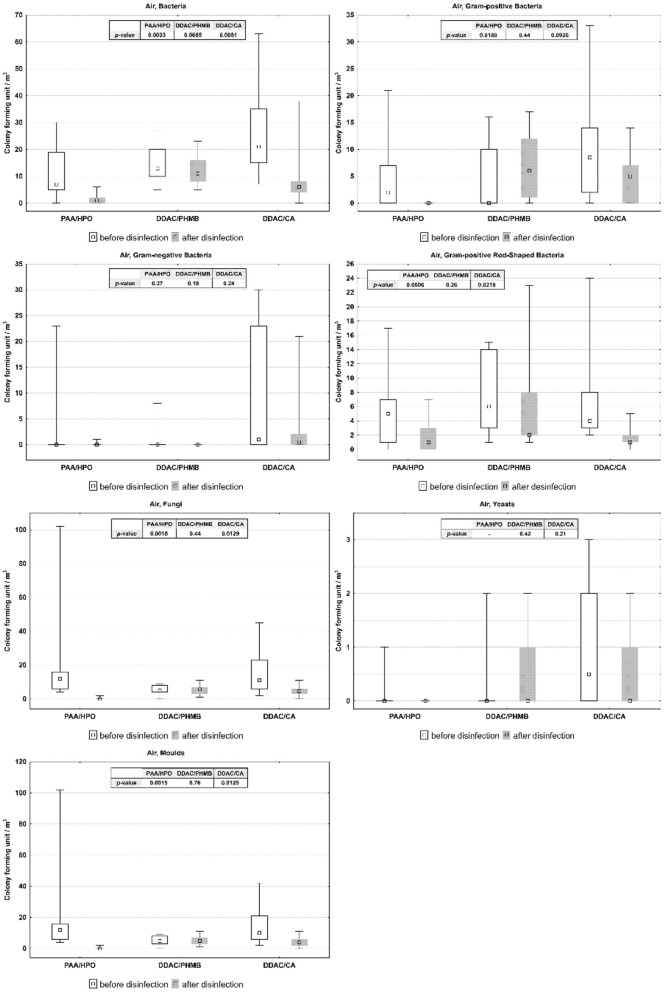
Cars with air conditioning systems have become the norm, but these systems can be dangerous for human health as a result of the accumulation of different microorganisms, including pathogenic ones, causing severe allergy or inflammation problems. The novel purpose of this study is 2-fold: on the one hand, to test different disinfection agents on a new area, that is, automobile cabins, and on the other, to compare activity in the gas phase of these agents for disinfection of car air conditioning and cabin surfaces. This study shown that tested disinfectant agents dedicated for decontamination medical areas (agent based on peracetic acid and an agent containing didecyldimethylammonium chloride, 2-phenoxyethanol with cinnamaldehyde) can be successfully used for disinfection car air conditioning and cabin surfaces. Both disinfectants were examined in comparison to a commercial "ready-to-use" spray from a local supermarket dedicated to car air conditioning disinfection. Our research found that very effective agents in this regard were acid stabilized by hydrogen peroxide applied by fumigator, and a combination of didecyldimethylammonium chloride, 2-phenoxyethanol, and cinnamaldehyde applied by atomizer. Tested disinfection procedures of car air conditioning significantly influence the quality of cabin air and surfaces by reducing the amount of microorganisms. The comparison of disinfection properties studied agents in the gas phase reveal statistically significant differences between it effect for disinfection car air conditioning and cabin surfaces. Our research found that very effective agents in this regard were acid stabilized by hydrogen peroxide applied by fumigator, and a combination of didecyldimethylammonium chloride, 2-phenoxyethanol, and cinnamaldehyde applied by atomizer. Tested disinfection procedures of car air conditioning significantly influence the quality of cabin air and surfaces by reducing the amount of microorganisms.
汽车空调系统已成为常态,但由于不同微生物(包括病原体)的积累,这些系统可能对人类健康造成危害,导致严重的过敏或炎症问题。本研究的新颖目的有两个方面:一方面,在汽车车厢这一新领域测试不同的消毒剂,另一方面,比较这些消毒剂在汽车空调和车厢表面的气相中的杀菌活性。本研究表明,专门用于医疗领域去污的测试消毒剂(基于过氧乙酸的消毒剂和一种含二癸基二甲基氯化铵、2-苯氧基乙醇和肉桂醛的消毒剂)可成功用于汽车空调和车厢表面的消毒。将这两种消毒剂与当地超市的一种用于汽车空调消毒的商业“即用型”喷雾进行了比较。我们的研究发现,非常有效的消毒剂是通过熏烟器应用的稳定氢过氧酸酸剂,以及通过雾化器应用的二癸基二甲基氯化铵、2-苯氧基乙醇和肉桂醛的组合。汽车空调的测试消毒程序通过减少微生物数量,显著影响车厢空气和表面的质量。在气相中研究消毒剂的消毒性能的比较揭示了它们对汽车空调和车厢表面的消毒效果之间存在统计学上的显著差异。我们的研究发现,非常有效的消毒剂是通过熏烟器应用的稳定氢过氧酸酸剂,以及通过雾化器应用的二癸基二甲基氯化铵、2-苯氧基乙醇和肉桂醛的组合。汽车空调的测试消毒程序通过减少微生物数量,显著影响车厢空气和表面的质量。在气相中研究消毒剂的消毒性能的比较揭示了它们对汽车空调和车厢表面的消毒效果之间存在统计学上的显著差异。