Sun Yiwei, Ma Ning, Qi Zengkai, Han Meng, Ma Xi
State Key Laboratory of Animal Nutrition, College of Animal Science and Technology, China Agricultural University, Beijing, China.
Front Nutr. 2022 Feb 25;9:819722. doi: 10.3389/fnut.2022.819722. eCollection 2022.
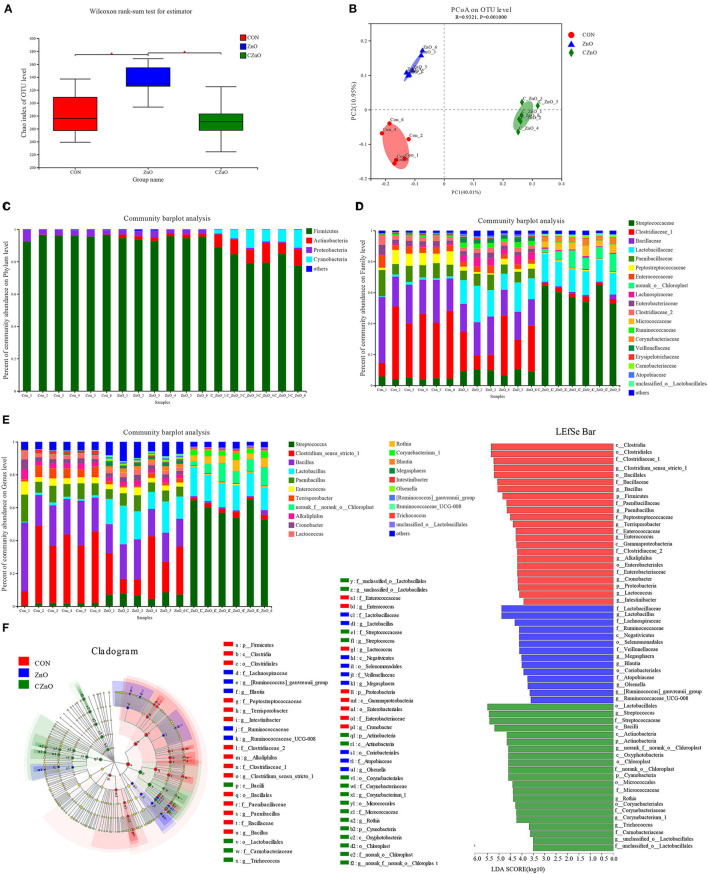
Weaned piglets stayed in transitional stages of internal organ development and external environment change. The dual stresses commonly caused intestinal disorders followed by damaged growth performance and severe diarrhea. High dose of zinc oxide could improve production efficiency and alleviate disease status whereas caused serious environmental pollution. This research investigated if coated ZnO (C_ZnO) in low dose could replace the traditional dose of ZnO to improve the growth performance, intestinal function, and gut microbiota structures in the weaned piglets. A total of 126 cross-bred piglets (7.0 ± 0.5 kg body weight) were randomly allocated into three groups and fed a basal diet or a basal diet supplemented with ZnO (2,000 mg Zn/kg) or C_ZnO (500 mg Zn/kg), respectively. The test lasted for 6 weeks. C_ZnO improved average daily gain (ADG) and feed efficiency, alleviated diarrhea, decreased the lactulose/mannitol ratio (L/M) in the urine, increased the ileal villus height, and upregulated the expression of Occludin in the ileal tissue and the effect was even better than a high concentration of ZnO. Importantly, C_ZnO also regulated the intestinal flora, enriching and and removing and intestinal disease-associated pathogens, including and in the ileal lumen. Although, colonic microbiota remained relatively stable, the marked rise of , a potential probiotic related to body health, could still be found. In addition, C_ZnO also led to a significant increase of acetate and propionate in both foregut and hindgut. Collectively, a low concentration of C_ZnO could effectively promote growth performance and reduce diarrhea through improving small intestinal morphology and permeability, enhancing the barrier function, adjusting the structure of gut microbiota, and raising the concentration of short-chain fatty acids (SCFAs) in the weaned piglets.
断奶仔猪处于内脏器官发育和外部环境变化的过渡阶段。这双重压力通常会导致肠道紊乱,进而损害生长性能并引发严重腹泻。高剂量的氧化锌可以提高生产效率并缓解疾病状况,但会造成严重的环境污染。本研究调查了低剂量的包被氧化锌(C_ZnO)是否可以替代传统剂量的氧化锌,以改善断奶仔猪的生长性能、肠道功能和肠道微生物群结构。总共126头杂交仔猪(体重7.0±0.5千克)被随机分为三组,分别饲喂基础日粮或添加氧化锌(2000毫克锌/千克)或C_ZnO(500毫克锌/千克)的基础日粮。试验持续6周。C_ZnO提高了平均日增重(ADG)和饲料效率,缓解了腹泻,降低了尿液中乳果糖/甘露醇比值(L/M),增加了回肠绒毛高度,并上调了回肠组织中闭合蛋白的表达,其效果甚至优于高浓度的氧化锌。重要的是,C_ZnO还调节了肠道菌群,富集了有益菌并去除了有害菌以及与肠道疾病相关的病原体,包括回肠腔中的某些菌。尽管结肠微生物群相对保持稳定,但仍可发现与身体健康相关的潜在益生菌显著增加。此外,C_ZnO还导致前肠和后肠中乙酸盐和丙酸盐显著增加。总体而言,低浓度的C_ZnO可以通过改善小肠形态和通透性、增强屏障功能、调整肠道微生物群结构以及提高断奶仔猪中短链脂肪酸(SCFAs)的浓度,有效促进生长性能并减少腹泻。