Sáez-Blázquez Rocío, Cuartero-González Álvaro, Feist Johannes, García-Vidal Francisco J, Fernández-Domínguez Antonio I
Departamento de Física Teórica de la Materia Condensada and Condensed Matter Physics Center (IFIMAC), Universidad Autónoma de Madrid, 28049 Madrid, Spain.
Vienna Center for Quantum Science and Technology, Atominstitut, TU Wien, 1040 Vienna, Austria.
Nano Lett. 2022 Mar 23;22(6):2365-2373. doi: 10.1021/acs.nanolett.1c04872. Epub 2022 Mar 14.
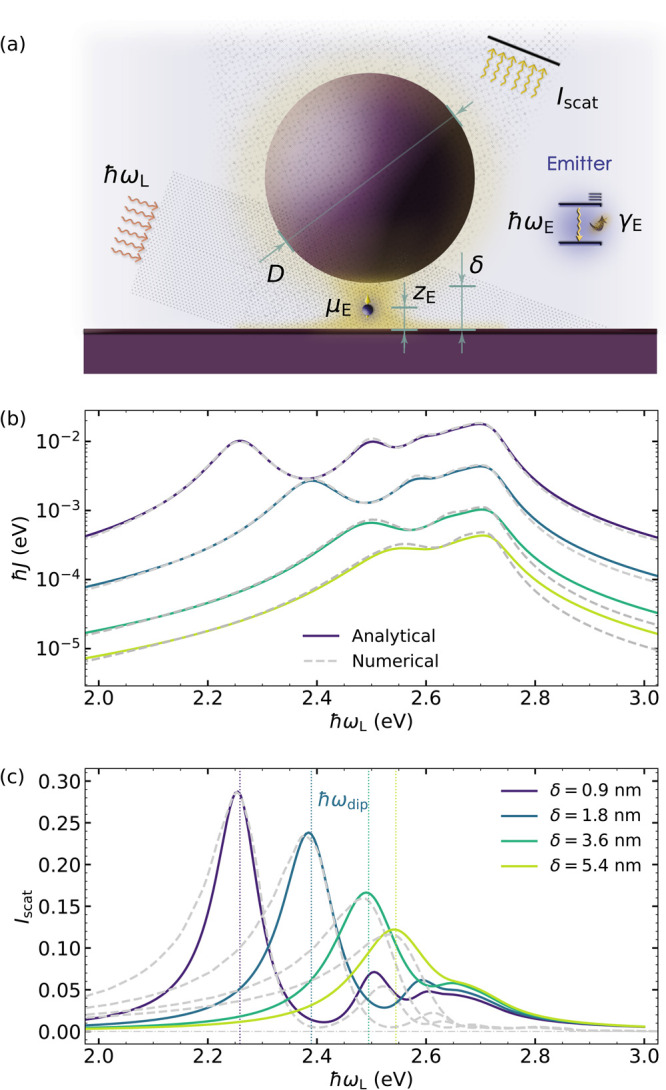
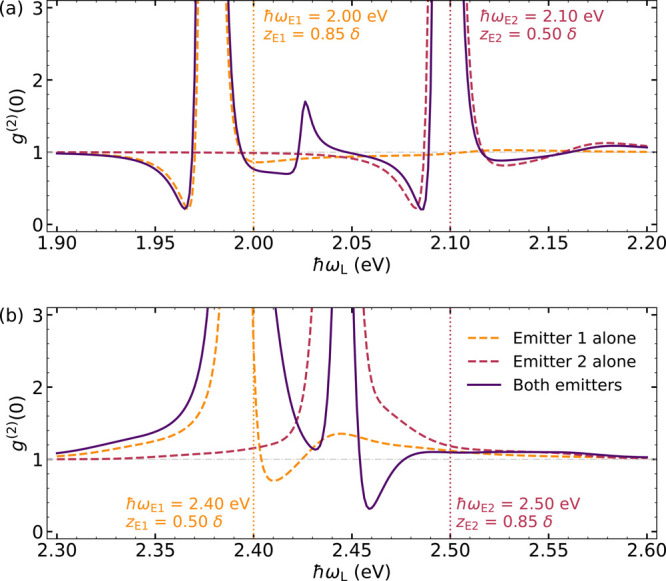
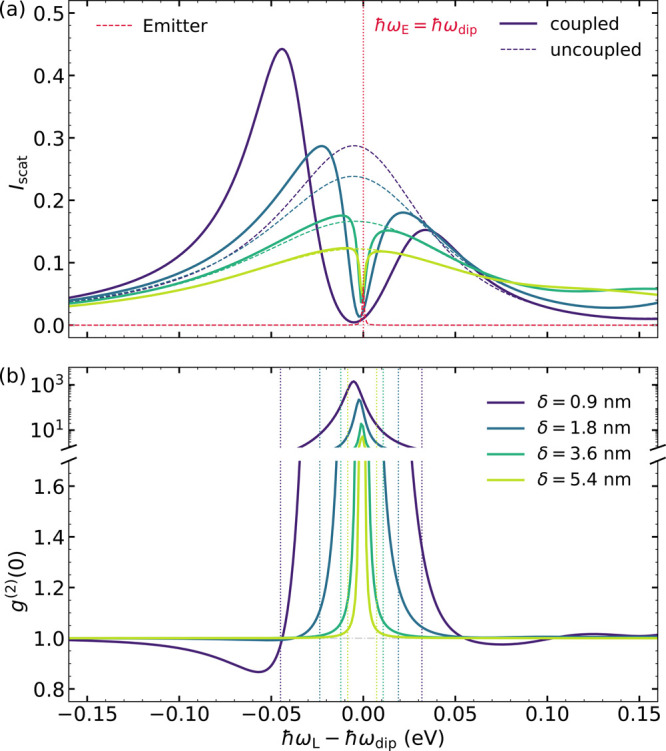
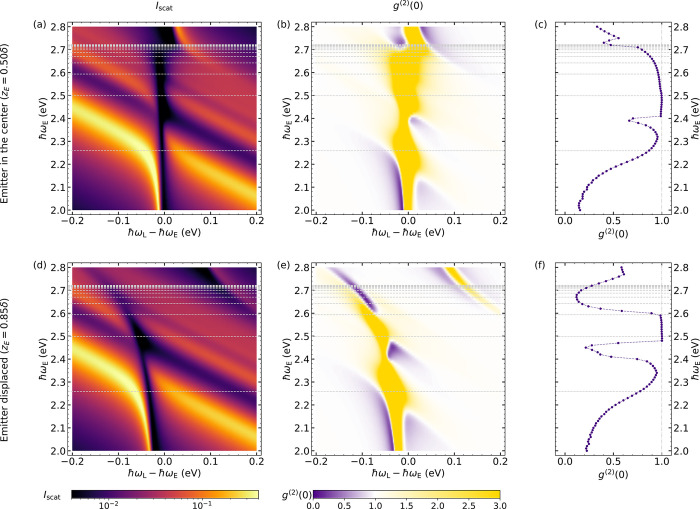
We investigate the quantum-optical properties of the light emitted by a nanoparticle-on-mirror cavity filled with a single quantum emitter. Inspired by recent experiments, we model a dark-field setup and explore the photon statistics of the scattered light under grazing laser illumination. Exploiting analytical solutions to Maxwell's equations, we quantize the nanophotonic cavity fields and describe the formation of plasmon-exciton polaritons (or plexcitons) in the system. This way, we reveal that the rich plasmonic spectrum of the nanocavity offers unexplored mechanisms for nonclassical light generation that are more efficient than the resonant interaction between the emitter natural transition and the brightest optical mode. Specifically, we find three different sample configurations in which strongly antibunched light is produced. Finally, we illustrate the power of our approach by showing that the introduction of a second emitter in the platform can enhance photon correlations further.
我们研究了充满单个量子发射器的镜上纳米颗粒腔所发射光的量子光学特性。受近期实验启发,我们对暗场装置进行建模,并探索掠入射激光照射下散射光的光子统计特性。利用麦克斯韦方程组的解析解,我们对纳米光子腔场进行量子化,并描述系统中激子 - 等离子体极化激元(或极化激子)的形成。通过这种方式,我们揭示了纳米腔丰富的等离子体光谱为非经典光产生提供了未被探索的机制,这些机制比发射器自然跃迁与最亮光学模式之间的共振相互作用更有效。具体而言,我们发现了三种产生强反聚束光的不同样品配置。最后,我们通过展示在该平台中引入第二个发射器可以进一步增强光子相关性,来说明我们方法的强大之处。