Centre for Complex Systems, Faculty of Engineering, The University of Sydney, Sydney, Australia.
Max Planck Institute for Dynamics and Self-Organization, Göttingen, Germany.
Elife. 2022 Mar 14;11:e74651. doi: 10.7554/eLife.74651.
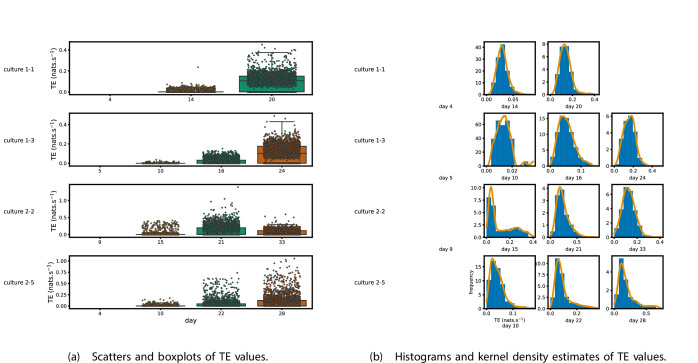
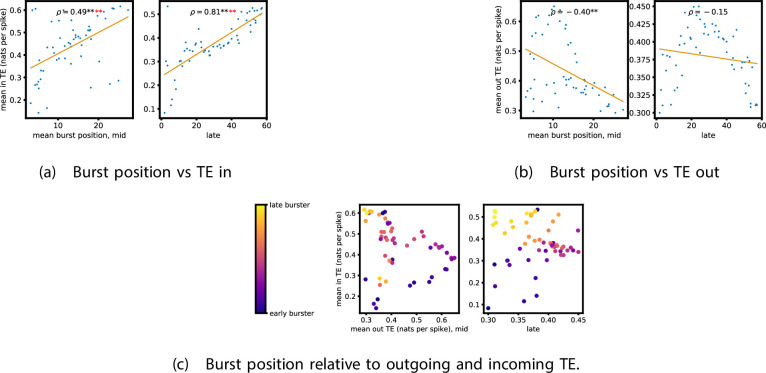
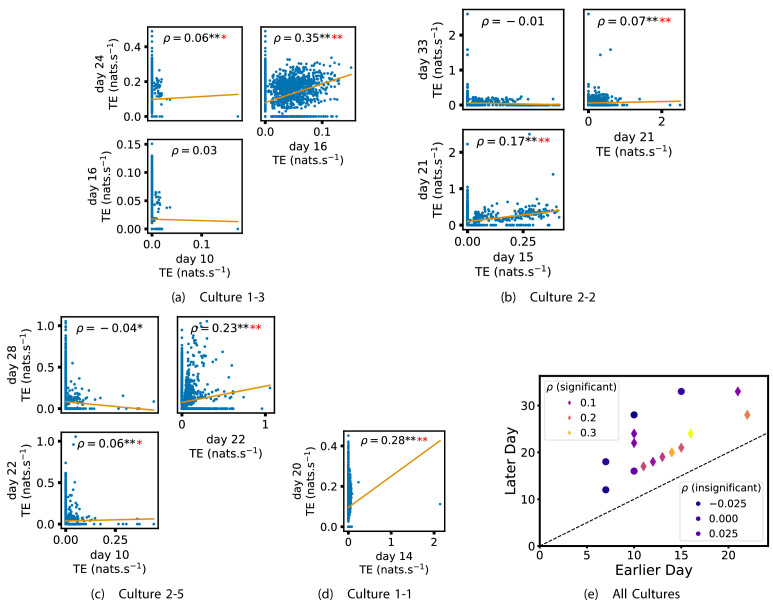
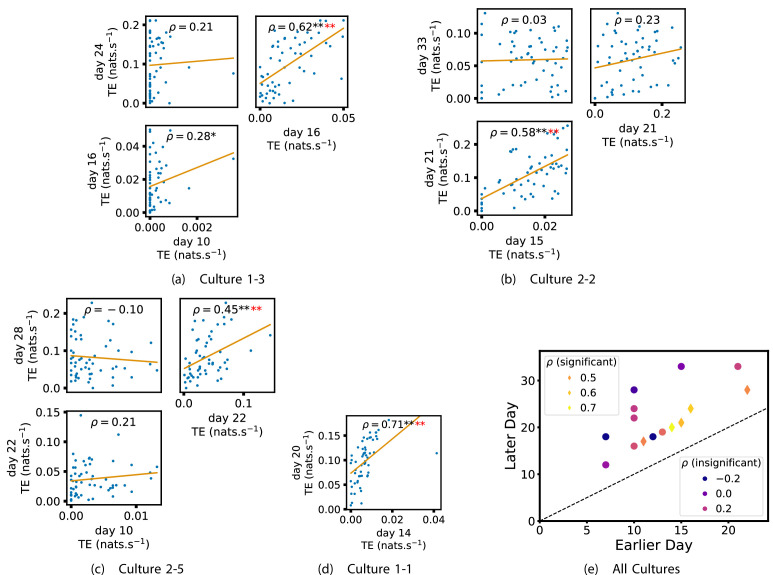
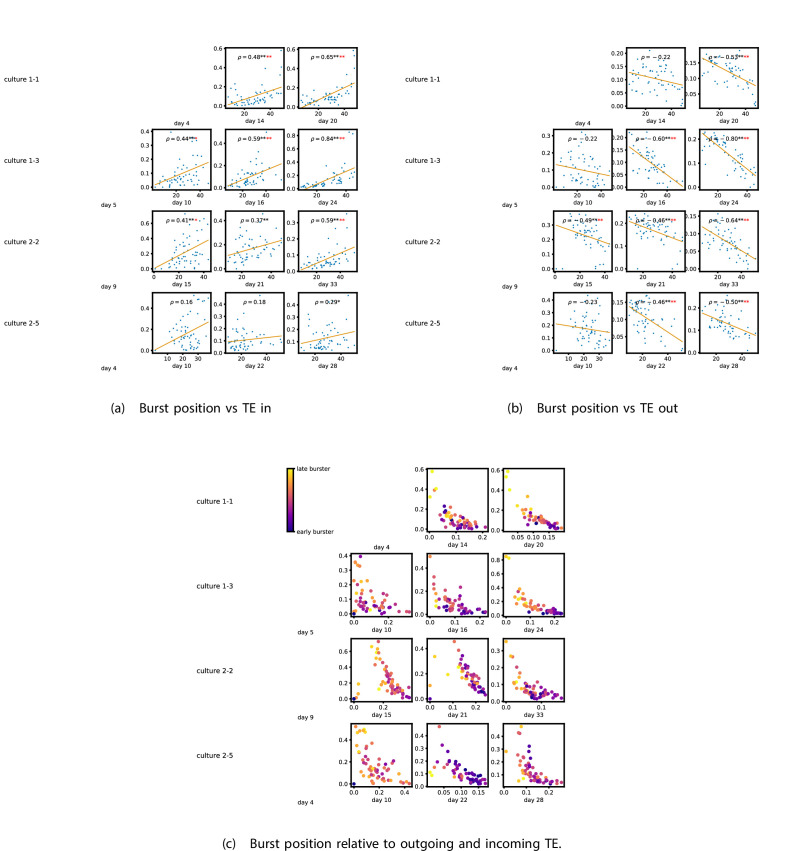
The brains of many organisms are capable of complicated distributed computation underpinned by a highly advanced information processing capacity. Although substantial progress has been made towards characterising the information flow component of this capacity in mature brains, there is a distinct lack of work characterising its emergence during neural development. This lack of progress has been largely driven by the lack of effective estimators of information processing operations for spiking data. Here, we leverage recent advances in this estimation task in order to quantify the changes in transfer entropy during development. We do so by studying the changes in the intrinsic dynamics of the spontaneous activity of developing dissociated neural cell cultures. We find that the quantity of information flowing across these networks undergoes a dramatic increase across development. Moreover, the spatial structure of these flows exhibits a tendency to lock-in at the point when they arise. We also characterise the flow of information during the crucial periods of population bursts. We find that, during these bursts, nodes tend to undertake specialised computational roles as either transmitters, mediators, or receivers of information, with these roles tending to align with their average spike ordering. Further, we find that these roles are regularly locked-in when the information flows are established. Finally, we compare these results to information flows in a model network developing according to a spike-timing-dependent plasticity learning rule. Similar temporal patterns in the development of information flows were observed in these networks, hinting at the broader generality of these phenomena.
许多生物体的大脑能够进行复杂的分布式计算,其基础是高度先进的信息处理能力。尽管在成熟大脑中对这种能力的信息流成分进行了大量的描述,但在神经发育过程中对其出现的描述却明显缺乏。这种进展的缺乏在很大程度上是由于缺乏用于尖峰数据的信息处理操作的有效估计器。在这里,我们利用这一估计任务的最新进展,以便量化在发展过程中传递熵的变化。我们通过研究分离的神经细胞培养物自发活动的内在动力学的变化来做到这一点。我们发现,这些网络中信息流动的数量在整个发育过程中发生了急剧增加。此外,这些流动的空间结构在出现时表现出锁定的趋势。我们还描述了在群体爆发的关键时期的信息流动。我们发现,在这些爆发期间,节点往往作为信息的发送者、中介者或接收者承担专门的计算角色,这些角色往往与它们的平均尖峰排序一致。此外,我们发现,当信息流建立时,这些角色经常被锁定。最后,我们将这些结果与根据尖峰时间依赖性可塑性学习规则发展的模型网络中的信息流进行比较。在这些网络中观察到信息流的发展具有相似的时间模式,这暗示了这些现象具有更广泛的普遍性。