Key Laboratory of Radiation Physics and Technology of the Ministry of Education, Institute of Nuclear Science and Technology, Sichuan University, Chengdu, China.
Department of Radiation Oncology, Radiation Oncology Key Laboratory of Sichuan Province, Sichuan Cancer Hospital and Institute, Chengdu, China.
BMC Med Imaging. 2022 Mar 14;22(1):44. doi: 10.1186/s12880-022-00773-x.
This study aims to further enhance a validated radiomics-based model for predicting pathologic complete response (pCR) after chemo‑radiotherapy in locally advanced rectal cancer (LARC) for use in clinical practice.
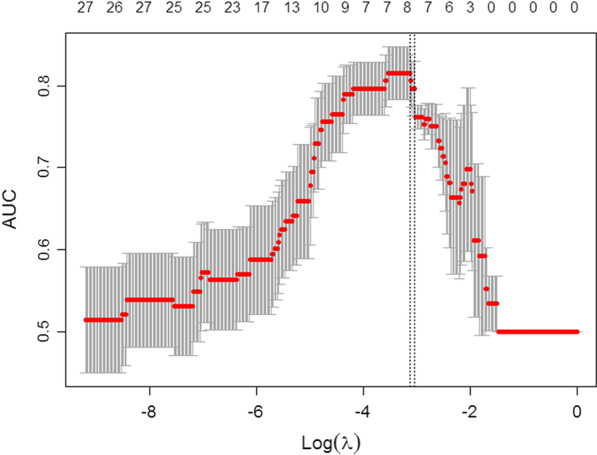
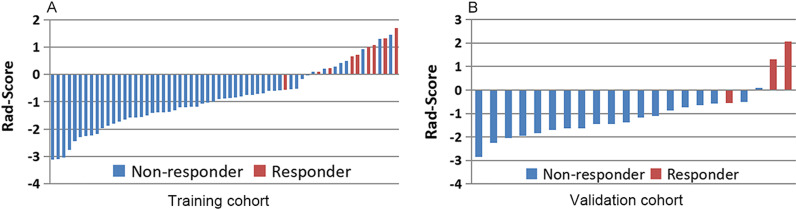
A generalized linear model (GLM) to predict pCR in LARC patients previously trained in Europe and validated with an external inter-continental cohort (59 patients), was first examined with further 88 intercontinental patient datasets to assess its reproducibility; then new radiomics and clinical features, and validation methods were investigated to build a new model for enhancing the pCR prediction for patients admitted to our department. The patients were divided into training group (75%) and validation group (25%) according to their demographic. The least absolute shrinkage and selection operator (LASSO) logistic regression was used to reduce the dimensionality of the extracted features of the training group and select the optimal ones; the performance of the reference GLM and enhanced models was compared through the area under curve (AUC) of the receiver operating characteristics.
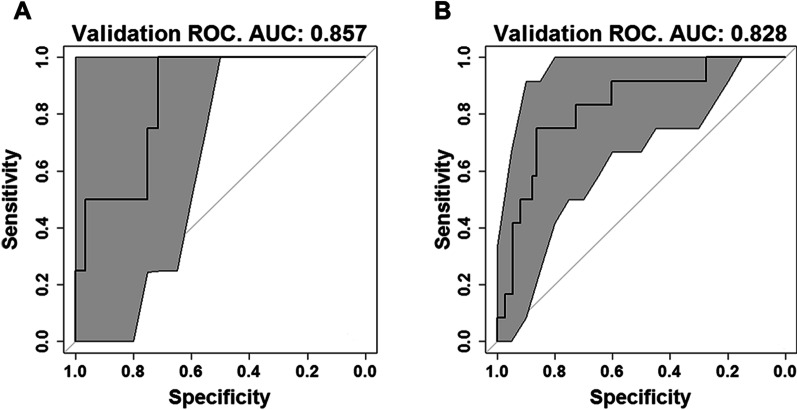
The value of AUC of the reference model was 0.831 (95% CI, 0.701-0.961), and 0.828 (95% CI, 0.700-0.956) in the original and new validation cohorts, respectively, showing a reproducibility in the applicability of the GLM model. Eight features were found to be significant with LASSO and used to establish an enhanced model. The AUC of the enhanced model of 0.926 (95% CI, 0.859-0.993) for training, and 0.926 (95% CI, 0.767-1.00) for the validation group shows better performance than the reference model.
The GLM model shows good reproducibility in predicting pCR in LARC; the enhanced model has the potential to improve prediction accuracy and may be a candidate in clinical practice.
本研究旨在进一步完善一种经验证的基于放射组学的模型,以预测局部晚期直肠癌(LARC)患者接受放化疗后的病理完全缓解(pCR),并将其应用于临床实践。
首先,利用欧洲训练的广义线性模型(GLM)对 59 例国际间验证队列的 LARC 患者进行 pCR 预测,并对 88 例国际间患者数据集进行进一步评估,以检验其可重复性;然后,研究新的放射组学和临床特征及验证方法,以建立一种新的模型,提高本部门患者的 pCR 预测能力。根据患者的人口统计学特征,将患者分为训练组(75%)和验证组(25%)。利用最小绝对收缩和选择算子(LASSO)逻辑回归对训练组提取的特征进行降维,并选择最优特征;通过受试者工作特征曲线(ROC)的曲线下面积(AUC)比较参考 GLM 和增强模型的性能。
参考模型的 AUC 值在原始验证队列和新验证队列中分别为 0.831(95%CI,0.701-0.961)和 0.828(95%CI,0.700-0.956),表明 GLM 模型具有可重复性。利用 LASSO 发现 8 个特征具有统计学意义,用于建立增强模型。增强模型在训练组的 AUC 值为 0.926(95%CI,0.859-0.993),验证组的 AUC 值为 0.926(95%CI,0.767-1.00),显示出优于参考模型的性能。
GLM 模型在预测 LARC 的 pCR 方面具有良好的可重复性;增强模型具有提高预测准确性的潜力,可能成为临床实践中的候选模型。