Yi Xiaoping, Pei Qian, Zhang Youming, Zhu Hong, Wang Zhongjie, Chen Chen, Li Qingling, Long Xueying, Tan Fengbo, Zhou Zhongyi, Liu Wenxue, Li Chenglong, Zhou Yuan, Song Xiangping, Li Yuqiang, Liao Weihua, Li Xuejun, Sun Lunquan, Pei Haiping, Zee Chishing, Chen Bihong T
Department of Radiology, Xiangya Hospital, Central South University, Changsha, China.
Postdoctoral Research Workstation of Pathology and Pathophysiology, Basic Medical Sciences, Xiangya Hospital, Central South University, Changsha, China.
Front Oncol. 2019 Jun 26;9:552. doi: 10.3389/fonc.2019.00552. eCollection 2019.
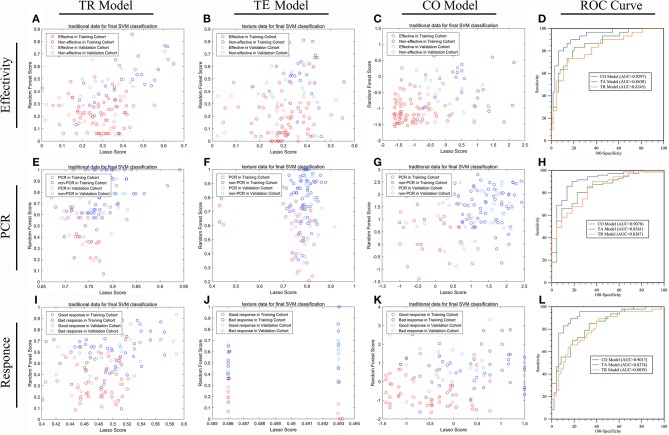
Conventional methods for predicting treatment response to neoadjuvant chemoradiotherapy (nCRT) in patients with locally advanced rectal cancer (LARC) are limited. This study retrospectively recruited 134 LARC patients who underwent standard nCRT followed by total mesorectal excision surgery in our institution. Based on pre-operative axial T2-weighted images, machine learning radiomics was performed. A receiver operating characteristic (ROC) curve was performed to test the efficiencies of the predictive model. Among the 134 patients, 32 (23.9%) achieved pathological complete response (pCR), 69 (51.5%) achieved a good response, and 91 (67.9%) achieved down-staging. For prediction of pCR, good-response, and down-staging, the predictive model demonstrated high classification efficiencies, with an AUC value of 0.91 (95% CI: 0.83-0.98), 0.90 (95% CI: 0.83-0.97), and 0.93 (95% CI: 0.87-0.98), respectively. Our machine learning radiomics model showed promise for predicting response to nCRT in patients with LARC. Our predictive model based on the commonly used T2-weighted images on pelvic Magnetic Resonance Imaging (MRI) scans has the potential to be adapted in clinical practice. Methods for predicting the response of the locally advanced rectal cancer (LARC, T3-4, or N+) to neoadjuvant chemoradiotherapy (nCRT) is lacking. In the present study, we developed a new machine learning radiomics method based on T2-weighted images. As a non-invasive tool, this method facilitates prediction performance effectively. It achieves a satisfactory overall diagnostic accuracy for predicting of pCR, good response, and down-staging show an AUC of 0.908, 0.902, and 0.930 in LARC patients, respectively.
预测局部晚期直肠癌(LARC)患者对新辅助放化疗(nCRT)治疗反应的传统方法有限。本研究回顾性招募了134例在我院接受标准nCRT后行全直肠系膜切除术的LARC患者。基于术前轴向T2加权图像,进行了机器学习放射组学分析。绘制受试者工作特征(ROC)曲线以测试预测模型的效率。在134例患者中,32例(23.9%)达到病理完全缓解(pCR),69例(51.5%)达到良好反应,91例(67.9%)实现降期。对于pCR、良好反应和降期的预测,预测模型显示出较高的分类效率,AUC值分别为0.91(95%CI:0.83 - 0.98)、0.90(95%CI:0.83 - 0.97)和0.93(95%CI:0.87 - 0.98)。我们的机器学习放射组学模型在预测LARC患者对nCRT的反应方面显示出前景。我们基于盆腔磁共振成像(MRI)扫描中常用的T2加权图像的预测模型有潜力应用于临床实践。目前缺乏预测局部晚期直肠癌(LARC,T3 - 4或N +)对新辅助放化疗(nCRT)反应的方法。在本研究中,我们基于T2加权图像开发了一种新的机器学习放射组学方法。作为一种非侵入性工具,该方法有效地促进了预测性能。它在预测LARC患者的pCR、良好反应和降期方面分别实现了令人满意的总体诊断准确性,AUC分别为0.908、0.902和0.930。