Departamento de Genética Molecular y Microbiología, Pontificia Universidad Católica de Chile, FONDAP Center for Genome Regulation and Millenium Institute for Integrative Biology (iBio), Av Libertador Bernardo O'Higgins 340, Santiago, Chile.
Univ. Bordeaux, INRAE, UMR1332 BFP, 33882, Villenave d'Ornon, France.
New Phytol. 2022 Jun;234(5):1614-1628. doi: 10.1111/nph.18095. Epub 2022 Apr 5.
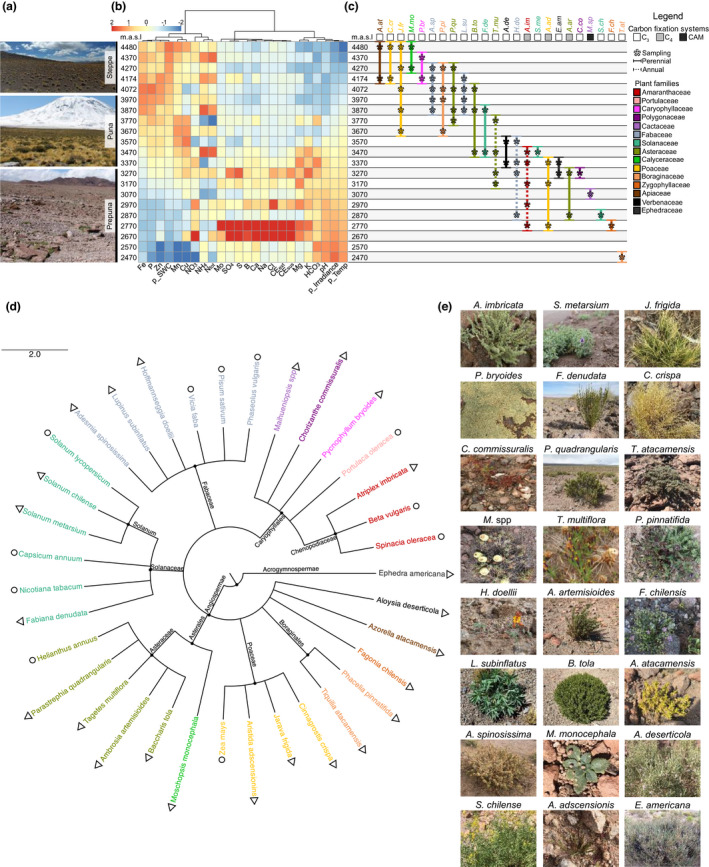
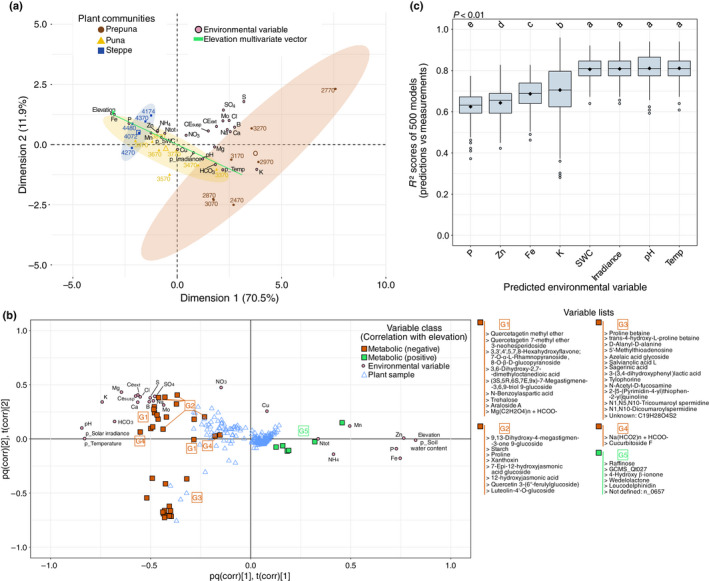
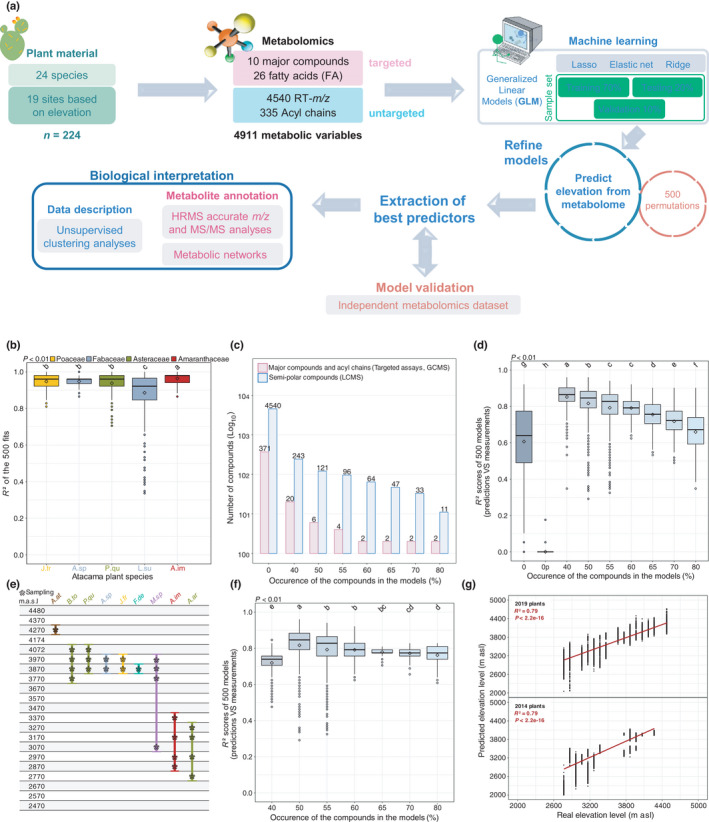
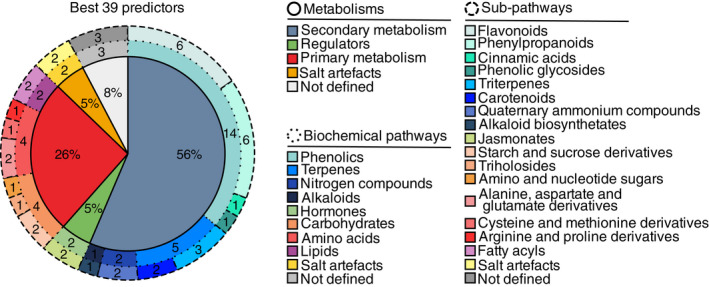
Current crop yield of the best ideotypes is stagnating and threatened by climate change. In this scenario, understanding wild plant adaptations in extreme ecosystems offers an opportunity to learn about new mechanisms for resilience. Previous studies have shown species specificity for metabolites involved in plant adaptation to harsh environments. Here, we combined multispecies ecological metabolomics and machine learning-based generalized linear model predictions to link the metabolome to the plant environment in a set of 24 species belonging to 14 families growing along an altitudinal gradient in the Atacama Desert. Thirty-nine common compounds predicted the plant environment with 79% accuracy, thus establishing the plant metabolome as an excellent integrative predictor of environmental fluctuations. These metabolites were independent of the species and validated both statistically and biologically using an independent dataset from a different sampling year. Thereafter, using multiblock predictive regressions, metabolites were linked to climatic and edaphic stressors such as freezing temperature, water deficit and high solar irradiance. These findings indicate that plants from different evolutionary trajectories use a generic metabolic toolkit to face extreme environments. These core metabolites, also present in agronomic species, provide a unique metabolic goldmine for improving crop performances under abiotic pressure.
目前,最佳理想型作物的产量趋于停滞,而且还受到气候变化的威胁。在这种情况下,了解野生植物在极端生态系统中的适应策略为我们提供了一个学习新的弹性机制的机会。先前的研究表明,代谢物在植物适应恶劣环境方面具有物种特异性。在这里,我们结合多物种生态代谢组学和基于机器学习的广义线性模型预测,将代谢组与安第斯山脉阿塔卡马沙漠中沿海拔梯度生长的 14 个科的 24 个物种的植物环境联系起来。39 种常见化合物以 79%的准确率预测了植物环境,从而确立了植物代谢组作为环境波动的优秀综合预测因子。这些代谢物与物种无关,并使用来自不同采样年份的独立数据集进行了统计和生物学验证。此后,使用多块预测回归,将代谢物与冷冻温度、水分亏缺和高太阳辐射等气候和土壤胁迫因素联系起来。这些发现表明,来自不同进化轨迹的植物使用通用的代谢工具包来应对极端环境。这些核心代谢物也存在于农业物种中,为在非生物压力下提高作物性能提供了独特的代谢金矿。