Yang Chuxiao, Hao Yu, Irfan Muhammad
Center for Energy and Environmental Policy Research, Beijing Institute of Technology, Beijing 100081, China.
School of Management and Economics, Beijing Institute of Technology, Beijing 100081, China.
Struct Chang Econ Dyn. 2021 Dec;59:442-453. doi: 10.1016/j.strueco.2021.06.017. Epub 2021 Sep 27.
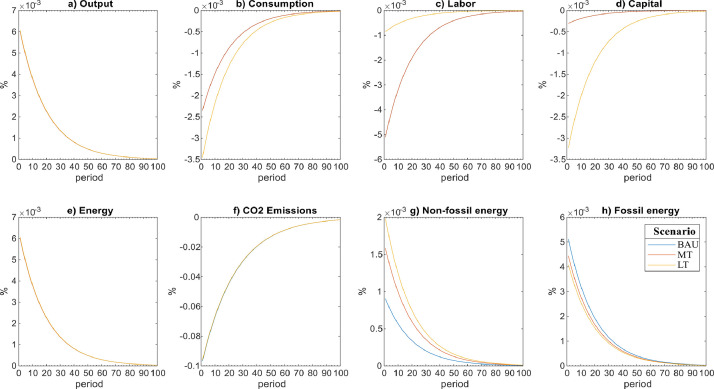
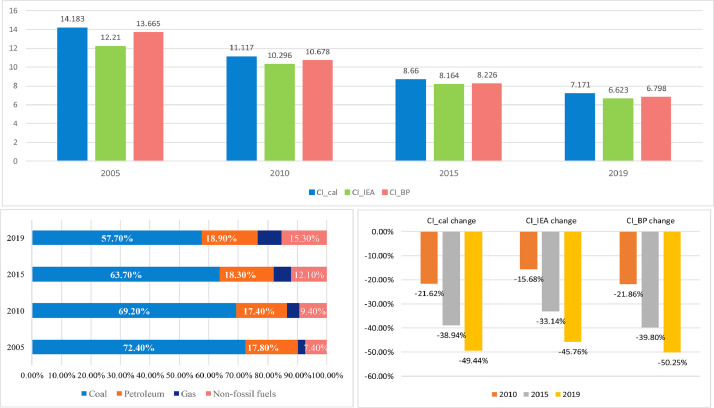
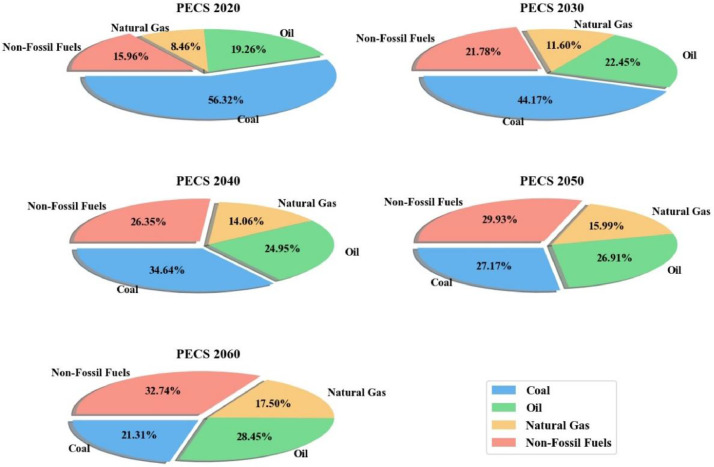
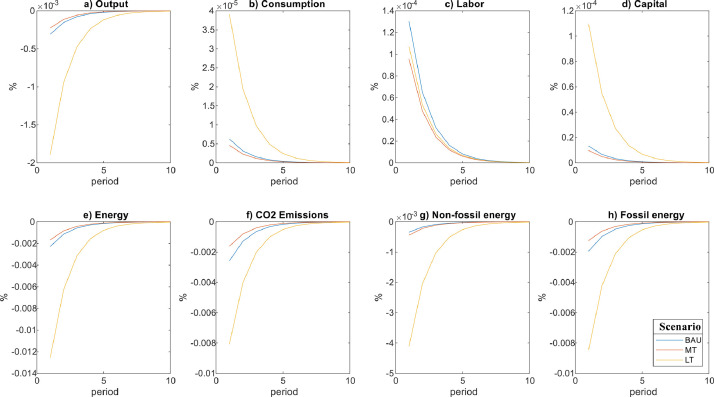
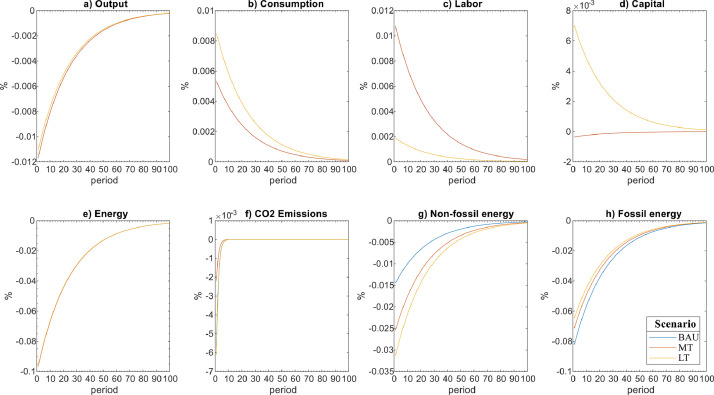
Since the spread of COVID-19 pandemic all over the world, a significant recession has broken out with no precedent. China has brought up a new voluntary contribution target that achieving carbon neutrality by 2060. How to achieve climate change mitigation targets without heavily hindering economic development is of great importance in the future. In this study, a Markov chain model is employed to forecast primary energy consumption (PEC) structure and verify whether the carbon intensity target would be achieved under three scenarios with different economic growth rates, such as 6.1%, 4.2%, and 2.3%, respectively. A multi-sector dynamic stochastic general equilibrium (DSGE) model is employed to simulate and evaluate economic development, fossil and non-fossil energy consumption, and CO emissions under three scenarios using data calibration according to the Markov chain prediction result. The prediction results from the Markov chain show that energy structural adjustment can help us achieve the carbon intensity target of 2030 under both steady and mid-speed development scenarios. As long as the economic growth rate is higher than 4.2%, the carbon intensity target can be achieved mainly through energy consumption structural change, which provides a way to achieve the carbon neutrality target of 2060. The simulation results from the DSGE model show that energy structural adjustment can also smooth the volatility of the economic fluctuation when exogenous stochastic shocks happened.
自新冠疫情在全球蔓延以来,一场史无前例的重大衰退爆发。中国提出了到2060年实现碳中和的新自愿贡献目标。未来,如何在不大幅阻碍经济发展的情况下实现气候变化缓解目标至关重要。在本研究中,采用马尔可夫链模型预测一次能源消费(PEC)结构,并验证在分别为6.1%、4.2%和2.3%的三种不同经济增长率情景下是否能实现碳强度目标。采用多部门动态随机一般均衡(DSGE)模型,根据马尔可夫链预测结果进行数据校准,对三种情景下的经济发展、化石能源和非化石能源消费以及碳排放进行模拟和评估。马尔可夫链的预测结果表明,在稳定和中速发展情景下,能源结构调整有助于实现2030年的碳强度目标。只要经济增长率高于4.2%,主要通过能源消费结构变化就能实现碳强度目标,这为实现2060年碳中和目标提供了一条途径。DSGE模型的模拟结果表明,当发生外生随机冲击时,能源结构调整还能平滑经济波动的起伏。