School of P.E. and Sport Science, National and Kapodistrian University of Athens, 17237 Athens, Greece.
Sport, Health and Performance Enhancement (SHAPE) Research Centre, Department of Sport Science, Nottingham Trent University, Nottingham NG11 8NS, UK.
Nutrients. 2022 Mar 8;14(6):1140. doi: 10.3390/nu14061140.
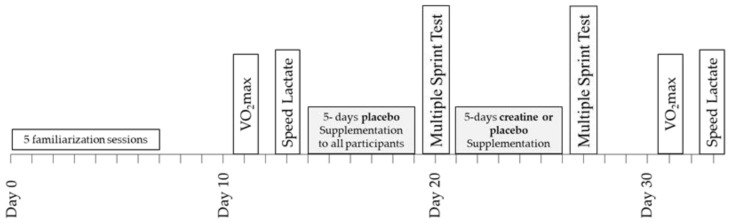
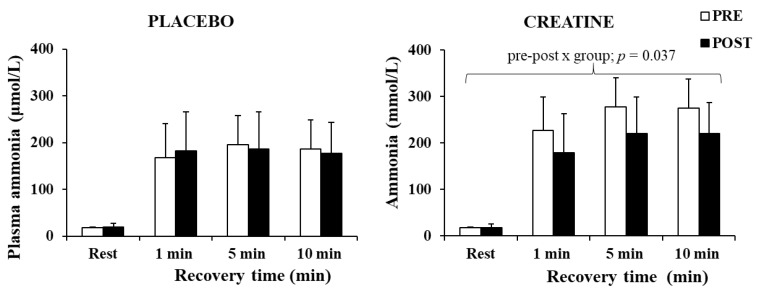
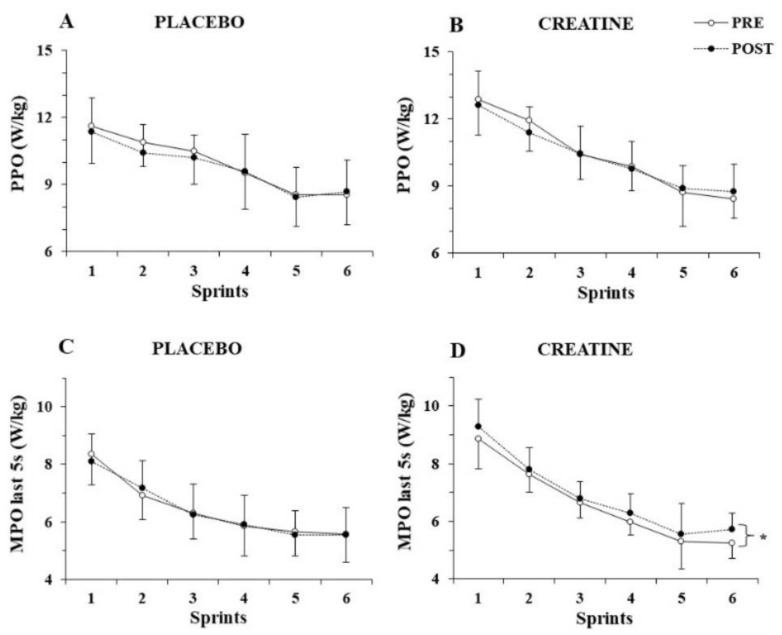
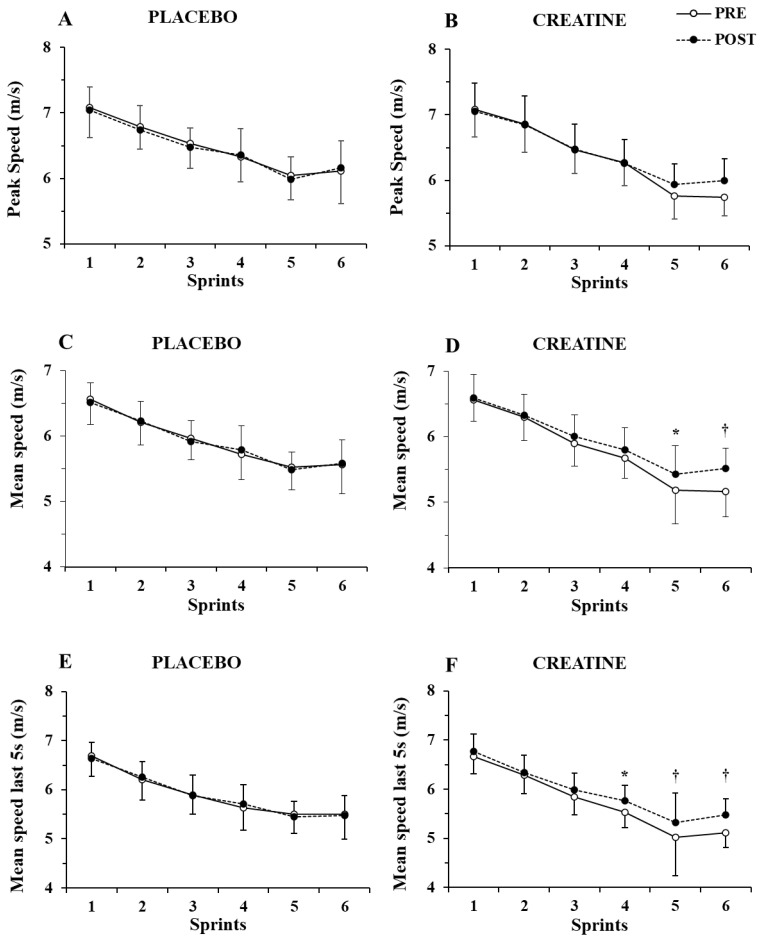
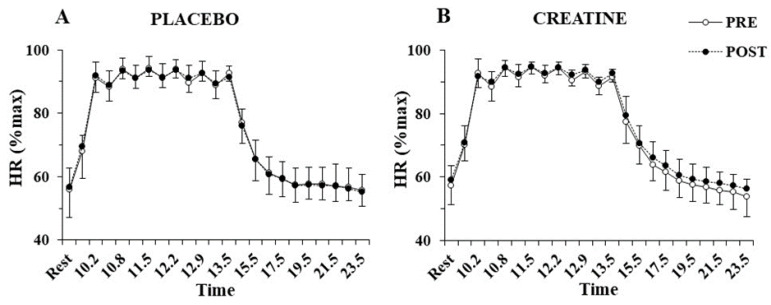
The aim of the present study was to examine the effects of creatine (Cr) supplementation on power output during repeated sprints on a non-motorized treadmill. Sixteen recreationally active males volunteered for this study (age 25.5 ± 4.8 y, height 179 ± 5 cm, body mass 74.8 ± 6.8 kg). All participants received placebo supplementation (75 mg of glucose·kg·day) for 5 days and then performed a baseline repeated sprints test (6 × 10 s sprints on a non-motorised treadmill). Thereafter, they were randomly assigned into a Cr (75 mg of Cr monohydrate·kg·day) or placebo supplementation, as above, and the repeated sprints test was repeated. After Cr supplementation, body mass was increased by 0.99 ± 0.83 kg ( 0.007), peak power output and peak running speed remained unchanged throughout the test in both groups, while the mean power output and mean running speed during the last 5 s of the sprints increased by 4.5% ( = 0.005) and 4.2% to 7.0%, respectively, during the last three sprints ( 0.005 to 0.001). The reduction in speed within each sprint was also blunted by 16.2% ( 0.003) following Cr supplementation. Plasma ammonia decreased by 20.1% ( = 0.037) after Cr supplementation, despite the increase in performance. VO and blood lactate during the repeated sprints test remained unchanged after supplementation, suggesting no alteration of aerobic or glycolytic contribution to adenosine triphosphate production. In conclusion, Cr supplementation improved the mean power and speed in the second half of a repeated sprint running protocol, despite the increased body mass. This improvement was due to the higher power output and running speed in the last 5 s of each 10 s sprint.
本研究旨在探讨肌酸(Cr)补充对非动力跑步机上重复冲刺的功率输出的影响。16 名有经验的男性自愿参加了这项研究(年龄 25.5 ± 4.8 岁,身高 179 ± 5 厘米,体重 74.8 ± 6.8 公斤)。所有参与者接受安慰剂补充(75 毫克葡萄糖·公斤·天)5 天,然后进行基线重复冲刺测试(非动力跑步机上进行 6 次 10 秒冲刺)。此后,他们被随机分为 Cr(75 毫克一水肌酸·公斤·天)或安慰剂补充组,如上所述,并重复进行重复冲刺测试。Cr 补充后,体重增加了 0.99 ± 0.83 公斤(0.007),两组在整个测试过程中峰值功率输出和峰值跑步速度保持不变,而最后 5 秒冲刺的平均功率输出和平均跑步速度分别增加了 4.5%(= 0.005)和 4.2%至 7.0%,在最后三个冲刺中(从 0.005 到 0.001)。Cr 补充后,每个冲刺内的速度下降也减少了 16.2%(= 0.003)。Cr 补充后,尽管运动表现提高,血浆氨仍降低了 20.1%(= 0.037)。重复冲刺测试期间的 VO 和血乳酸在补充后保持不变,表明有氧或糖酵解对三磷酸腺苷产生的贡献没有改变。总之,尽管体重增加,Cr 补充仍能提高重复冲刺跑方案后半段的平均功率和速度。这种改善是由于最后 5 秒冲刺中每个 10 秒冲刺的功率输出和跑步速度提高所致。