Pignolo Antonia, Mastrilli Sergio, Davì Chiara, Arnao Valentina, Aridon Paolo, Dos Santos Mendes Felipe Augusto, Gagliardo Cesare, D'Amelio Marco
Department of Biomedicine, Neurosciences and Advanced Diagnostics, University of Palermo, 90127 Palermo, Italy.
UO Neurologia e Stroke Unit, Azienda di Rilievo Nazionale ad Alta Specializzazione, Ospedali Civico Di Cristina Benfratelli, 90134 Palermo, Italy.
Nutrients. 2022 Mar 14;14(6):1220. doi: 10.3390/nu14061220.
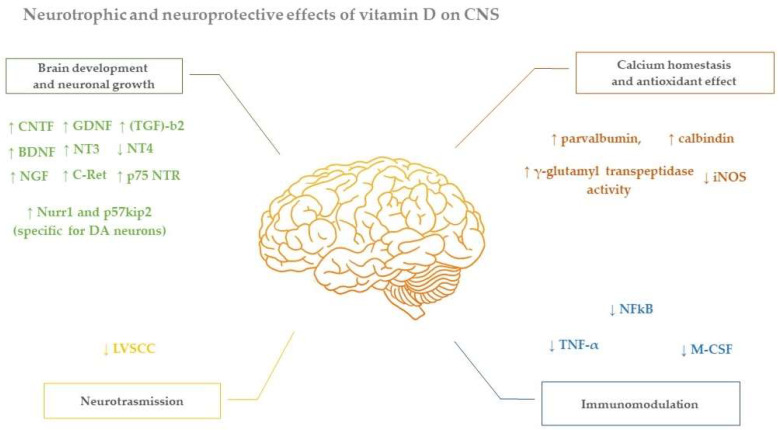
Vitamin D is a fat-soluble secosteroid, traditionally considered a key regulator of bone metabolism, calcium and phosphorous homeostasis. Its action is made possible through the binding to the vitamin D receptor (VDR), after which it directly and indirectly modulates the expression of thousands of genes. Vitamin D is important for brain development, mature brain activity and associated with many neurological diseases, including Parkinson's disease (PD). High frequency of vitamin D deficiency in patients with Parkinson's disease compared to control population was noted nearly twenty years ago. This finding is of interest given vitamin D's neuroprotective effect, exerted by the action of neurotrophic factors, regulation of nerve growth or through protection against cytotoxicity. Vitamin D deficiency seems to be related to disease severity and disease progression, evaluated by Unified Parkinson's Disease Rating Scale (UPDRS) and Hoehn and Yahr (H&Y) scale, but not with age of PD onset and duration of disease. Additionally, fall risk has been associated with lower vitamin D levels in PD. However, while the association between vitamin D and motor-symptoms seems to be possible, results of studies investigating the association with non-motor symptoms are conflicting. In addition, very little evidence exists regarding the possibility to use vitamin D supplementation to reduce clinical manifestations and disability in patients with PD. However, considering the positive balance between potential benefits against its limited risks, vitamin D supplementation for PD patients will probably be considered in the near future, if further confirmed in clinical studies.
维生素D是一种脂溶性类固醇激素,传统上被认为是骨代谢、钙和磷稳态的关键调节因子。它通过与维生素D受体(VDR)结合发挥作用,之后直接或间接调节数千个基因的表达。维生素D对大脑发育、成熟大脑活动很重要,且与包括帕金森病(PD)在内的多种神经疾病相关。近二十年前就注意到,与对照人群相比,帕金森病患者维生素D缺乏的频率较高。鉴于维生素D通过神经营养因子的作用、神经生长的调节或通过抵御细胞毒性发挥神经保护作用,这一发现很有意思。维生素D缺乏似乎与疾病严重程度和疾病进展有关,通过统一帕金森病评定量表(UPDRS)和霍恩及雅尔(H&Y)量表评估,但与帕金森病发病年龄和病程无关。此外,帕金森病患者跌倒风险与较低的维生素D水平有关。然而,虽然维生素D与运动症状之间似乎可能存在关联,但研究其与非运动症状关联的研究结果相互矛盾。此外,关于使用维生素D补充剂来减轻帕金森病患者临床表现和残疾的可能性,证据非常少。然而,考虑到潜在益处与其有限风险之间的积极平衡,如果在临床研究中得到进一步证实,帕金森病患者补充维生素D可能会在不久的将来被考虑。