Physics Department & I3N, University of Aveiro, 3810-193 Aveiro, Portugal.
Electromagnetism and Telecommunication Department, University of Mons, 31 Bld Dolez, 7000 Mons, Belgium.
Sensors (Basel). 2022 Mar 10;22(6):2141. doi: 10.3390/s22062141.
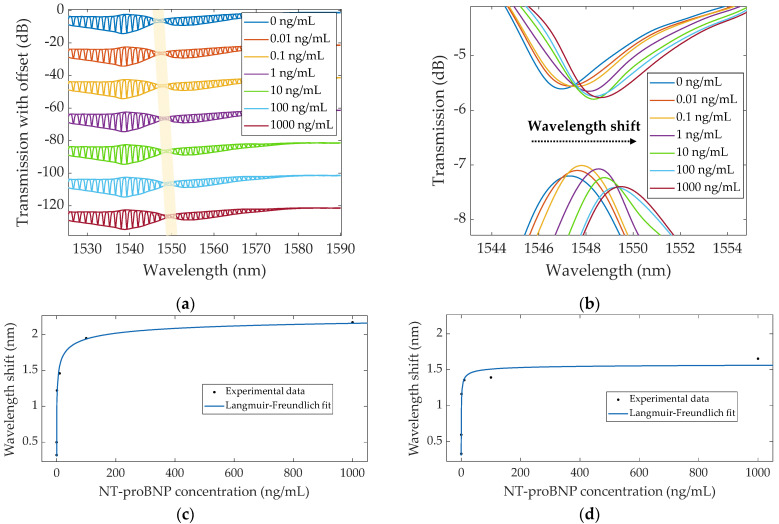
Optical fiber technology has rapidly progressed over the years, providing valuable benefits for biosensing purposes such as sensor miniaturization and the possibility for remote and real-time monitoring. In particular, tilted fiber Bragg gratings (TFBGs) are extremely sensitive to refractive index variations taking place on their surface. The present work comprises a case-study on the impact of different methods of analysis applied to decode spectral variations of bare and plasmonic TFBGs during the detection of N-terminal B-type natriuretic peptide (NT-proBNP), a heart failure biomarker, namely by following the most sensitive mode, peaks of the spectral envelopes, and the envelopes' crossing point and area. Tracking the lower envelope resulted in the lowest limits of detection (LOD) for bare and plasmonic TFBGs, namely, 0.75 ng/mL and 0.19 ng/mL, respectively. This work demonstrates the importance of the analysis method on the outcome results, which is crucial to attain the most reliable and sensitive method with lower LOD sensors. Furthermore, it makes the scientific community aware to take careful attention when comparing the performance of different biosensors in which different analysis methods were used.
光纤技术近年来发展迅速,为生物传感提供了有价值的好处,例如传感器的小型化和远程实时监测的可能性。特别是,倾斜光纤布拉格光栅(TFBG)对其表面发生的折射率变化极其敏感。本工作研究了不同分析方法对裸 TFBG 和等离子体 TFBG 在检测心力衰竭生物标志物 N 端 B 型利钠肽(NT-proBNP)时的光谱变化进行解码的影响,即通过跟踪最敏感的模式、光谱包络的峰值以及包络的交点和面积。跟踪较低的包络导致裸 TFBG 和等离子体 TFBG 的检测限(LOD)最低,分别为 0.75ng/mL 和 0.19ng/mL。这项工作表明分析方法对结果的重要性,对于获得具有更低 LOD 传感器的最可靠和最敏感的方法至关重要。此外,它使科学界意识到在比较使用不同分析方法的不同生物传感器的性能时要小心谨慎。