Physics Department, Babes-Bolyai University, 400084 Cluj-Napoca, Romania.
Sensors (Basel). 2022 Mar 17;22(6):2337. doi: 10.3390/s22062337.
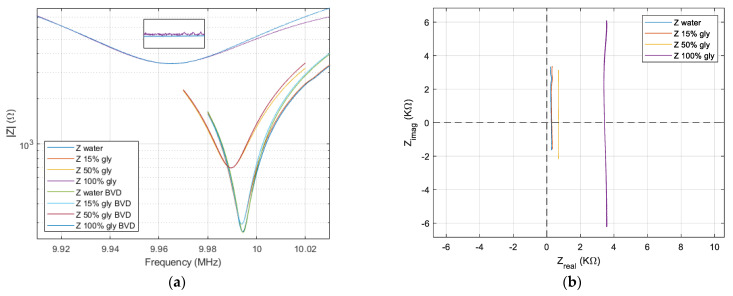
Technological evolution has allowed impedance analysis to become a versatile and efficient method for the precise measurement of the equivalent electrical parameters of the quartz crystal microbalance (QCM). By measuring the dissipation factor, or another equivalent electrical parameter, the QCM sensor provides access to the sample mass per unit area and its physical parameters, thus ensuring a detailed analysis. This paper aims to demonstrate the benefits of advanced impedance spectroscopy concerning the Butterworth-van Dyke (BVD) model for QCM sensors immersed with an electrode in a liquid medium. The support instrument in this study is a fast and accurate software-defined virtual impedance analyzer (VIA) with real-time computing capabilities of the QCM sensor's electric model. Advanced software methods of self-calibration, real-time compensation, innovative post-compensation, and simultaneous calculation by several methods are the experimental resources of the results presented in this paper. The experimental results validate the theoretical concepts and demonstrate both the capabilities of VIA as an instrument and the significant improvements brought by the advanced software methods of impedance spectroscopy analysis related to the BVD model.
技术的发展使得阻抗分析成为一种精确测量石英晶体微天平(QCM)等效电参数的通用而有效的方法。通过测量耗散因数或其他等效电参数,QCM 传感器可以获得单位面积的样品质量及其物理参数,从而实现详细分析。本文旨在展示先进的阻抗谱技术在 QCM 传感器与电极浸入液体介质中的 Butterworth-van Dyke(BVD)模型方面的优势。本研究中的支持仪器是一种快速、准确的软件定义虚拟阻抗分析仪(VIA),具有实时计算 QCM 传感器电模型的能力。高级软件的自校准、实时补偿、创新的后补偿以及同时通过多种方法进行计算等方法是本文所呈现实验结果的实验资源。实验结果验证了理论概念,同时展示了 VIA 作为一种仪器的能力,以及与 BVD 模型相关的先进阻抗谱分析软件方法带来的显著改进。