Department of Microbiology, University of Tennessee, Knoxville, Tennessee, USA.
Department of Biomedical and Diagnostic Sciences, University of Tennessee, Knoxville, Tennessee, USA.
J Virol. 2022 Apr 27;96(8):e0025022. doi: 10.1128/jvi.00250-22. Epub 2022 Mar 30.
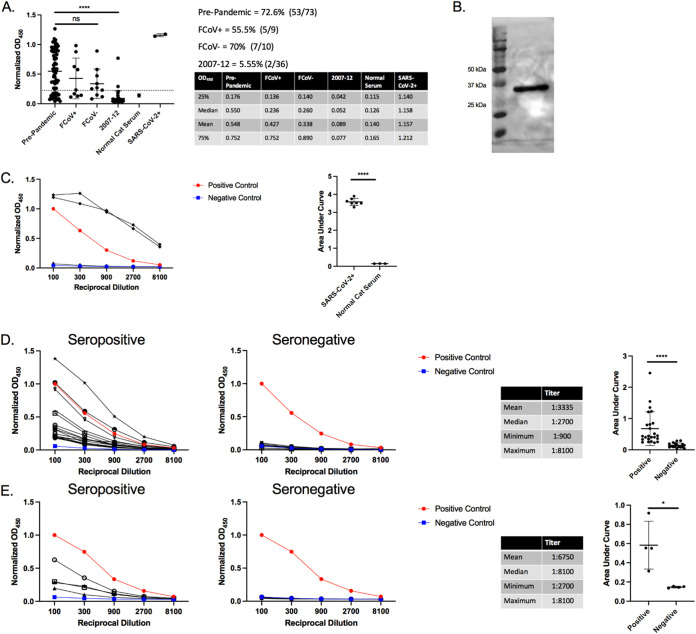
In late 2019, a novel coronavirus began circulating within humans in central China. It was designated SARS-CoV-2 because of its genetic similarities to the 2003 SARS coronavirus (SARS-CoV). Now that SARS-CoV-2 has spread worldwide, there is a risk of it establishing new animal reservoirs and recombination with native circulating coronaviruses. To screen local animal populations in the United States for exposure to SARS-like coronaviruses, we developed a serological assay using the receptor binding domain (RBD) from SARS-CoV-2. SARS-CoV-2's RBD is antigenically distinct from common human and animal coronaviruses, allowing us to identify animals previously infected with SARS-CoV or SARS-CoV-2. Using an indirect enzyme-linked immunosorbent assay (ELISA) for SARS-CoV-2's RBD, we screened serum from wild and domestic animals for the presence of antibodies against SARS-CoV-2's RBD. Surprisingly prepandemic feline serum samples submitted to the University of Tennessee Veterinary Hospital were ∼50% positive for anti-SARS RBD antibodies. Some of these samples were serologically negative for feline coronavirus (FCoV), raising the question of the etiological agent generating anti-SARS-CoV-2 RBD cross-reactivity. We also identified several white-tailed deer from South Carolina with anti-SARS-CoV-2 antibodies. These results are intriguing, as cross-reactive antibodies toward SARS-CoV-2 RBD have not been reported to date. The etiological agent responsible for seropositivity was not readily apparent, but finding seropositive cats prior to the current SARS-CoV-2 pandemic highlights our lack of information about circulating coronaviruses in other species. We report cross-reactive antibodies from prepandemic cats and postpandemic South Carolina white-tailed deer that are specific for that SARS-CoV RBD. There are several potential explanations for this cross-reactivity, each with important implications to coronavirus disease surveillance. Perhaps the most intriguing possibility is the existence and transmission of an etiological agent (such as another coronavirus) with similarity to SARS-CoV-2's RBD region. However, we lack conclusive evidence of prepandemic transmission of a SARS-like virus. Our findings provide impetus for the adoption of a One Health Initiative focusing on infectious disease surveillance of multiple animal species to predict the next zoonotic transmission to humans and future pandemics.
2019 年末,一种新型冠状病毒开始在中国中部的人群中传播。由于其与 2003 年 SARS 冠状病毒(SARS-CoV)的遗传相似性,它被指定为 SARS-CoV-2。现在 SARS-CoV-2 已经在全球范围内传播,它有可能在新的动物宿主中建立,并与当地流行的冠状病毒重组。为了筛选美国当地动物种群是否接触过 SARS 样冠状病毒,我们使用 SARS-CoV-2 的受体结合域(RBD)开发了一种血清学检测方法。SARS-CoV-2 的 RBD 在抗原上与常见的人类和动物冠状病毒不同,使我们能够识别以前感染过 SARS-CoV 或 SARS-CoV-2 的动物。我们使用间接酶联免疫吸附试验(ELISA)检测 SARS-CoV-2 的 RBD,筛查野生和家养动物的血清中是否存在针对 SARS-CoV-2 的 RBD 的抗体。出乎意料的是,田纳西大学兽医院提交的大流行前猫血清样本对 SARS RBD 抗体的阳性率约为 50%。其中一些样本对猫冠状病毒(FCoV)呈血清学阴性,这引发了一个问题,即产生抗 SARS-CoV-2 RBD 交叉反应的病原体是什么。我们还在南卡罗来纳州发现了几只带有抗 SARS-CoV-2 抗体的白尾鹿。这些结果很有趣,因为迄今为止尚未报道针对 SARS-CoV-2 RBD 的交叉反应性抗体。导致血清阳性的病原体并不明显,但在当前 SARS-CoV-2 大流行之前发现血清阳性的猫,突显了我们对其他物种中循环冠状病毒的了解不足。我们报告了来自大流行前猫和大流行后南卡罗来纳州白尾鹿的针对 SARS-CoV RBD 的交叉反应性抗体。这种交叉反应有几种潜在的解释,每种解释都对冠状病毒疾病监测有重要意义。也许最有趣的可能性是存在并传播了与 SARS-CoV-2 的 RBD 区域具有相似性的病原体(例如另一种冠状病毒)。然而,我们缺乏大流行前传播 SARS 样病毒的明确证据。我们的发现为采用一项关注多种动物物种传染病监测的“同一健康”倡议提供了动力,以预测下一次向人类的动物传染病传播和未来的大流行。