Department of Biopsychology and Neuroergonomics, Technical University of Berlin, Fasanenstr. 1, 10623, Berlin, Germany.
Faculty of Psychology and Human Movement Science, University of Hamburg, Turmweg 2, 20148, Hamburg, Germany.
BMC Public Health. 2022 Mar 30;22(1):624. doi: 10.1186/s12889-022-12993-5.
Nurses experience high, and often chronic, levels of occupational stress. As high-quality care requires a healthy workforce, individualized stress-alleviating interventions for nurses are needed. This study explored barriers and resources associated with health behaviors in nurses with different stress levels and work-related behavioral tendencies and identified health behavior determinants based on the Health Action Process Approach (HAPA) model.
Applying a mixed methods transformative triangulation design, n = 43 nurses filled out chronic stress (SSCS) and work-related behavior and experience patterns (German acronym AVEM) questionnaires, and participated in semi-structured interviews. With content analysis, categories of health behavior-related barriers and resources emerged. Behavior determinants (self-efficacy, outcome expectancies), health behavior, and barriers and resources were quantified via frequency and magnitude coding and interrelated with SSCS and AVEM scores to link level of health behavior with potential influencing factors. Nonparametric tests explored differences in quantified variables for SSCS and AVEM scores and 4-step-hierarchical regression analysis identified predictors for health behavior.
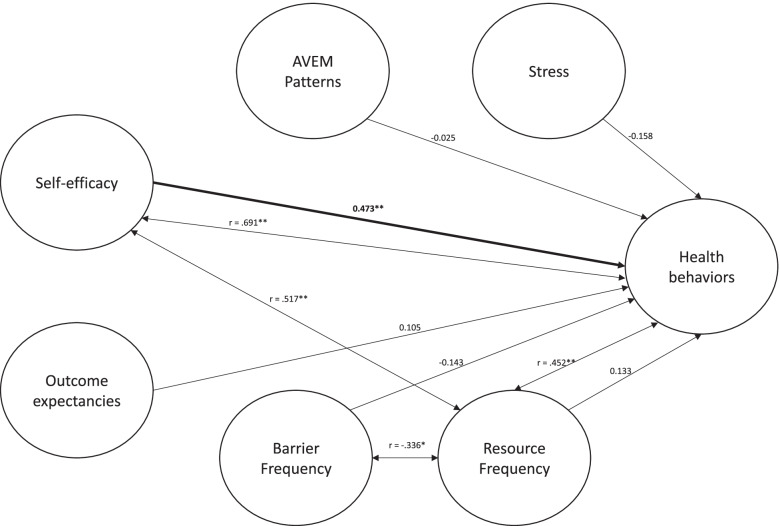
Eighty-four percent of the nurses were chronically stressed while 49% exhibited unhealthy behavioral tendencies at the workplace. 16 personal and organizational themes (six resources, ten barriers) influenced health behaviors. Stress was associated with resource frequency (p = .027) and current health behaviors (p = .07). Self-efficacy significantly explained variance in health behaviors (p = .003).
Health promotion related barriers and resources should be considered in designing nurse health promotion campaigns. Practitioners need to individualize and tailor interventions toward stress and behavioral experiences for sustainable effects on adherence and health.
护士经历着高强度、且往往是慢性的职业压力。由于高质量的护理需要一支健康的劳动力队伍,因此需要针对不同压力水平和与工作相关的行为倾向的护士制定个性化的减轻压力干预措施。本研究探讨了与不同压力水平和与工作相关的行为倾向的护士的健康行为相关的障碍和资源,并根据健康行动过程方法(HAPA)模型确定了健康行为决定因素。
采用混合方法转化三角设计,n=43 名护士填写了慢性压力(SSCS)和与工作相关的行为和体验模式(德语缩写 AVEM)问卷,并参加了半结构化访谈。通过内容分析,出现了与健康行为相关的障碍和资源类别。行为决定因素(自我效能感、预期结果)、健康行为以及障碍和资源通过频率和幅度编码进行量化,并与 SSCS 和 AVEM 分数相关联,以将健康行为水平与潜在的影响因素联系起来。非参数检验探索了 SSCS 和 AVEM 分数的量化变量的差异,4 步分层回归分析确定了健康行为的预测因素。
84%的护士处于慢性压力状态,而 49%的护士在工作场所表现出不健康的行为倾向。16 个人和组织主题(六个资源,十个障碍)影响健康行为。压力与资源频率(p=0.027)和当前健康行为(p=0.07)相关。自我效能感显著解释了健康行为的差异(p=0.003)。
在设计护士健康促进活动时,应考虑与健康相关的促进因素和障碍因素。从业者需要根据压力和行为体验个体化和调整干预措施,以对坚持和健康产生可持续的影响。