Department of Precision Cancer Medicine, Center for Innovative Cancer Treatment, Tokyo Medical and Dental University, Tokyo, Japan.
Department of Gastrointestinal Surgery, Tokyo Medical and Dental University, Tokyo, Japan.
PLoS One. 2022 Mar 31;17(3):e0266112. doi: 10.1371/journal.pone.0266112. eCollection 2022.
Clinical sequencing has provided molecular and therapeutic insights into the field of clinical oncology. However, despite its significance, its clinical utility in Japanese patients remains unknown. Here, we examined the clinical utility of tissue-based clinical sequencing with FoundationOne® CDx and FoundationOne® Heme. Between August 2018 and August 2019, 130 Japanese pretreated patients with advanced solid tumors were tested with FoundationOne® CDx or FoundationOne® Heme.
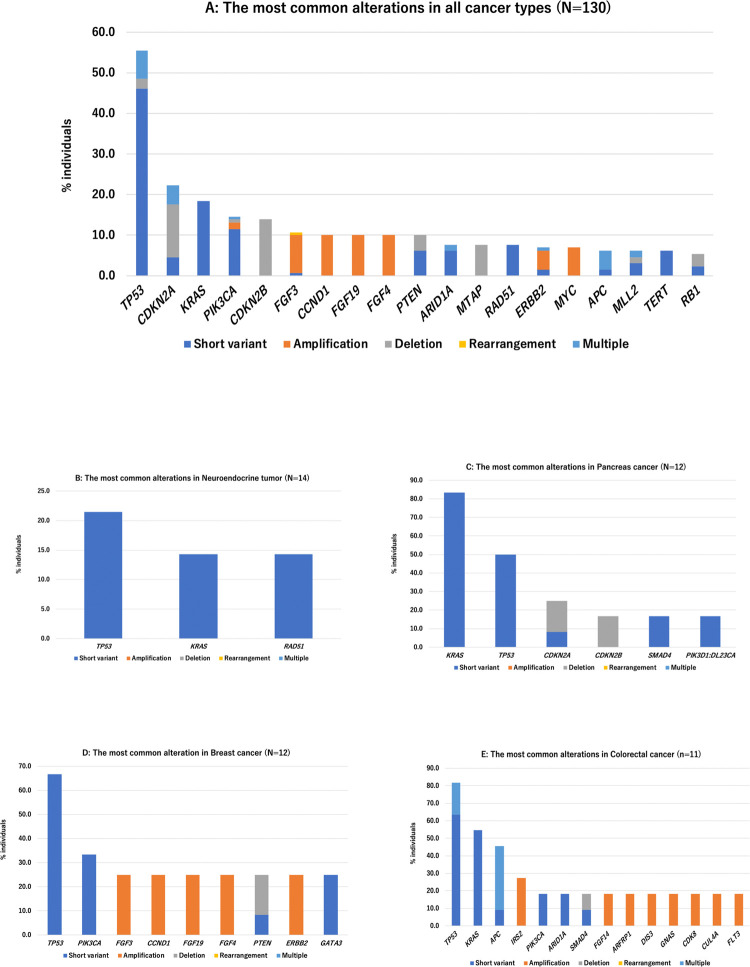
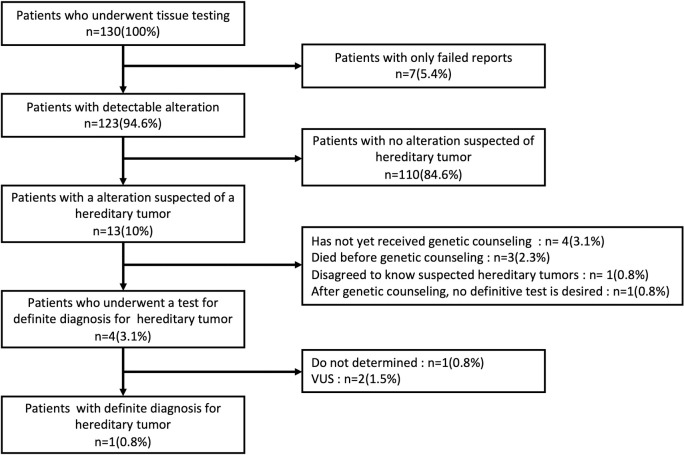
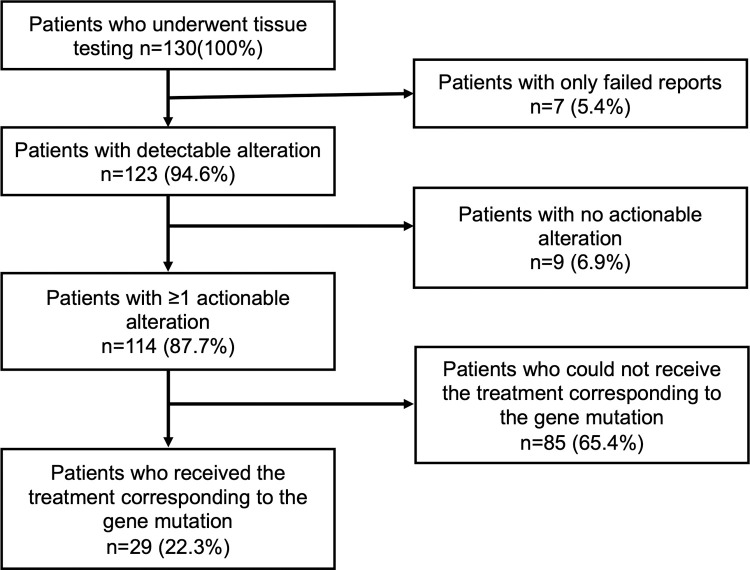
The median age of 130 patients was 60.5 years (range: 3 to 84 years), and among them, 64 were males and 66 were females. Major cancer types were gastrointestinal cancer (23 cases) and hepatic, biliary, and pancreatic cancer (21 cases). A molecular tumor board had been completed on all 130 cases by October 31, 2019. The median number of gene alterations detected by Foundation testing, excluding variants of unknown significance (VUS) was 4 (ranged 0 to 21) per case. Of the 130 cases, one or more alterations were found in 123 cases (94.6%), and in 114 cases (87.7%), actionable alterations with candidates for therapeutic agents were found. In 29 (22.3%) of them, treatment corresponding to the gene alteration was performed. Regarding secondary findings, 13 cases (10%) had an alteration suspected of a hereditary tumor. Of the 13 cases, only one case received a definite diagnosis of hereditary tumor.
Our study showed that clinical sequencing might be useful for detecting gene alterations in various cancer types and exploring treatment options. However, many issues still need to be improved.
临床测序为临床肿瘤学领域提供了分子和治疗方面的见解。然而,尽管其意义重大,但在日本患者中的临床实用性仍不清楚。在这里,我们研究了基于组织的临床测序在 FoundationOne® CDx 和 FoundationOne® Heme 中的临床实用性。在 2018 年 8 月至 2019 年 8 月期间,对 130 名患有晚期实体瘤的日本预处理患者使用 FoundationOne® CDx 或 FoundationOne® Heme 进行了检测。
130 名患者的中位年龄为 60.5 岁(范围:3 至 84 岁),其中 64 名为男性,66 名为女性。主要癌症类型为胃肠道癌(23 例)和肝胆胰癌(21 例)。截至 2019 年 10 月 31 日,所有 130 例均完成了分子肿瘤委员会评估。排除意义不明的变异(VUS)后,通过 Foundation 检测检测到的基因改变的中位数为 4 个(范围 0 至 21 个)。在 130 例患者中,123 例(94.6%)发现了一个或多个改变,114 例(87.7%)发现了有治疗药物候选物的可操作改变。在 29 例(22.3%)中,对与基因改变相对应的治疗进行了治疗。关于次要发现,13 例(10%)的改变怀疑为遗传性肿瘤。在这 13 例中,只有 1 例被确诊为遗传性肿瘤。
我们的研究表明,临床测序可能有助于检测各种癌症类型的基因改变,并探索治疗选择。然而,仍有许多问题需要改进。