Wang Yuting, Ye Qing, Sun Yujun, Jiang Yulu, Meng Bo, Du Jun, Chen Jingjing, Tugarova Anna V, Kamnev Alexander A, Huang Shengwei
Department of Pathology, The First Affiliated Hospital of USTC, Division of Life Sciences and Medicine, University of Science and Technology of China, Hefei, China.
Intelligent Pathology Institute, Division of Life Sciences and Medicine, University of Science and Technology of China, Hefei, China.
Front Microbiol. 2022 Mar 10;13:845321. doi: 10.3389/fmicb.2022.845321. eCollection 2022.
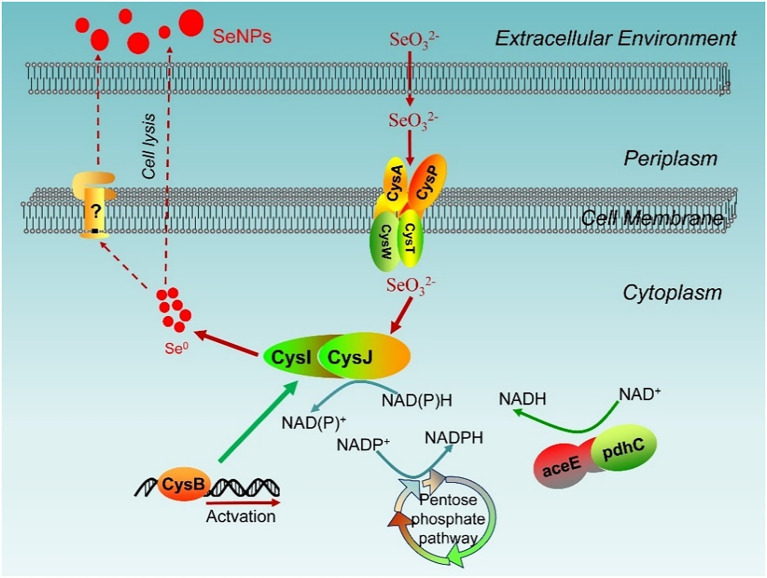
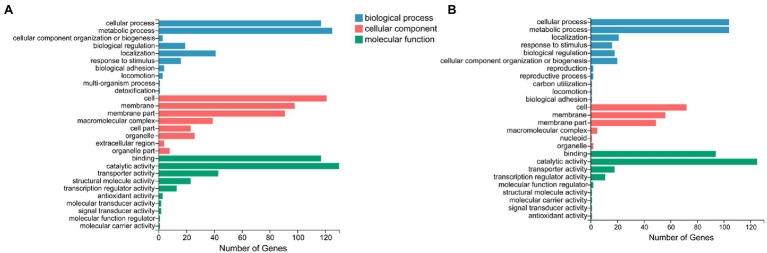
Biotransformation of selenite by microorganisms is an effective detoxification (in cases of dissimilatory reduction, e.g., to Se) and assimilation process (when Se is assimilated by cells). However, the current knowledge of the molecular mechanism of selenite reduction remains limited. In this study, a selenite-resistant bacterium was isolated and identified as sp. YS02. Strain YS02 reduced 93.2% of 5.0 mM selenite to selenium nanoparticles (SeNPs) within 24 h, and the produced SeNPs were spherical and localized intracellularly or extracellularly, with an average dimension of 140 ± 43 nm. The morphology and composition of the isolated and purified SeNPs were characterized using dynamic light scattering (DLS), scanning electron microscopy (SEM) with energy-dispersive X-ray (EDX) spectrometry, and Fourier transform infrared (FTIR) spectroscopy. FTIR spectroscopy indicated the presence of proteins, polysaccharides, and lipids on the surface of the isolated SeNPs. Furthermore, the SeNPs showed excellent antimicrobial activity against several Gram-positive and Gram-negative pathogenic bacteria. Comparative transcriptome analysis was performed to elucidate the selenite reduction mechanism and biosynthesis of SeNPs. It is revealed that 197 genes were significantly upregulated, and 276 genes were significantly downregulated under selenite treatment. Gene ontology and Kyoto Encyclopedia of Genes and Genomes (KEGG) analyses revealed that genes associated with ABC transporters, sulfur metabolism, pentose phosphate pathway (PPP), and pyruvate dehydrogenase were significantly enhanced, indicating selenite is reduced by sulfite reductase with PPP and pyruvate dehydrogenase supplying reducing equivalents and energy. This work suggests numerous genes are involved in the response to selenite stress, providing new insights into the molecular mechanisms of selenite bioreduction with the formation of SeNPs.
微生物对亚硒酸盐的生物转化是一种有效的解毒过程(如异化还原情况下,例如还原为硒)和同化过程(当细胞同化硒时)。然而,目前关于亚硒酸盐还原分子机制的知识仍然有限。在本研究中,分离并鉴定出一株抗亚硒酸盐细菌,命名为YS02菌。菌株YS02在24小时内将5.0 mM亚硒酸盐的93.2%还原为硒纳米颗粒(SeNP),所产生的SeNP呈球形,位于细胞内或细胞外,平均尺寸为140±43 nm。使用动态光散射(DLS)、带能量色散X射线(EDX)光谱的扫描电子显微镜(SEM)和傅里叶变换红外(FTIR)光谱对分离和纯化的SeNP的形态和组成进行了表征。FTIR光谱表明分离出的SeNP表面存在蛋白质、多糖和脂质。此外,SeNP对几种革兰氏阳性和革兰氏阴性病原菌表现出优异的抗菌活性。进行了比较转录组分析以阐明亚硒酸盐还原机制和SeNP的生物合成。结果表明,在亚硒酸盐处理下,197个基因显著上调,276个基因显著下调。基因本体论和京都基因与基因组百科全书(KEGG)分析表明,与ABC转运蛋白、硫代谢、磷酸戊糖途径(PPP)和丙酮酸脱氢酶相关的基因显著增强,表明亚硒酸盐由亚硫酸盐还原酶还原,PPP和丙酮酸脱氢酶提供还原当量和能量。这项工作表明许多基因参与了对亚硒酸盐胁迫的响应,为亚硒酸盐生物还原形成SeNP的分子机制提供了新的见解。