Hallam Brendan, Petersen Irene, Cooper Claudia, Avgerinou Christina, Walters Kate
UCL Research Department of Primary Care & Population Health, University College London, London, UK.
Division of Psychiatry, University College London, London, UK.
Clin Epidemiol. 2022 Mar 24;14:395-408. doi: 10.2147/CLEP.S350396. eCollection 2022.
To investigate time trends in incidence of recorded memory concerns (MC) and cognitive decline (CD) in a UK older population presenting to primary care with no prior diagnosis of dementia. To determine the risk of developing dementia in people with recorded memory concern and cognitive decline.
We included individuals aged 65-99 years who contributed to data within the IQVIA medical research database from 1st January 2009 to 31st December 2018. We reported crude incidence rates for MC (study population n=1,310,838) and CD (n=1,348,796). We conducted survival analysis to estimate the risk of developing dementia using fine-grey sub-distribution hazard model with competing risk of death.
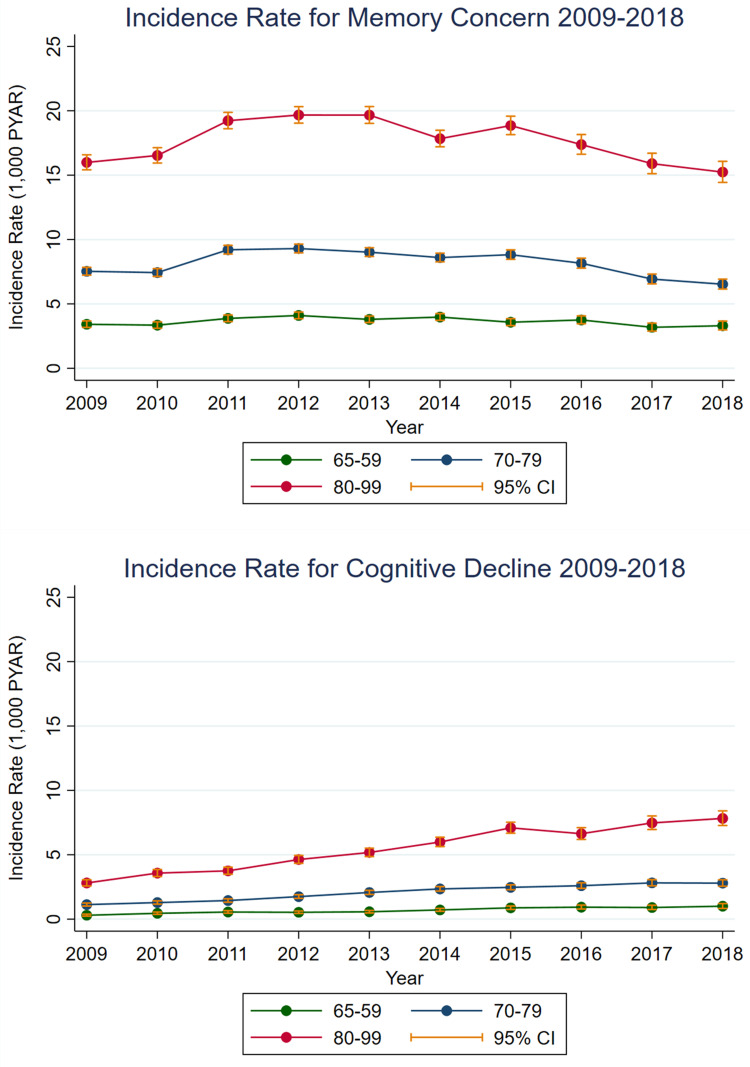
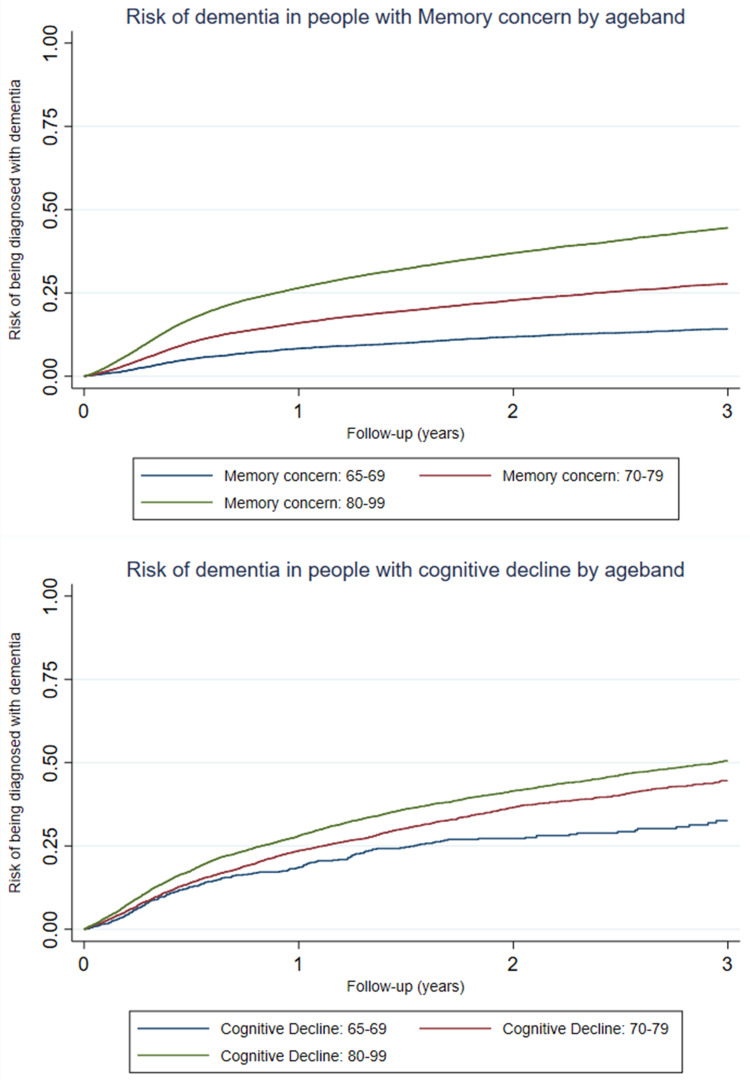
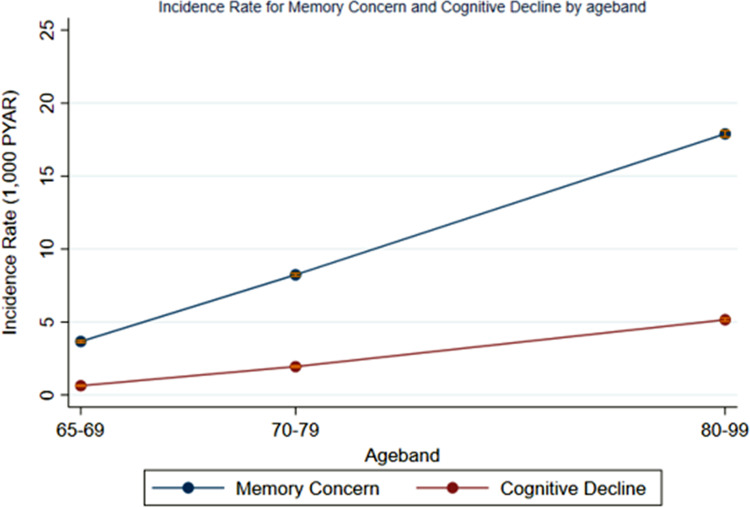
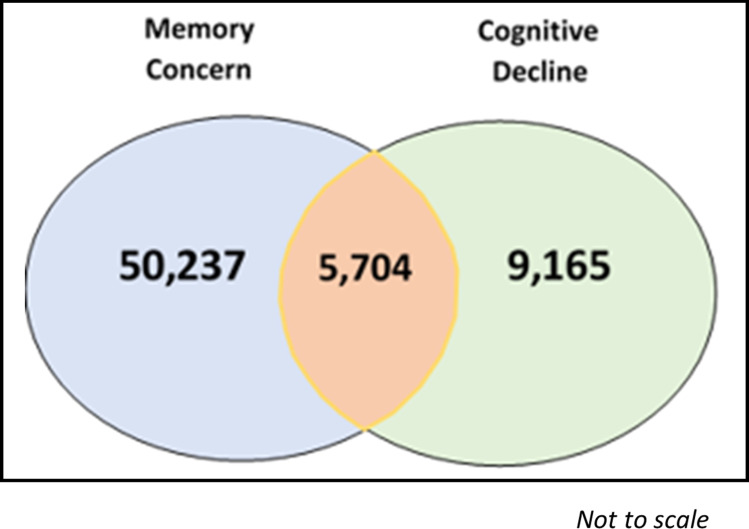
We identified 55,941 individuals (4.3%) with a record of incident MC; rates were fairly stable over the decade of study. We identified 14,869 people (1.1%) with a record of incident CD, and these rates increased from 1.29/1000 PYAR (95% CI 1.21 to 1.38) in 2009 to 3.49/1000 PYAR (95% CI 3.30 to 3.68) in 2018. Within 3 years of follow up from the first record of MC, 45.5% of individuals received a diagnosis of dementia, while of those with a record of CD, 51.7% received a dementia diagnosis. Women, people in older age groups and those living in more deprived areas were more likely to have a record of MC or CD, and their symptoms were more likely to progress to a dementia diagnosis.
Incidence rates of MC and CD estimated from routinely collected primary care data are lower than those reported in community surveys, suggesting that a minority of people who experience memory loss consult their GP and have it recorded. Our findings indicate that those who do report concerns to primary care, especially women, those in older age groups and those in more deprived areas, are at a higher risk for developing dementia.
调查在英国未预先诊断为痴呆症的老年初级保健人群中,记录的记忆问题(MC)和认知衰退(CD)的发病率随时间的变化趋势。确定有记录的记忆问题和认知衰退的人群患痴呆症的风险。
我们纳入了年龄在65 - 99岁之间、在2009年1月1日至2018年12月31日期间为IQVIA医学研究数据库提供数据的个体。我们报告了MC(研究人群n = 1,310,838)和CD(n = 1,348,796)的粗发病率。我们进行了生存分析,使用带有死亡竞争风险的精细灰色子分布风险模型来估计患痴呆症的风险。
我们识别出55,941名个体(4.3%)有新发MC记录;在研究的十年中发病率相当稳定。我们识别出14,869人(1.1%)有新发CD记录,这些发病率从2009年的1.29/1000人年(95%可信区间1.21至1.38)增加到2018年的3.49/1000人年(95%可信区间3.30至3.68)。在首次记录MC后的3年随访内,45.5%的个体被诊断为痴呆症,而有CD记录的个体中,51.7%被诊断为痴呆症。女性、年龄较大的人群以及生活在更贫困地区的人群更有可能有MC或CD记录,并且他们的症状更有可能发展为痴呆症诊断。
从常规收集的初级保健数据估计的MC和CD发病率低于社区调查中报告的发病率,这表明少数经历记忆丧失的人会咨询他们的全科医生并被记录下来。我们的研究结果表明,那些向初级保健机构报告问题的人,尤其是女性、年龄较大的人群以及生活在更贫困地区的人群,患痴呆症的风险更高。