Posts and Telecommunications Institute of Technology, Hanoi, Vietnam.
Biomed Eng Online. 2022 Apr 2;21(1):22. doi: 10.1186/s12938-022-00993-w.
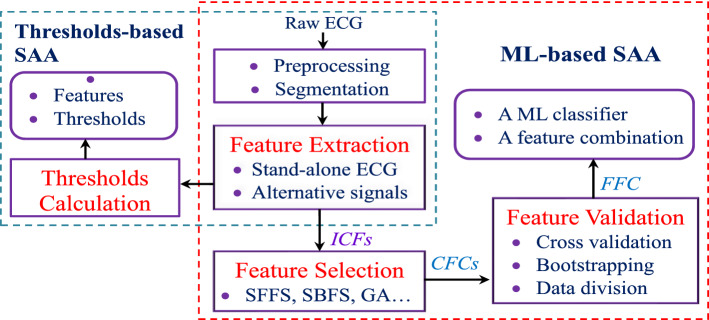
Shock advice algorithm plays a vital role in the detection of sudden cardiac arrests on electrocardiogram signals and hence, brings about survival improvement by delivering prompt defibrillation. The last decade has witnessed a surge of research efforts in racing for efficient shock advice algorithms, in this context. On one hand, it has been reported that the classification performance of traditional threshold-based methods has not complied with the American Heart Association recommendations. On the other hand, the rise of machine learning and deep learning-based counterparts is paving the new ways for the development of intelligent shock advice algorithms. In this paper, we firstly provide a comprehensive survey on the development of shock advice algorithms for rhythm analysis in automated external defibrillators. Shock advice algorithms are categorized into three groups based on the classification methods in which the detection performance is significantly improved by the use of machine learning and/or deep learning techniques instead of threshold-based approaches. Indeed, in threshold-based shock advice algorithms, a parameter is calculated as a threshold to distinguish shockable rhythms from non-shockable ones. In contrast, machine learning-based methods combine multiple parameters of conventional threshold-based approaches as a set of features to recognize sudden cardiac arrest. Noticeably, those features are possibly extracted from stand-alone ECGs, alternative signals using various decomposition techniques, or fully augmented ECG segments. Moreover, these signals can be also used directly as the input channels of deep learning-based shock advice algorithm designs. Then, we propose an advanced shock advice algorithm using a support vector machine classifier and a feature set extracted from a fully augmented ECG segment with its shockable and non-shockable signals. The relatively high detection performance of the proposed shock advice algorithm implies a potential application for the automated external defibrillator in the practical clinic environment. Finally, we outline several interesting yet challenging research problems for further investigation.
电击建议算法在心电图信号中检测心搏骤停方面起着至关重要的作用,因此通过及时除颤提高了生存率。在这种情况下,过去十年中,人们在竞相开发有效的电击建议算法方面付出了大量努力。一方面,据报道,传统基于阈值的方法的分类性能不符合美国心脏协会的建议。另一方面,机器学习和基于深度学习的方法的兴起为开发智能电击建议算法开辟了新途径。在本文中,我们首先对自动体外除颤器中用于节律分析的电击建议算法的发展进行了全面调查。电击建议算法基于分类方法分为三组,其中通过使用机器学习和/或深度学习技术而不是基于阈值的方法,检测性能得到了显著提高。实际上,在基于阈值的电击建议算法中,计算一个参数作为阈值,以区分可电击节律和不可电击节律。相比之下,基于机器学习的方法将传统基于阈值的方法的多个参数组合为一组特征来识别心搏骤停。值得注意的是,这些特征可能是从独立的 ECG、使用各种分解技术的替代信号或完全增强的 ECG 段中提取的。此外,这些信号也可以直接用作基于深度学习的电击建议算法设计的输入通道。然后,我们提出了一种使用支持向量机分类器和从完全增强的 ECG 段及其可电击和不可电击信号中提取的特征集的高级电击建议算法。所提出的电击建议算法具有较高的检测性能,这意味着它可能在实际临床环境中用于自动体外除颤器。最后,我们概述了几个有趣但具有挑战性的研究问题,以供进一步研究。