Panayi Peter, Berry Katherine, Sellwood William, Campodonico Carolina, Bentall Richard P, Varese Filippo
Division of Psychology and Mental Health, Manchester Academic Health Sciences Centre, University of Manchester, Manchester, United Kingdom.
Complex Trauma and Resilience Research Unit, Greater Manchester Mental Health NHS Foundation Trust, Manchester, United Kingdom.
Front Psychol. 2022 Mar 16;13:791996. doi: 10.3389/fpsyg.2022.791996. eCollection 2022.
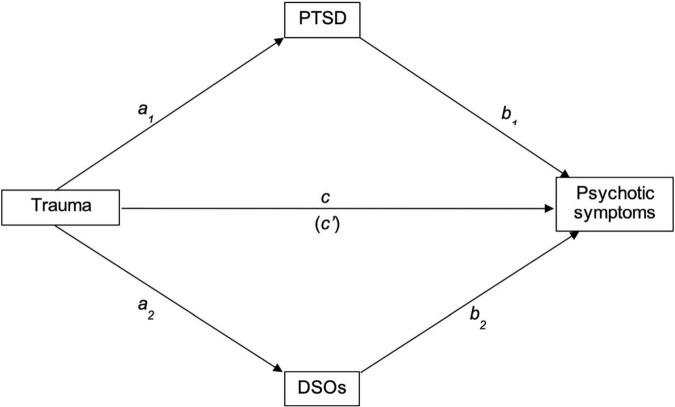
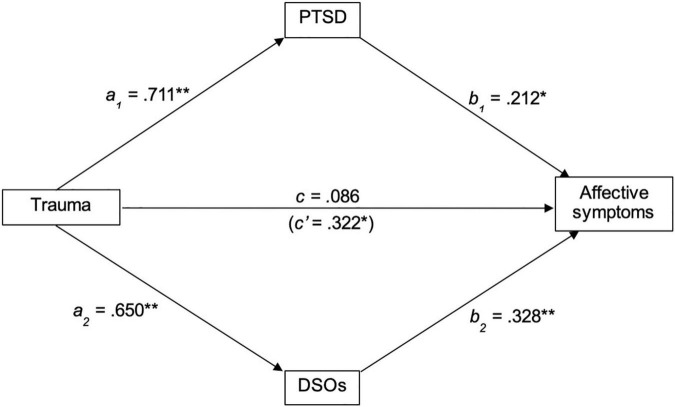
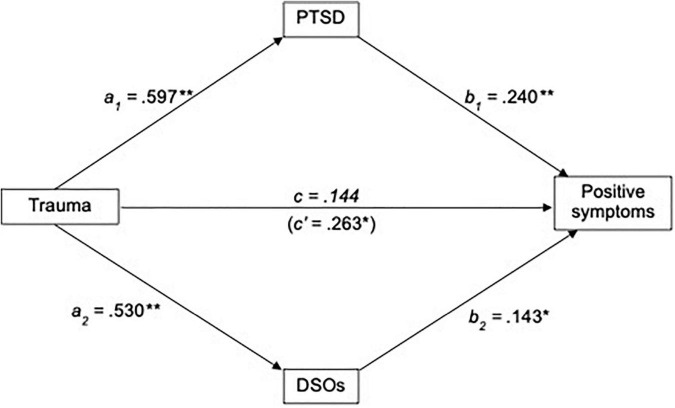
Traumatic experiences and post-traumatic stress are highly prevalent in people with psychosis, increasing symptom burden, decreasing quality of life and moderating treatment response. A range of post-traumatic sequelae have been found to mediate the relationship between trauma and psychotic experiences, including the "traditional" symptoms of post-traumatic stress disorder (PTSD). The International Classification of Diseases-11th Edition recognizes a more complex post-traumatic presentation, complex PTSD (cPTSD), which captures both the characteristic symptoms of PTSD alongside more pervasive post-traumatic sequelae known as 'disturbances in self-organization' (DSOs). The prevalence and impact of cPTSD and DSOs in psychosis remains to be explored. In the first study of this kind, 144 participants with psychosis recruited from North West United Kingdom mental health services completed measures assessing trauma, PTSD and cPTSD symptoms and symptoms of psychosis. Forty-percent of the sample met criteria for cPTSD, compared to 10% who met diagnostic criteria for PTSD. PTSD and DSOs mediated the relationship between trauma and positive symptoms, controlling for dataset membership. Both PTSD and DSOs mediated the relationship between trauma and affective symptoms but did not explain a significant proportion of variance in negative symptoms. Cognitive and excitative symptoms of psychosis did not correlate with trauma, PTSD or DSO scores. These findings indicate the possible value of adjunct therapies to manage cPTSD symptoms in people with psychosis, pending replication in larger epidemiological samples and longitudinal studies.
创伤经历和创伤后应激在精神病患者中极为普遍,会增加症状负担、降低生活质量并影响治疗反应。一系列创伤后后遗症被发现介导了创伤与精神病性体验之间的关系,包括创伤后应激障碍(PTSD)的“传统”症状。《国际疾病分类》第11版认可了一种更为复杂的创伤后表现形式,即复杂创伤后应激障碍(cPTSD),它既包含了PTSD的特征性症状,也包括了更为普遍的被称为“自我组织障碍”(DSO)的创伤后后遗症。cPTSD和DSO在精神病中的患病率及影响仍有待探索。在这类研究中的第一项研究里,从英国西北部心理健康服务机构招募的144名精神病患者完成了评估创伤、PTSD和cPTSD症状以及精神病症状的测量。样本中有40%符合cPTSD标准,相比之下,符合PTSD诊断标准的为10%。PTSD和DSO介导了创伤与阳性症状之间的关系,并对数据集成员身份进行了控制。PTSD和DSO都介导了创伤与情感症状之间的关系,但并未解释阴性症状中很大一部分的变异。精神病的认知和激越症状与创伤、PTSD或DSO评分均无相关性。这些发现表明,在更大规模的流行病学样本和纵向研究中进行重复验证之前,辅助治疗对于管理精神病患者的cPTSD症状可能具有价值。