
缺氧微环境中的肿瘤源性外泌体:释放机制、生物学功能及临床应用
Tumor-derived exosomes in hypoxic microenvironment: release mechanism, biological function and clinical application.
作者信息
Qian Da, Xie Yaoyao, Huang Mingyao, Gu Jianfeng
机构信息
Department of Burn and Plastic Surgery-Hand Surgery, First People's Hospital of Changshu City, Changshu Hospital Affiliated to Soochow University, Soochow, China.
College of Pharmaceutical Science, Soochow University, Soochow, China.
出版信息
J Cancer. 2022 Mar 14;13(5):1685-1694. doi: 10.7150/jca.69278. eCollection 2022.
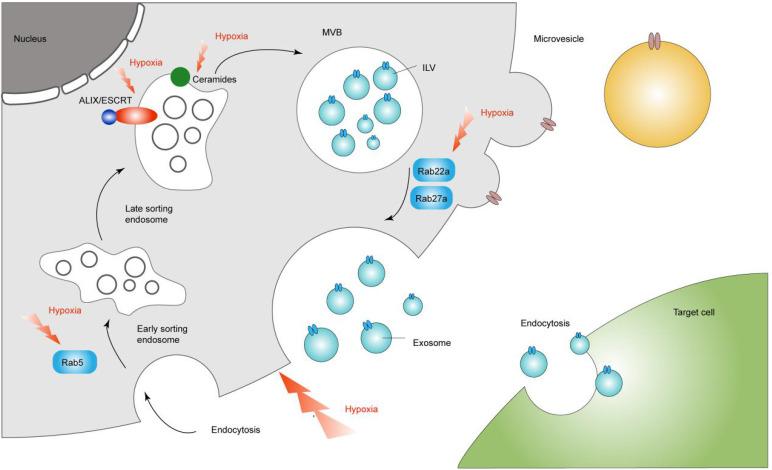
Hypoxia is a key feature of solid tumors and is related to disease aggressiveness and adverse outcomes. It is recognized that the two-way communication between cancer cells and their microenvironment is critical to cancer progression. Increasing evidences show that the cellular communication and crosstalk between tumor cells and their microenvironment is not limited to secreted molecules, but also includes exosomes secreted by tumor cells. Exosomes are nano-scale extracellular vesicles (30-100 nm in diameter), which carry the molecular characteristics and cargo of the source cell, participating in intercellular communication through autocrine, paracrine and near-crine pathways. Recent studies have shown that cancer cells produce more exosomes under hypoxic conditions than normoxia conditions. The secretion and function of exosomes could be influenced by hypoxia in various types of cancer. Therefore, in this review, we summarize and discuss the latest research on the physiological mechanism of hypoxia regulating the secretion of exosomes, and the involvement of hypoxic exosomes in cancer progression and immune escape processes, and expounds the potential for targeting hypoxia-induced exosomes for cancer therapy strategies.
缺氧是实体瘤的一个关键特征,与疾病的侵袭性和不良预后相关。人们认识到,癌细胞与其微环境之间的双向通讯对癌症进展至关重要。越来越多的证据表明,肿瘤细胞与其微环境之间的细胞通讯和相互作用不仅限于分泌分子,还包括肿瘤细胞分泌的外泌体。外泌体是纳米级的细胞外囊泡(直径30-100纳米),携带源细胞的分子特征和货物,通过自分泌、旁分泌和近分泌途径参与细胞间通讯。最近的研究表明,癌细胞在缺氧条件下比在常氧条件下产生更多的外泌体。外泌体的分泌和功能可能受到各种类型癌症中缺氧的影响。因此,在本综述中,我们总结并讨论了关于缺氧调节外泌体分泌的生理机制、缺氧外泌体参与癌症进展和免疫逃逸过程的最新研究,并阐述了针对缺氧诱导的外泌体进行癌症治疗策略的潜力。

 Zotero 插件