Department of Sociology, School of Humanities and Social Science, Xi'an Jiaotong University, No. 28 Xianning West Road, Xi'an, China.
J Youth Adolesc. 2022 Aug;51(8):1483-1496. doi: 10.1007/s10964-022-01600-w. Epub 2022 Apr 4.
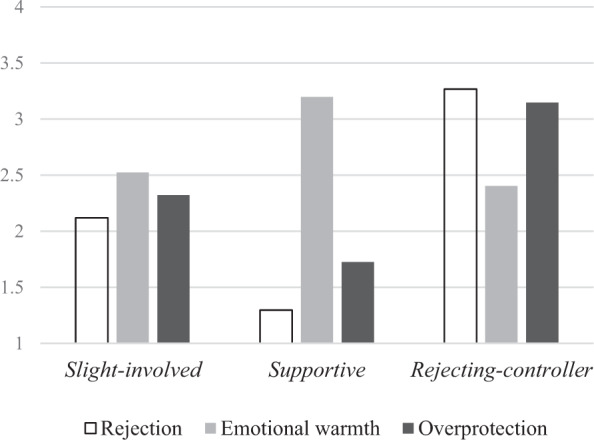
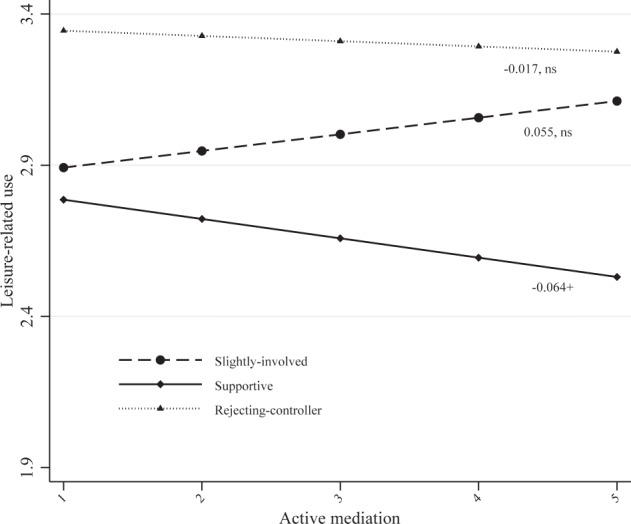
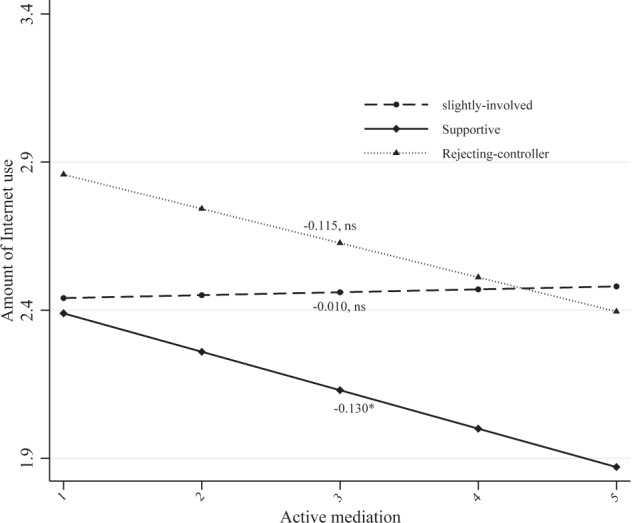
Internet use can be distinguished into different uses (e.g., leisure-related, learning-related), yet comprehensive studies on how different uses are associated with everyday parenting situations are still lacking. This study attempts to locate parental mediation within broader family contexts and simultaneously considers the relationships among general parenting style, media-specific parenting practices, and adolescents' amount and types of Internet use. Building on survey data collected from 1284 middle school students in China (mean age = 13, SD = 0.79, 48.60% girls), the Latent Profile Analysis identified three child-perceived profiles of general parenting style: slight-engaged, supportive, and rejecting-controller. The subsequent regressions suggested that adolescents with supportive parents reported lower levels of time spent online as well as leisure-related use; more restrictive parental mediation was associated with reduced leisure-related use while more active mediation was associated with more learning-related use. Notably, associations between parental use of active mediation and youth's amount of Internet use and leisure-related use varied based on parenting style profiles. Only for the supportive parenting profile, more use of active mediation was associated with decreased amount of Internet use as well as leisure-related use. These findings have implications on how parents can be more effective in guiding youth's Internet use.
互联网的使用可以分为不同的用途(例如,与休闲相关、与学习相关),但关于不同用途如何与日常育儿情况相关联的综合研究仍然缺乏。本研究试图在更广泛的家庭环境中定位父母的中介作用,同时考虑一般育儿风格、特定媒体的育儿实践以及青少年互联网使用的数量和类型之间的关系。本研究基于从中国 1284 名中学生(平均年龄为 13 岁,标准差为 0.79,48.60%为女生)中收集的调查数据,采用潜在剖面分析识别出三种儿童感知的一般育儿风格:轻度参与型、支持型和拒绝控制型。随后的回归分析表明,有支持型父母的青少年报告上网时间和休闲相关使用时间较少;父母更严格的中介作用与休闲相关使用减少有关,而更积极的中介作用与更多的学习相关使用有关。值得注意的是,父母积极中介作用与青少年互联网使用量和休闲相关使用之间的关联因育儿风格的不同而有所不同。只有在支持型育儿风格中,更多地使用积极的中介作用与减少互联网使用量和休闲相关使用有关。这些发现对父母如何更有效地指导青少年的互联网使用具有启示意义。