Department of Environmental Science, Faculty of Agriculture, Bangabandhu Sheikh Mujibur Rahman Agricultural University, Gazipur, 1706, Bangladesh.
Department of Horticulture, Faculty of Agriculture, Bangabandhu Sheikh Mujibur Rahman Agricultural University, Gazipur, 1706, Bangladesh.
Sci Rep. 2022 Apr 4;12(1):5599. doi: 10.1038/s41598-022-09519-9.
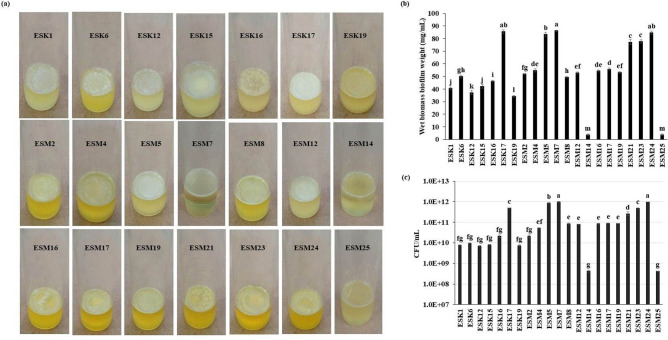
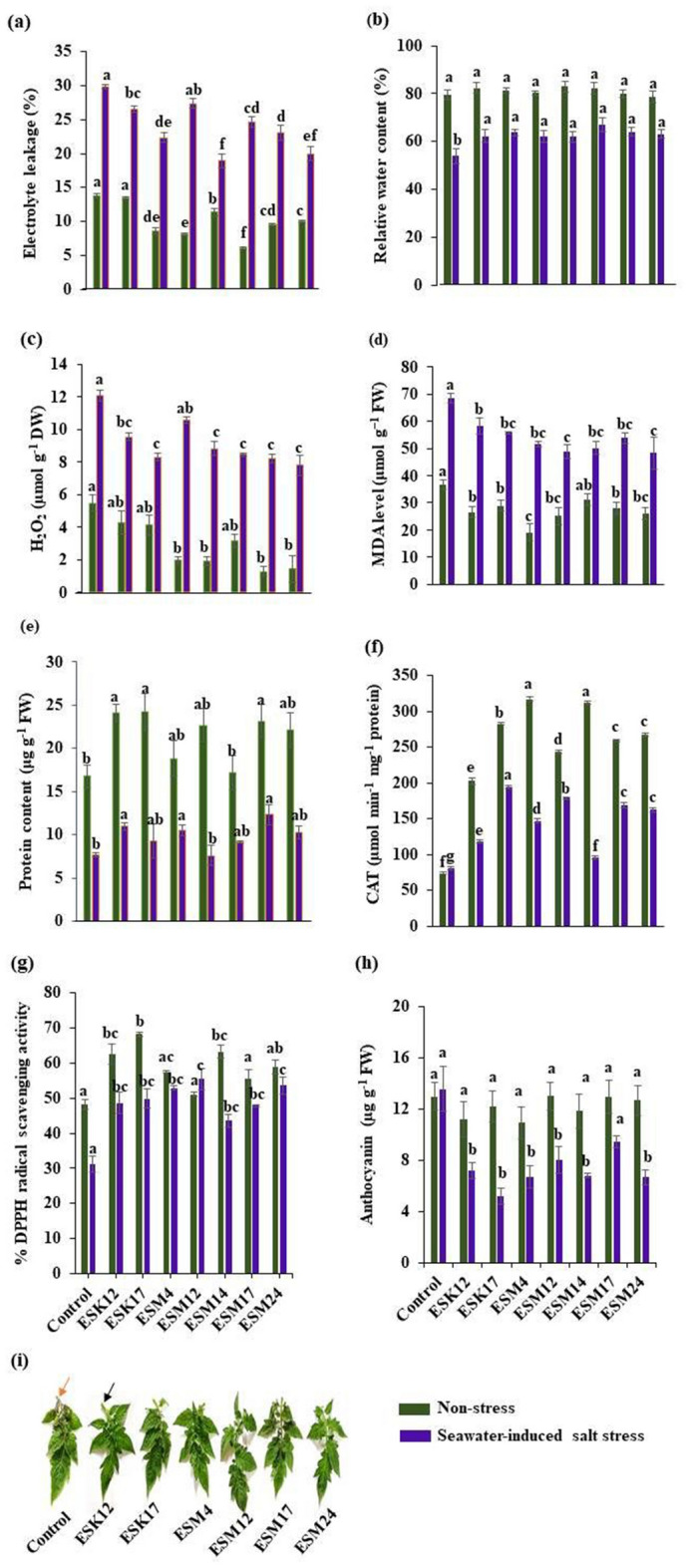
Biofilm-producing rhizobacteria (BPR) enhance productivity and mitigate abiotic stresses in plants. This study showed that 21 out of 65 halotolerant rhizobacteria could build biofilms. The components of the biofilm matrices i.e., extracellular polymeric substances (EPS) are proteins, curli, nanocelloluse, nucleic acids, lipids, and peptidoglycans. Various functional groups including carbonyl, carboxyl, amino, hydroxyl, and phosphate were identified. Positions of these groups were shifted by application of 5% NaCl, suggesting Na biosorption. By sequencing, Glutamicibacter arilaitensis (ESK1, ESM4 and ESM7), G. nicotianae (ESK19, ESM8 and ESM16), Enterobacter ludwigii (ESK15, ESK17, ESM2 and ESM17), E. cloacae (ESM5 and ESM12), Exiguobacterium acetylicum (ESM24 and ESM25), Staphylococcus saprophyticus ESK6, Leclercia adecarboxylata ESK12, Pseudomonas poae ESK16, Bacillus subtilis ESM14, and P. putida ESM17 were identified. These rhizobacteria exhibited numerous plant growth-promoting (PGP) activities including producing IAA, ACC deaminase, and siderophores, and solubilizing phosphate. Under non-stress, bacterized plants increased biomass accumulation (8-23.2% roots and 23-49.4% shoots), while under seawater-induced salt stress only ESK12, ESM4, ESM12, and ESM14 enhanced biomass production (5.8-52.9% roots and 8.8-33.4% shoots). Bacterized plants induced antioxidant defense system (19.5-142% catalase and 12.3-24.2% DPPH radical scavenging activity), retained a greater relative water content (17-124%), showed lesser membrane injuries (19.9-26.5%), and a reduced Na (6-24% in roots) and increased K/Na ratio (78.8 and 103% in roots by ESK12 and ESM24, respectively) than the non-bacterized plants in saline conditions. Thus, native halotolerant BPR can be utilized as ameliorators of salt stress.
产生生物膜的根际细菌(BPR)可提高植物的生产力并减轻非生物胁迫。本研究表明,在 65 株耐盐根际细菌中有 21 株可以形成生物膜。生物膜基质的成分,即胞外聚合物(EPS)是由蛋白质、卷曲、纳米纤维素、核酸、脂类和肽聚糖组成的。鉴定出了各种功能基团,包括羰基、羧基、氨基、羟基和磷酸基。应用 5%NaCl 后,这些基团的位置发生了移动,表明存在钠离子的吸附。通过测序,鉴定出了谷氨酸棒杆菌(ESK1、ESM4 和 ESM7)、烟草节杆菌(ESK19、ESM8 和 ESM16)、阴沟肠杆菌(ESK15、ESK17、ESM2 和 ESM17)、普通变形杆菌(ESM5 和 ESM12)、乙酸钙不动杆菌(ESM24 和 ESM25)、粪产碱菌(ESK6)、脱羧勒克菌(ESK12)、豌豆假单胞菌(ESK16)、枯草芽孢杆菌(ESM14)和恶臭假单胞菌(ESM17)。这些根际细菌表现出多种植物促生长(PGP)活性,包括产生吲哚乙酸、ACC 脱氨酶和铁载体,以及溶解磷酸盐。在非胁迫条件下,细菌处理的植物增加了生物量积累(根增加 8-23.2%,茎增加 23-49.4%),而在海水诱导的盐胁迫下,只有 ESK12、ESM4、ESM12 和 ESM14 增加了生物量的产生(根增加 5.8-52.9%,茎增加 8.8-33.4%)。细菌处理的植物诱导了抗氧化防御系统(过氧化氢酶增加 19.5-142%,DPPH 自由基清除活性增加 12.3-24.2%),保持了较高的相对含水量(根增加 17-124%),膜损伤较小(根减少 19.9-26.5%),钠离子减少(根减少 6-24%),钾钠比增加(根增加 78.8%和 103%,分别由 ESK12 和 ESM24 引起),在盐胁迫条件下优于非细菌处理的植物。因此,本地耐盐 BPR 可以用作盐胁迫的改良剂。