Liu Taisheng, Hu Xiaoshan, Lin Chunxuan, Shi Xiaoshun, He Yujing, Zhang Jian, Cai Kaican
Department of Thoracic Surgery, Nanfang Hospital, Southern Medical University, Guangzhou, China.
Department of Thoracic Surgery, Affiliated Cancer Hospital & Institute of Guangzhou Medical University, Guangzhou, China.
Ann Transl Med. 2022 Mar;10(5):259. doi: 10.21037/atm-22-500.
Accumulating evidence has shown that 5-methylcytosinec (m5C) RNA methylation plays an essential role in tumorigenesis. However, the roles of m5C regulators in the prognosis, tumor microenvironment (TME), and immunotherapy responses of lung adenocarcinoma (LUAD) have not been fully analyzed.
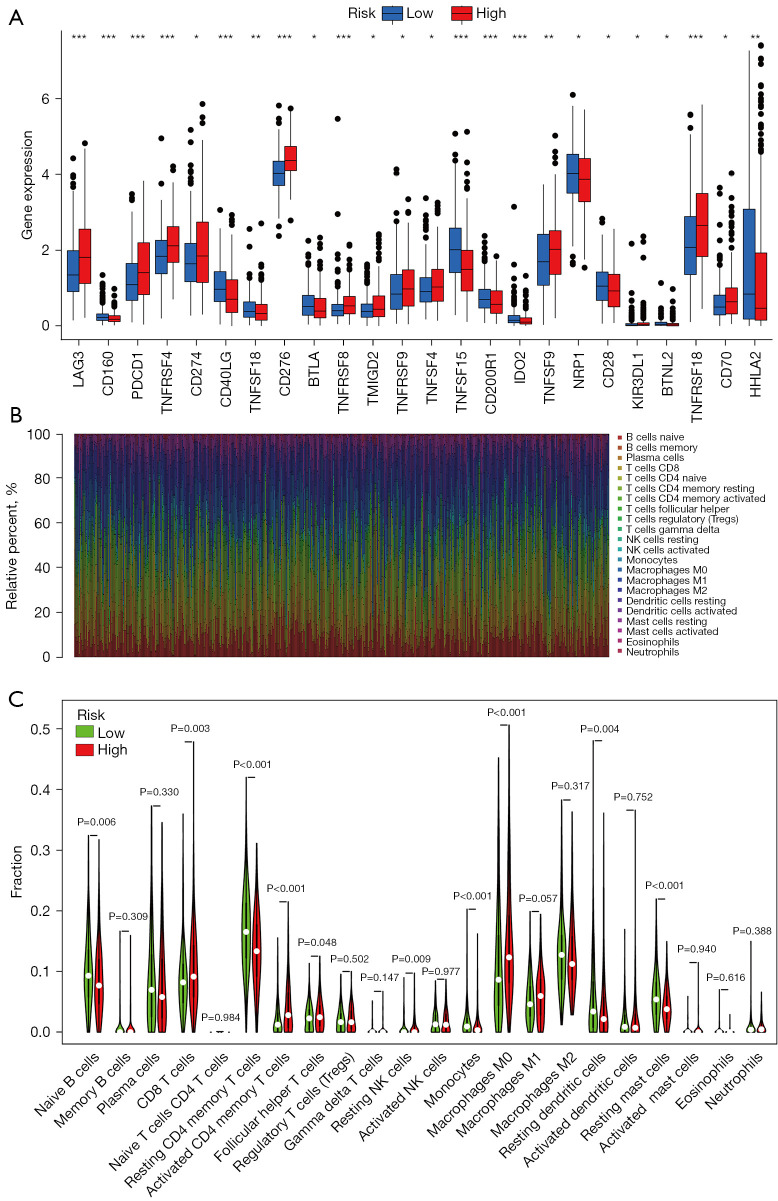
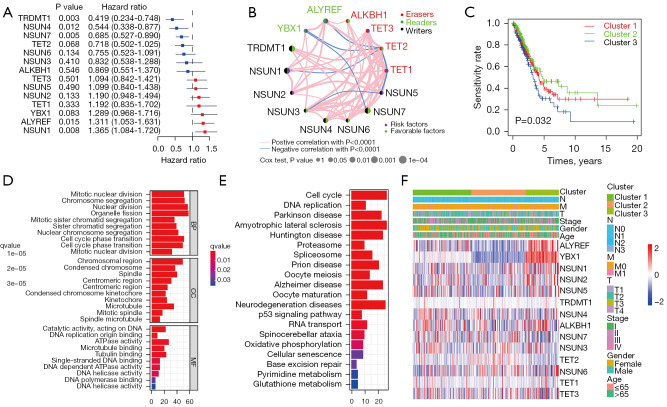
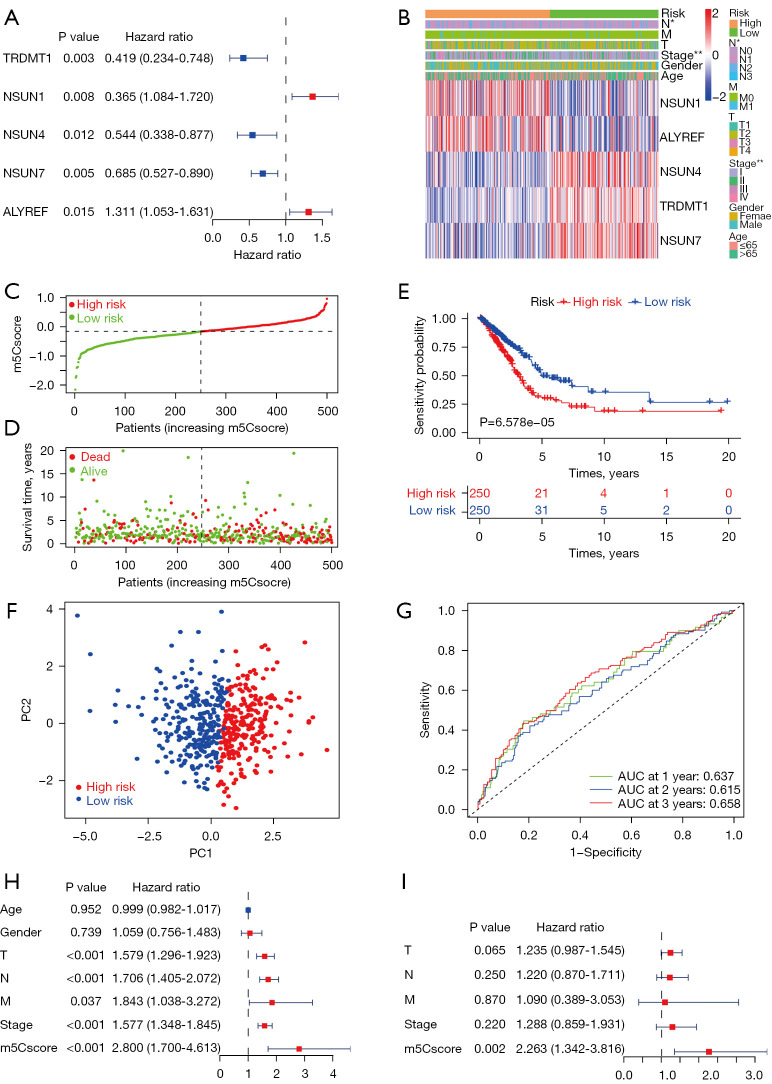
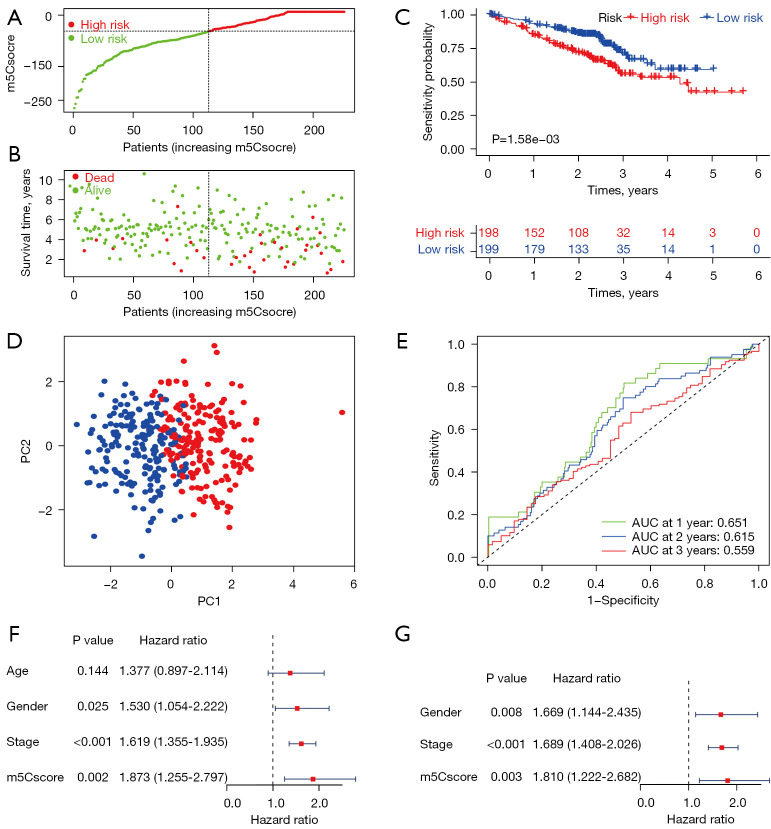
Based on 14 m5C RNA regulators, we evaluated the m5C RNA modification patterns in patients with LUAD (n=594) in The Cancer Genome Atlas (TCGA). Unsupervised clustering analysis was performed to confirm distinct m5C modification patterns. Gene ontology (GO) and Kyoto Encyclopedia of Genes and Genomes (KEGG) enrichment analyses were performed to investigate the biological functions of differentially expressed genes (DEGs) among different m5C RNA modification patterns. An m5C signature (m5Csig) was constructed using least absolute shrinkage and selection operator (LASSO) algorithms. The GSE72094 cohort (n=442) from the Gene Expression Omnibus (GEO) was used to validate m5Csig. A receiver operating characteristic (ROC) model was constructed to evaluate the sensitivity and specificity of m5Csig. Tumor-infiltrating immune cells (TIICs) between the high- and low-risk groups were estimated using the Cell Type Identification By Estimating Relative Subsets Of RNA Transcripts (CIBERSORT) algorithm.
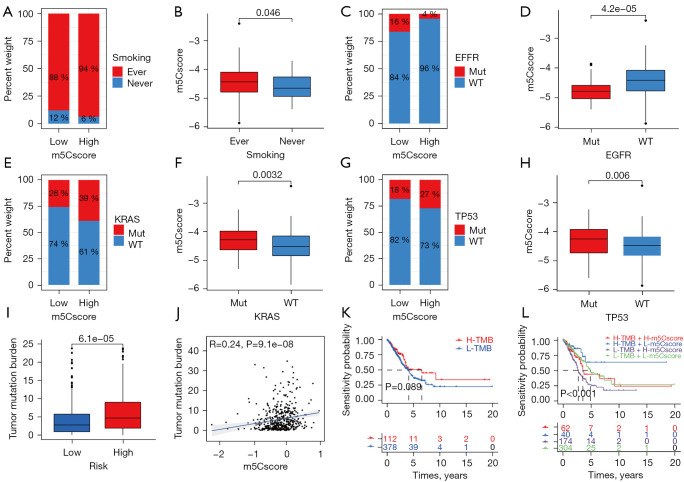
We identified 3 m5C RNA modification clusters. Overall survival (OS) differed among the 3 clusters. The m5Csig, including , , , , and , was constructed to classify patients with LUAD into high- and low-risk groups. The high-risk group, with more immune cell infiltration, had a significantly poorer OS than that the low-risk group, which was associated with better response to immune checkpoint blockade therapy.
The present study revealed that m5C RNA regulators play a significant role in TME regulation in LUAD. The m5Csig can predict the prognosis of patients with LUAD and might provide novel strategies for tumor immunotherapy.
越来越多的证据表明,5-甲基胞嘧啶(m5C)RNA甲基化在肿瘤发生中起重要作用。然而,m5C调节因子在肺腺癌(LUAD)的预后、肿瘤微环境(TME)和免疫治疗反应中的作用尚未得到充分分析。
基于14种m5C RNA调节因子,我们评估了癌症基因组图谱(TCGA)中LUAD患者(n = 594)的m5C RNA修饰模式。进行无监督聚类分析以确认不同的m5C修饰模式。进行基因本体(GO)和京都基因与基因组百科全书(KEGG)富集分析,以研究不同m5C RNA修饰模式之间差异表达基因(DEG)的生物学功能。使用最小绝对收缩和选择算子(LASSO)算法构建m5C特征(m5Csig)。来自基因表达综合数据库(GEO)的GSE72094队列(n = 442)用于验证m5Csig。构建受试者工作特征(ROC)模型以评估m5Csig的敏感性和特异性。使用通过估计RNA转录本相对子集进行细胞类型鉴定(CIBERSORT)算法估计高风险组和低风险组之间的肿瘤浸润免疫细胞(TIIC)。
我们鉴定出3种m5C RNA修饰簇。3个簇之间的总生存期(OS)有所不同。构建了包括 、 、 、 和 的m5Csig,将LUAD患者分为高风险组和低风险组。高风险组免疫细胞浸润更多,其OS明显低于低风险组,这与对免疫检查点阻断疗法的更好反应相关。
本研究表明,m5C RNA调节因子在LUAD的TME调节中起重要作用。m5Csig可以预测LUAD患者的预后,并可能为肿瘤免疫治疗提供新策略。