Danladi Yohanna, Loh Teck Chwen, Foo Hooi Ling, Akit Henny, Md Tamrin Nur Aida, Naeem Azizi Mohammad
Department of Animal Science, Faculty of Agriculture, Universiti Putra Malaysia (UPM), Serdang 43400, Selangor, Malaysia.
Institute of Tropical Agriculture and Food Security, Universiti Putra Malaysia (UPM), Serdang 43400, Selangor, Malaysia.
Animals (Basel). 2022 Apr 3;12(7):917. doi: 10.3390/ani12070917.
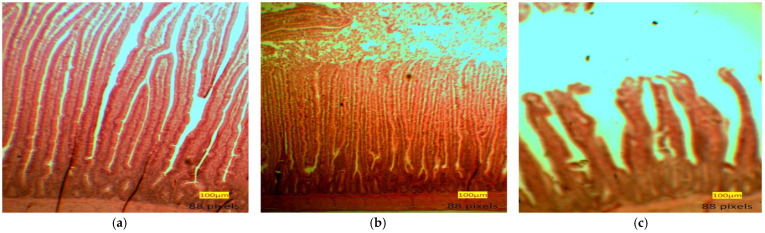
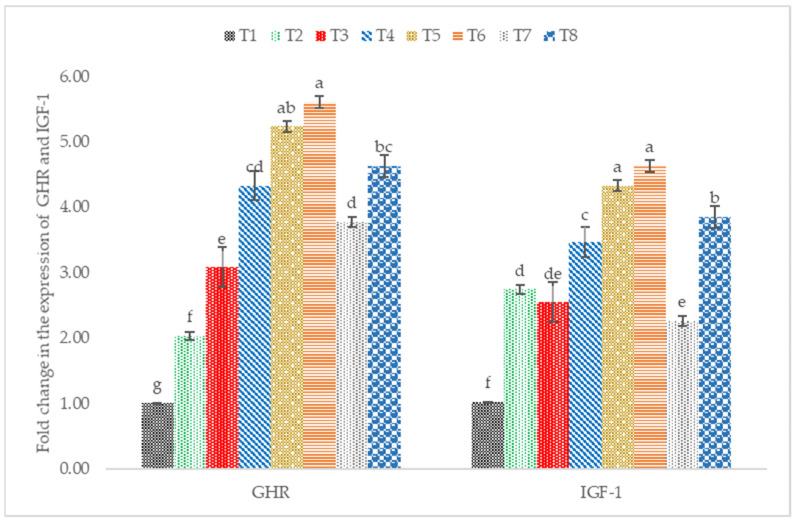
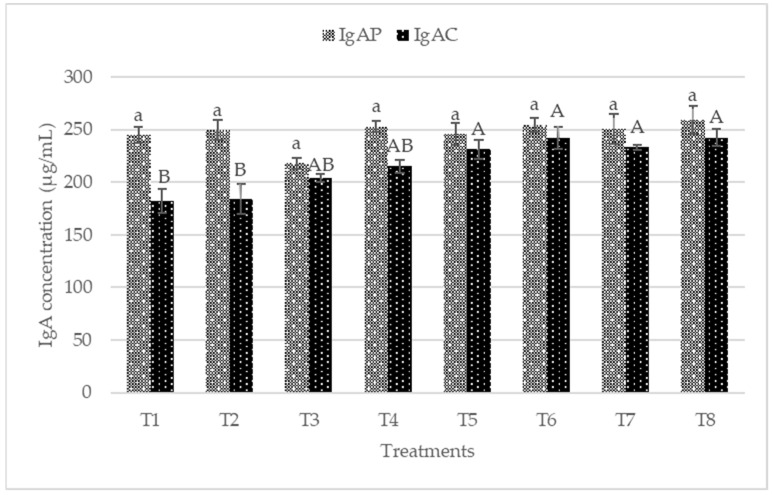
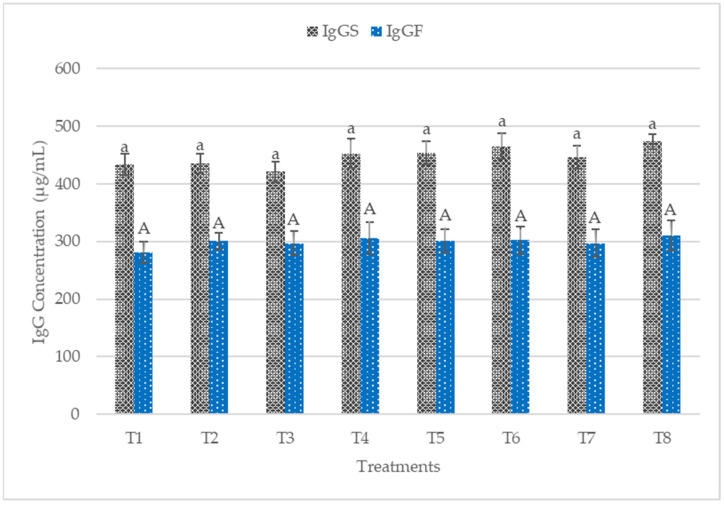
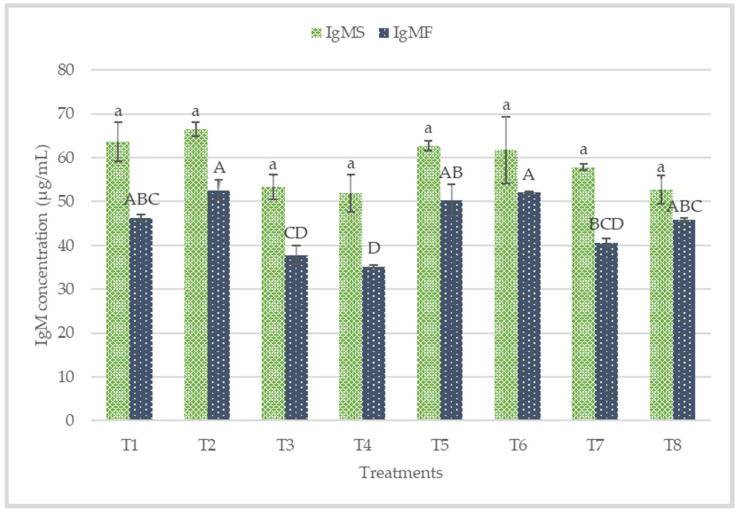
Background: This experiment was designed to investigate how replacing antibiotics with postbiotics and paraprobiotics could affect growth performance, small intestine morphology, immune status, and hepatic growth gene expression in broiler chickens. Methods: The experiment followed a completely randomized design (CRD) in which eight treatments were replicated six times with seven birds per replicate. A total of 336, one-day-old (COBB 500) chicks were fed with the eight treatment diets, which include T1 = negative control (Basal diet), T2 = positive control (Basal diet + 0.01% (w/w) Oxytetracycline), T3 = Basal diet + 0.2% (v/w) postbiotic TL1, T4 = Basal diet + 0.2% (v/w) postbiotic RS5, T5 = Basal diet + 0.2% (v/w) paraprobiotic RG11, T6 = Basal diet + 0.2% (v/w) postbiotic RI11, T7 = Basal diet + 0.2% (v/w) paraprobiotic RG14, T8 = Basal diet + 0.2% (v/w) paraprobiotic RI11, for 35 days in a closed house system. Results: The growth performance indicators (final body weight, cumulative weight gain, and feed conversion ratio) were not significantly (p > 0.05) affected by the dietary treatments. However, feed intake recorded a significant (p < 0.05) change in the starter and finisher phases across the dietary treatments. Paraprobiotic RG14 had significantly (p < 0.05) lower abdominal fat and intestines. Villi heights were significantly (p < 0.05) increased, while the crypt depth decreased significantly due to dietary treatments. The dietary treatments significantly influenced colon mucosa sIgA (p < 0.05). Similarly, plasma immunoglobulin IgM level recorded significant (p < 0.05) changes at the finisher phase. In this current study, the hepatic GHR and IGF-1 expressions were significantly (p < 0.05) increased by postbiotics and paraprobiotics supplementation. Conclusions: Therefore, it was concluded that postbiotics and paraprobiotics differ in their effect on broiler chickens. However, they can replace antibiotics without compromising the growth performance, carcass yield, and immune status of broiler chickens.
本实验旨在研究用后生元和副益生菌替代抗生素对肉鸡生长性能、小肠形态、免疫状态和肝脏生长基因表达的影响。方法:实验采用完全随机设计(CRD),8种处理,每个处理重复6次,每次重复7只鸡。总共336只1日龄(科宝500)雏鸡饲喂8种处理日粮,包括T1 = 阴性对照(基础日粮),T2 = 阳性对照(基础日粮 + 0.01%(w/w)土霉素),T3 = 基础日粮 + 0.2%(v/w)后生元TL1,T4 = 基础日粮 + 0.2%(v/w)后生元RS5,T5 = 基础日粮 + 0.2%(v/w)副益生菌RG11,T6 = 基础日粮 + 0.2%(v/w)后生元RI11,T7 = 基础日粮 + 0.2%(v/w)副益生菌RG14,T8 = 基础日粮 + 0.2%(v/w)副益生菌RI11,在封闭鸡舍系统中饲养35天。结果:日粮处理对生长性能指标(终末体重、累积增重和饲料转化率)无显著(p > 0.05)影响。然而,在整个日粮处理中,雏鸡和育成期的采食量有显著(p < 0.05)变化。副益生菌RG14显著(p < 0.05)降低了腹脂和肠道重量。日粮处理使绒毛高度显著(p < 0.05)增加,隐窝深度显著降低。日粮处理对结肠黏膜分泌型免疫球蛋白A有显著影响(p < 0.05)。同样,血浆免疫球蛋白IgM水平在育成期有显著(p < 0.05)变化。在本研究中,补充后生元和副益生菌显著(p < 0.05)提高了肝脏生长激素受体(GHR)和胰岛素样生长因子-1(IGF-1)的表达。结论:因此,得出结论,后生元和副益生菌对肉鸡的影响不同。然而,它们可以替代抗生素,而不影响肉鸡的生长性能、胴体产量和免疫状态。