Faculty of Social Sciences, University of Ljubljana, SI-1000 Ljubljana, Slovenia.
Computer Systems Department, Jožef Stefan Institute, SI-1000 Ljubljana, Slovenia.
Nutrients. 2022 Mar 23;14(7):1346. doi: 10.3390/nu14071346.
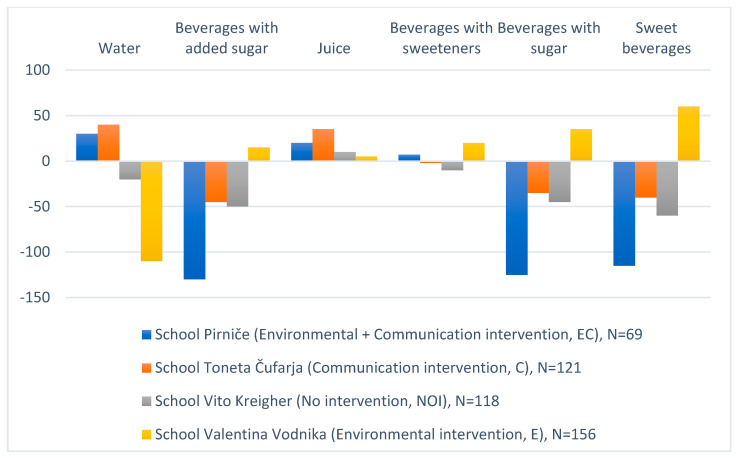
We compared three interventions designed for reducing the consumption of sugar-sweetened beverages (SSBs) aimed at decreasing the risk of overweight and obesity among children. We included three experimental (n = 508) and one control school (n = 164) in Slovenia (672 children; 10-16 years) to evaluate interventions that influence behaviour change via environmental (E), communication (C), or combined (i.e., double) environmental and communication approaches (EC) compared to no intervention (NOI). Data of children from the 'intervention' and 'non-intervention' schools were compared before and after the interventions. The quantity of water consumed (average, mL/day) by children increased in the C and EC schools, while it decreased in the E and NOI schools. Children in the C and EC schools consumed less beverages with sugar (SSBs + fruit juices), and sweet beverages (beverages with: sugar, low-calorie and/or noncaloric sweeteners) but consumed more juices. The awareness about the health risks of SSB consumption improved among children of the 'combined intervention' EC school and was significantly different from the awareness among children of other schools ( = 0.03). A communication intervention in the school environment has more potential to reduce the intake of SSBs than a sole environmental intervention, but optimum results can be obtained when combined with environmental changes.
我们比较了三种旨在降低儿童超重和肥胖风险的减少含糖饮料(SSB)消费的干预措施。我们在斯洛文尼亚纳入了三所实验组(n=508)和一所对照组学校(n=164)(672 名儿童;10-16 岁),以评估通过环境(E)、沟通(C)或环境和沟通相结合(即双重)方法(EC)影响行为改变的干预措施,与无干预(NOI)相比。干预组和非干预组学校的儿童数据在干预前后进行了比较。C 组和 EC 组学校儿童的平均饮水量(mL/天)增加,而 E 组和 NOI 组学校儿童的饮水量减少。C 组和 EC 组学校的儿童饮用的含糖饮料(SSB +果汁)和甜饮料(含糖、低热量和/或无热量甜味剂的饮料)减少,但果汁摄入量增加。EC 组学校的儿童对 SSB 消费健康风险的认识有所提高,与其他学校的儿童相比存在显著差异(=0.03)。在学校环境中进行沟通干预比单纯的环境干预更有潜力减少 SSB 的摄入,但当与环境变化相结合时,可以获得最佳效果。