Lopez Ryan M, White Joshua R, Truong Lisa, Tanguay Robyn L
Sinnhuber Aquatic Research Laboratory, Department of Environmental and Molecular Toxicology, Oregon State University, Corvallis, OR 97333, USA.
Nanomaterials (Basel). 2022 Mar 23;12(7):1050. doi: 10.3390/nano12071050.
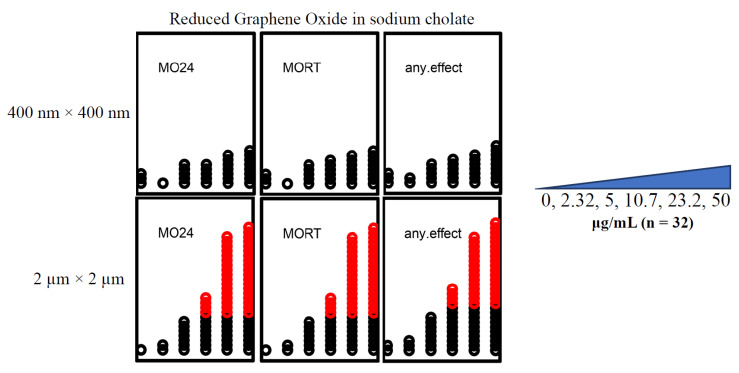
Graphene oxides (GOs) are a popular graphene alternative. The goal of this study was to compare the biocompatibility of a diversity of well-characterized GOs. Our previous work advanced developmental zebrafish as a model to interrogate the interactions and biological responses following exposures to engineered nanomaterials (ENMs). Here, we investigated GO 250 nm × 250 nm (sGO), 400 nm × 400 nm (mGO), and 1 μm × 1 μm (lGO), partially reduced GO (prGO) 400 nm × 400 nm, and reduced GO (rGO) 400 nm × 400 nm and 2 μm × 2 μm, which first underwent extensive characterization under the support of the Nanomaterials Health Implications Research (NHIR) Consortium. GOs were stabilized in water (GOs), while prGO and rGOs were dispersed in sodium cholate. Zebrafish were statically exposed to up to 50 μg/mL of each material from 6 h post-fertilization (hpf) until 120 hpf. Toxicity was dependent on GO properties. mGO was the most toxic material; its effects manifested in the yolk syncytial layer (YSL). Additionally, sodium cholate stabilization significantly increased GO toxicity. The observed effects were size- and oxidation-state-dependent, revealing the importance of identifying the structure-specific toxicity of GOs.
氧化石墨烯(GOs)是一种广受欢迎的石墨烯替代物。本研究的目的是比较多种特性明确的GOs的生物相容性。我们之前的工作将发育中的斑马鱼作为模型,以探究暴露于工程纳米材料(ENMs)后的相互作用和生物学反应。在此,我们研究了尺寸为250 nm×250 nm的GO(sGO)、400 nm×400 nm的GO(mGO)和1μm×1μm的GO(lGO)、尺寸为400 nm×400 nm的部分还原氧化石墨烯(prGO)以及尺寸为400 nm×400 nm和2μm×2μm的还原氧化石墨烯(rGO),这些材料首先在纳米材料健康影响研究(NHIR)联盟的支持下进行了广泛表征。GOs在水中稳定存在(GOs),而prGO和rGOs分散在胆酸钠中。斑马鱼在受精后6小时(hpf)至120 hpf期间静态暴露于每种材料最高50μg/mL的浓度下。毒性取决于GO的性质。mGO是毒性最大的材料;其影响表现在卵黄合胞体层(YSL)。此外,胆酸钠稳定化显著增加了GO的毒性。观察到的影响取决于尺寸和氧化态,揭示了确定GOs结构特异性毒性的重要性。