Department of Computer Science, College of Computer and Information Sciences, King Saud University, Riyadh 11451, Saudi Arabia.
Department of Software Engineering, College of Computer and Information Sciences, King Saud University, Riyadh 11451, Saudi Arabia.
Sensors (Basel). 2022 Apr 6;22(7):2801. doi: 10.3390/s22072801.
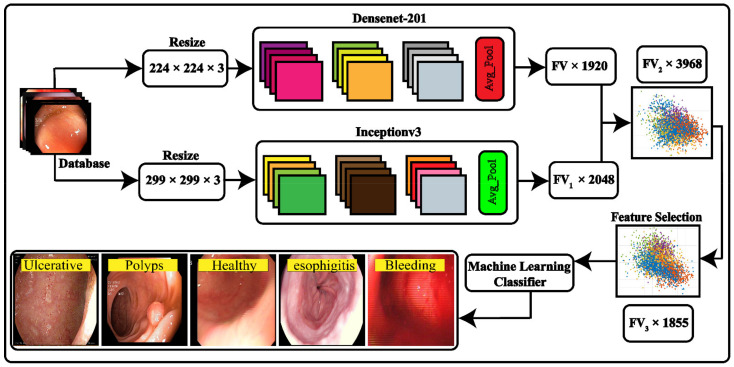
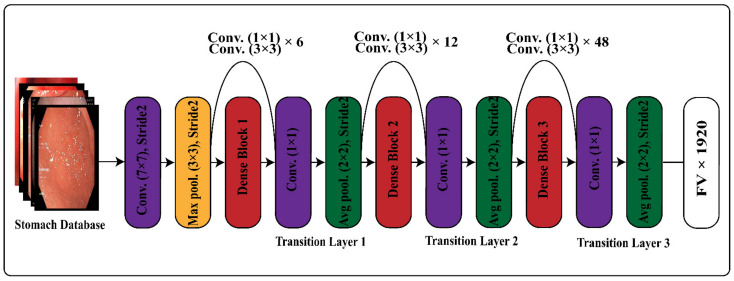
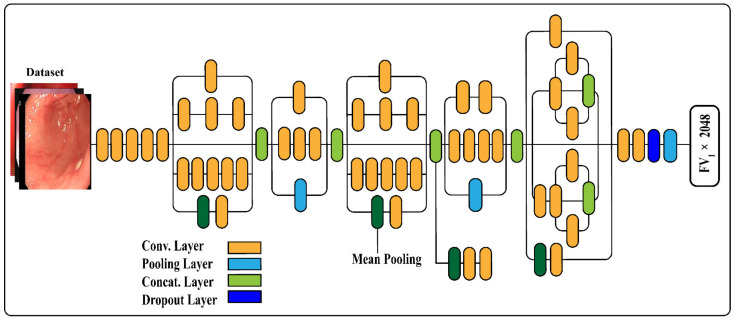
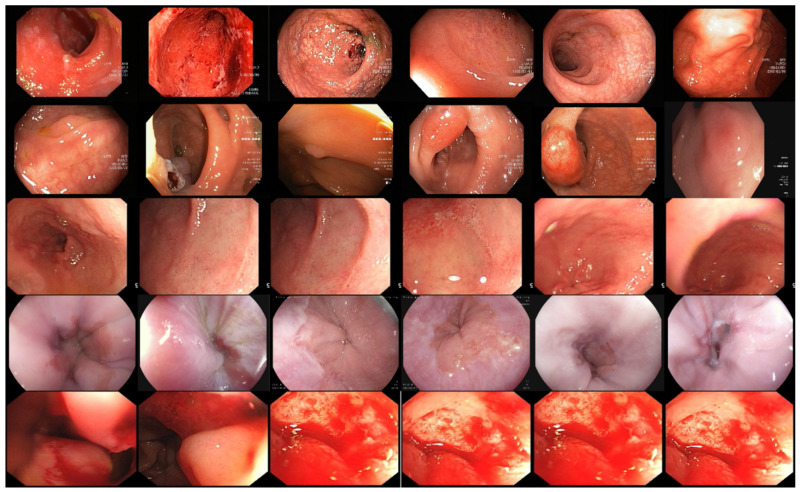
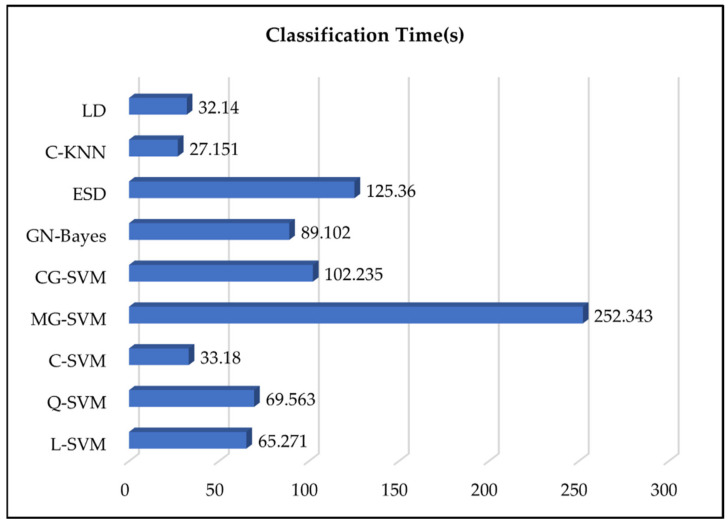
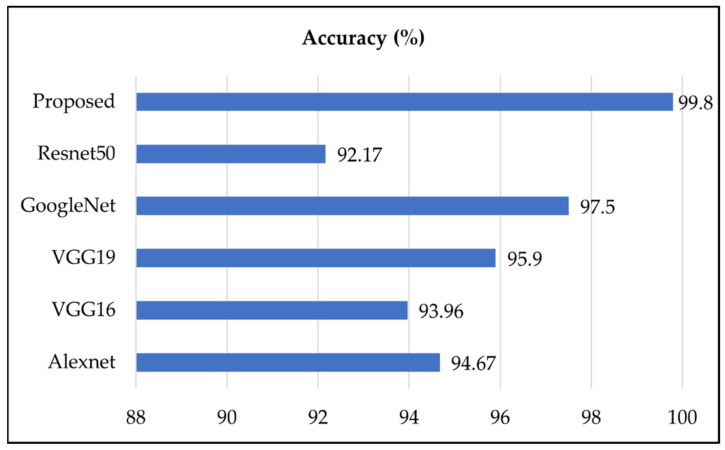
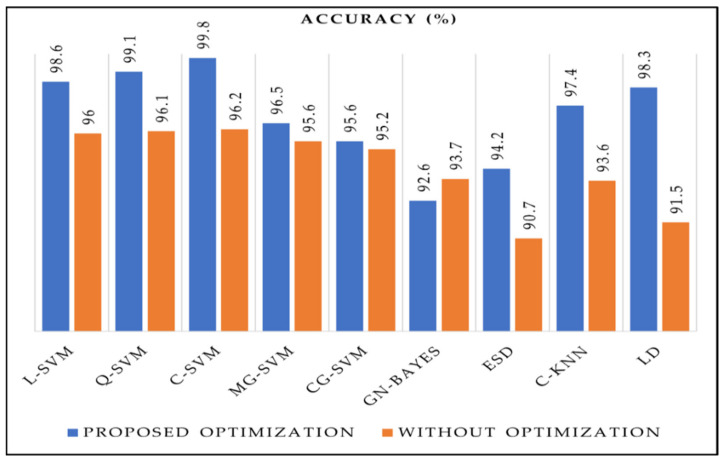
Cancer is the deadliest disease among all the diseases and the main cause of human mortality. Several types of cancer sicken the human body and affect organs. Among all the types of cancer, stomach cancer is the most dangerous disease that spreads rapidly and needs to be diagnosed at an early stage. The early diagnosis of stomach cancer is essential to reduce the mortality rate. The manual diagnosis process is time-consuming, requires many tests, and the availability of an expert doctor. Therefore, automated techniques are required to diagnose stomach infections from endoscopic images. Many computerized techniques have been introduced in the literature but due to a few challenges (i.e., high similarity among the healthy and infected regions, irrelevant features extraction, and so on), there is much room to improve the accuracy and reduce the computational time. In this paper, a deep-learning-based stomach disease classification method employing deep feature extraction, fusion, and optimization using WCE images is proposed. The proposed method comprises several phases: data augmentation performed to increase the dataset images, deep transfer learning adopted for deep features extraction, feature fusion performed on deep extracted features, fused feature matrix optimized with a modified dragonfly optimization method, and final classification of the stomach disease was performed. The features extraction phase employed two pre-trained deep CNN models (Inception v3 and DenseNet-201) performing activation on feature derivation layers. Later, the parallel concatenation was performed on deep-derived features and optimized using the meta-heuristic method named the dragonfly algorithm. The optimized feature matrix was classified by employing machine-learning algorithms and achieved an accuracy of 99.8% on the combined stomach disease dataset. A comparison has been conducted with state-of-the-art techniques and shows improved accuracy.
癌症是所有疾病中最致命的疾病,也是人类死亡的主要原因。有几种类型的癌症会使人体患病并影响器官。在所有类型的癌症中,胃癌是最危险的疾病,它传播迅速,需要早期诊断。早期诊断胃癌对于降低死亡率至关重要。人工诊断过程耗时耗力,需要进行多项检查,并且需要专家医生的参与。因此,需要自动化技术来从内窥镜图像中诊断胃癌。文献中已经介绍了许多计算机技术,但由于存在一些挑战(例如,健康和感染区域之间的高度相似性、无关特征提取等),因此还有很大的改进空间,可以提高准确性并减少计算时间。在本文中,提出了一种基于深度学习的利用 WCE 图像进行深度特征提取、融合和优化的胃病分类方法。该方法包括以下几个阶段:数据增强以增加数据集图像、深度迁移学习用于深度特征提取、深度提取特征上的特征融合、使用改进的蜻蜓优化算法对融合特征矩阵进行优化以及对胃病进行最终分类。特征提取阶段采用了两个预先训练的深度 CNN 模型(Inception v3 和 DenseNet-201)在特征推导层上进行激活。然后,对深度推导特征进行并行串联,并使用元启发式算法蜻蜓算法进行优化。优化后的特征矩阵通过机器学习算法进行分类,在组合胃病数据集上达到了 99.8%的准确率。与最先进的技术进行了比较,结果表明该方法具有更高的准确性。