Mei Shanshan, Ding Jie, Wang Kaili, Ni Zhexin, Yu Jin
Shanghai University of Traditional Chinese Medicine, Shanghai, China.
Department of Gynecology of Traditional Chinese Medicine, Changhai Hospital of PLA Military Medical University, Shanghai, China.
Front Nutr. 2022 Apr 4;9:876620. doi: 10.3389/fnut.2022.876620. eCollection 2022.
To determine the therapeutic effect of a Mediterranean diet (MED) combined with a low-carbohydrate (LC) dietary model in overweight polycystic ovary syndrome (PCOS) patients.
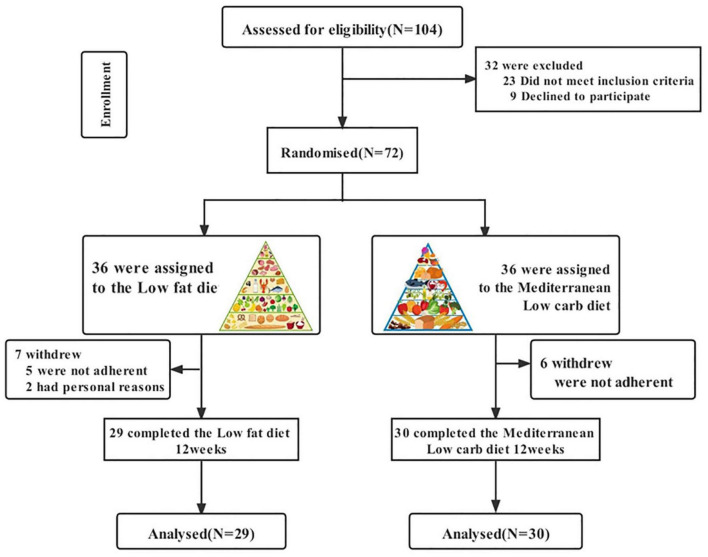
In this 12-week randomized controlled clinical trial, 72 overweight patients with PCOS were randomly assigned to one of two energy-restricted dietary models: the MED/LC diet or the Low fat (LF) diet. After the intervention, the number of the two groups returned to normal menstruation was counted. Body weight, body mass index (BMI), waist circumference, waist-hip ratio (WHR), body fat percentage (BF%), serum fasting insulin(FINS), fasting plasma glucose(FPG), insulin resistance index (HOMA-IR), quantitative insulin sensitivity index (QUIKI), total cholesterol (TC) and high density lipoprotein cholesterol (HDL-C), low density lipoprotein cholesterol (LDL-C), triglyceride (TG), total testosterone (TT), luteinizing hormone (LH), follicle-stimulating hormone (FSH), and prolactin (PRL) were compared between 2 groups before and after intervention.
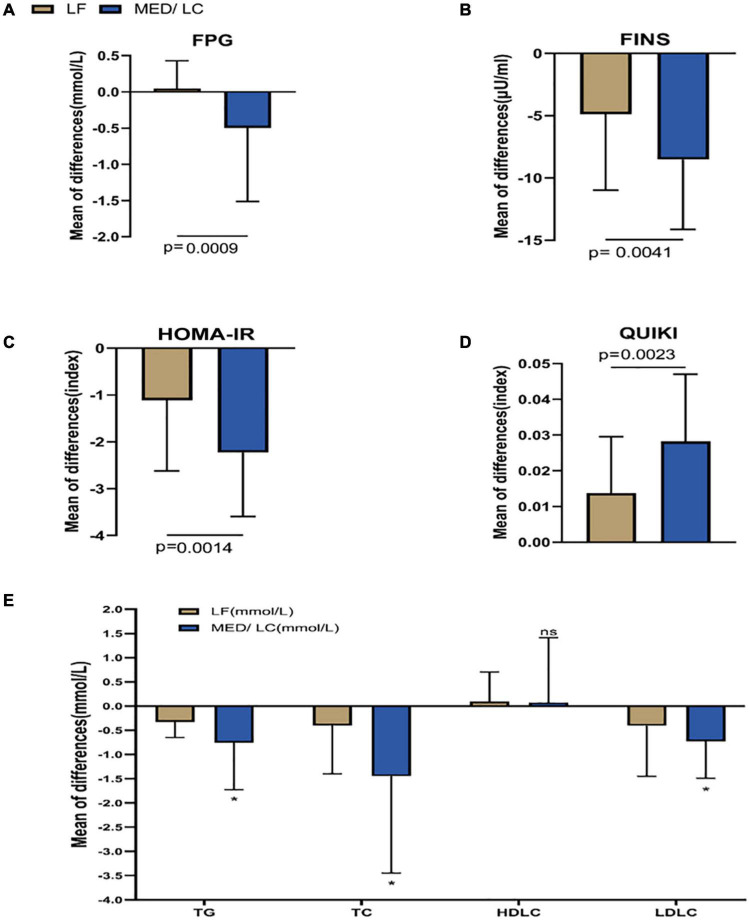
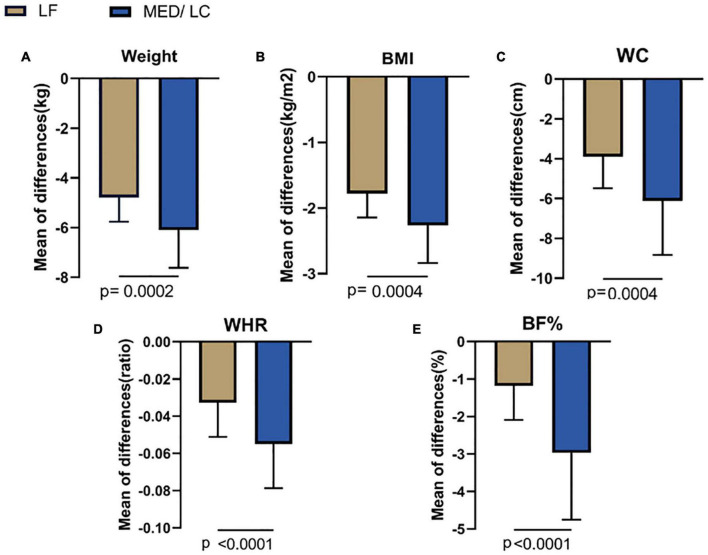
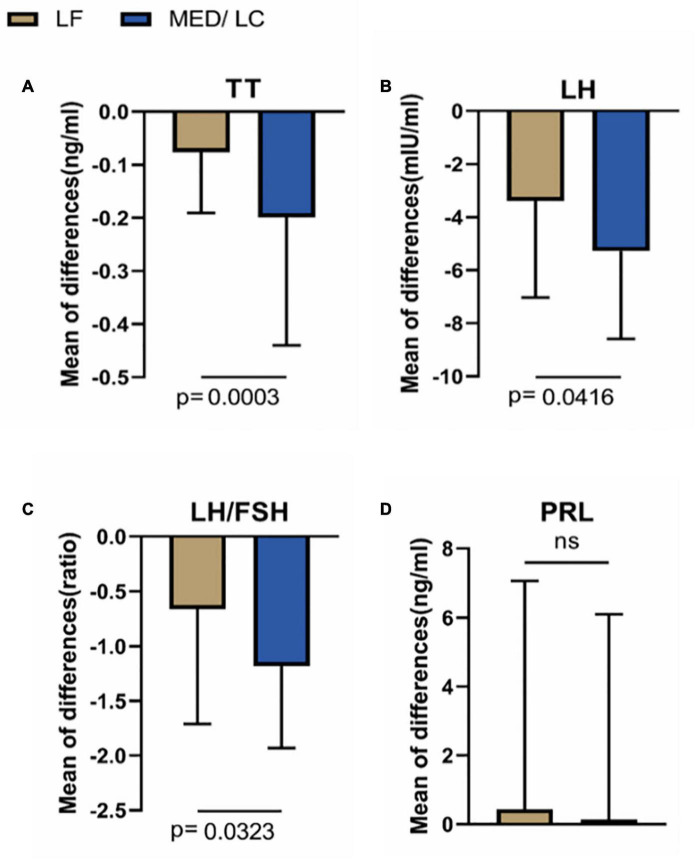
MED/LC group had more significant reduction trend in weight (-6.10 ± 1.52 kg vs -4.79 ± 0.97 kg, < 0.05), BMI (-2.12 ± 0.57 kg/m vs -1.78 ± 0.36 kg/m, < 0.05), WC (-6.12 ± 5.95 cm vs -3.90 ± 1.58 cm, < 0.05), WHR (-0.06 ± 0.02 vs -0.03 ± 0.02, < 0.05), BF% (-2.97% ± 1.78% vs -1.19% ± 0.91%, < 0.05), TT (-0.20 ± 0.24 ng/mL vs 0.08 ± 0.11 ng/Ml, < 0.001), LH (-5.28 ± 3.31 mIU/mL vs -3.39 ± 3.64 mIU/mL, < 0.05), and LH/FSH (-1.18 ± 0.75 vs -0.66 ± 1.05, < 0.05) compared with the LF group. In addition, FPG (0.05 ± 0.38 mmol/mL vs -0.50 ± 1.01 mmol/mL, < 0.001), FINS (-4.88 ± 6.11 μU/mL vs -8.53 ± 5.61 μU/mL, < 0.01), HOMA-IR index (-1.11 ± 1.51 vs -2.23 ± 0.25, < 0.05), and QUIKI index (0.014 ± 0.016 vs 0.028 ± 0.019, < 0.05) decreased significantly in the MED/LC group compared with the LF group. Comparing the changes in lipid parameters between the two groups (LF vs MED/LC), significant differences in TG (-0.33 ± 0.32 mmol vs -0.76 ± 0.97 mmol, < 0.05), TC (-0.40 ± 1.00 mmol vs -1.45 ± 2.00 mmol, < 0.05), and LDL-C (-0.41 ± 1.05 mmol vs -0.73 ± 0.76 mmol, < 0.05) were observed.
The results of this study suggest that the MED/LC diet model is a good treatment for overweight PCOS patients, significantly restoring their menstrual cycle, improving their anthropometric parameters and correcting their disturbed endocrine levels, and its overall effectiveness is significantly better than the LF diet model. Therefore, this study recommends that the MED/LC diet model can be used in the clinical treatment of patients with overweight PCOS.
确定地中海饮食(MED)联合低碳水化合物(LC)饮食模式对超重多囊卵巢综合征(PCOS)患者的治疗效果。
在这项为期12周的随机对照临床试验中,72例超重PCOS患者被随机分配到两种能量限制饮食模式之一:MED/LC饮食或低脂(LF)饮食。干预后,统计两组恢复正常月经的人数。比较两组干预前后的体重、体重指数(BMI)、腰围、腰臀比(WHR)、体脂百分比(BF%)、血清空腹胰岛素(FINS)、空腹血糖(FPG)、胰岛素抵抗指数(HOMA-IR)、定量胰岛素敏感性指数(QUIKI)、总胆固醇(TC)和高密度脂蛋白胆固醇(HDL-C)、低密度脂蛋白胆固醇(LDL-C)、甘油三酯(TG)、总睾酮(TT)、黄体生成素(LH)、卵泡刺激素(FSH)和催乳素(PRL)。
与LF组相比,MED/LC组在体重(-6.10±1.52kg对-4.79±0.97kg,P<0.05)、BMI(-2.12±0.57kg/m对-1.78±0.36kg/m,P<0.05)、腰围(-6.12±5.95cm对-3.90±1.58cm,P<0.05)、WHR(-0.06±0.02对-0.03±0.02,P<0.05)、BF%(-2.97%±1.78%对-1.19%±0.91%,P<0.05)、TT(-0.20±0.24ng/mL对0.08±0.11ng/Ml,P<0.001)、LH(-5.28±3.31mIU/mL对-3.39±3.64mIU/mL)、LH/FSH(-1.18±0.75对-0.66±1.05,P<0.05)方面有更显著的下降趋势。此外,与LF组相比,MED/LC组的FPG(0.05±0.38mmol/mL对-0.50±1.01mmol/mL,P<0.001)、FINS(-4.88±6.11μU/mL对-8.53±5.61μU/mL,P<0.01)、HOMA-IR指数(-1.11±1.51对-2.23±0.25,P<0.05)和QUIKI指数(0.014±0.016对0.028±0.019,P<0.05)显著降低。比较两组(LF对MED/LC)血脂参数的变化,观察到TG(-0.33±0.32mmol对-0.76±0.97mmol,P<0.05)、TC(-0.40±1.00mmol对-1.45±2.00mmol,P<0.05)和LDL-C(-0.41±1.05mmol对-0.73±0.76mmol,P<0.05)有显著差异。
本研究结果表明,MED/LC饮食模式对超重PCOS患者是一种良好的治疗方法,能显著恢复其月经周期,改善其人体测量参数并纠正其紊乱的内分泌水平,其总体效果明显优于LF饮食模式。因此,本研究建议MED/LC饮食模式可用于超重PCOS患者的临床治疗。