Abdellatif Ahmed A H, Alhathloul Sultan S, Aljohani Abdullah S M, Maswadeh Hamzah, Abdallah Emad M, Hamid Musa Khalid, El Hamd Mohamed A
Department of Pharmaceutics, College of Pharmacy, Qassim University, Buraydah 51452, Saudi Arabia.
Department of Pharmaceutics and Pharmaceutical Technology, Faculty of Pharmacy, Al-Azhar University, Assiut 71524, Egypt.
Bioinorg Chem Appl. 2022 Apr 11;2022:2432758. doi: 10.1155/2022/2432758. eCollection 2022.
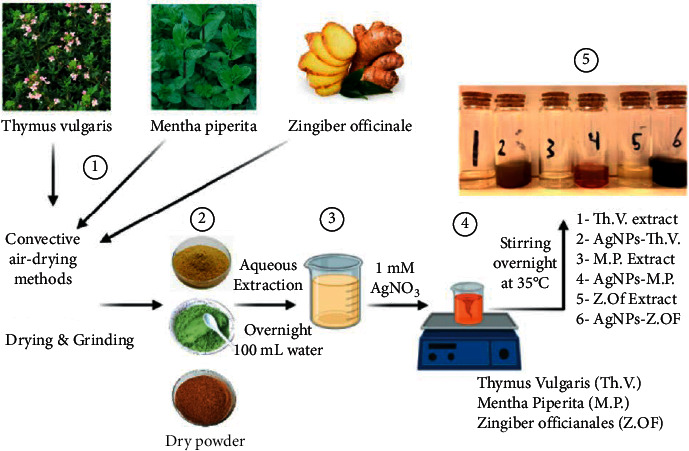
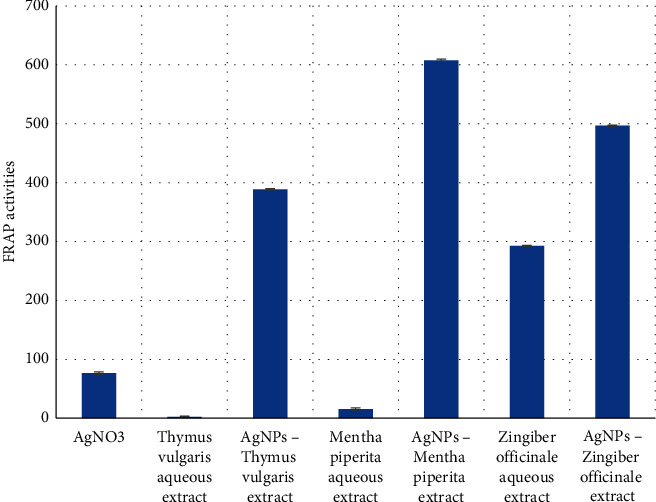
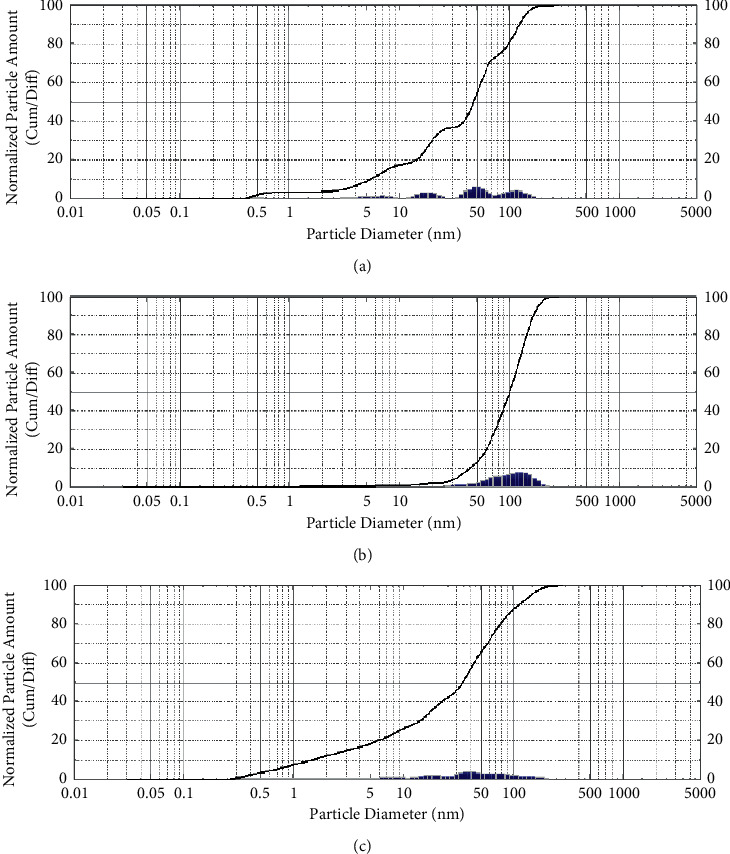
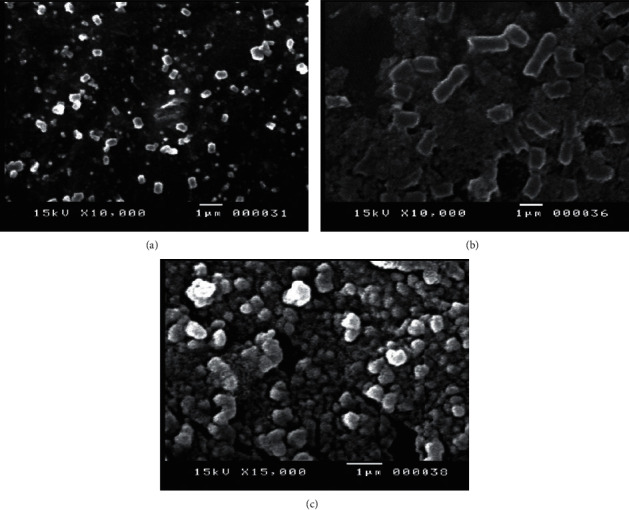
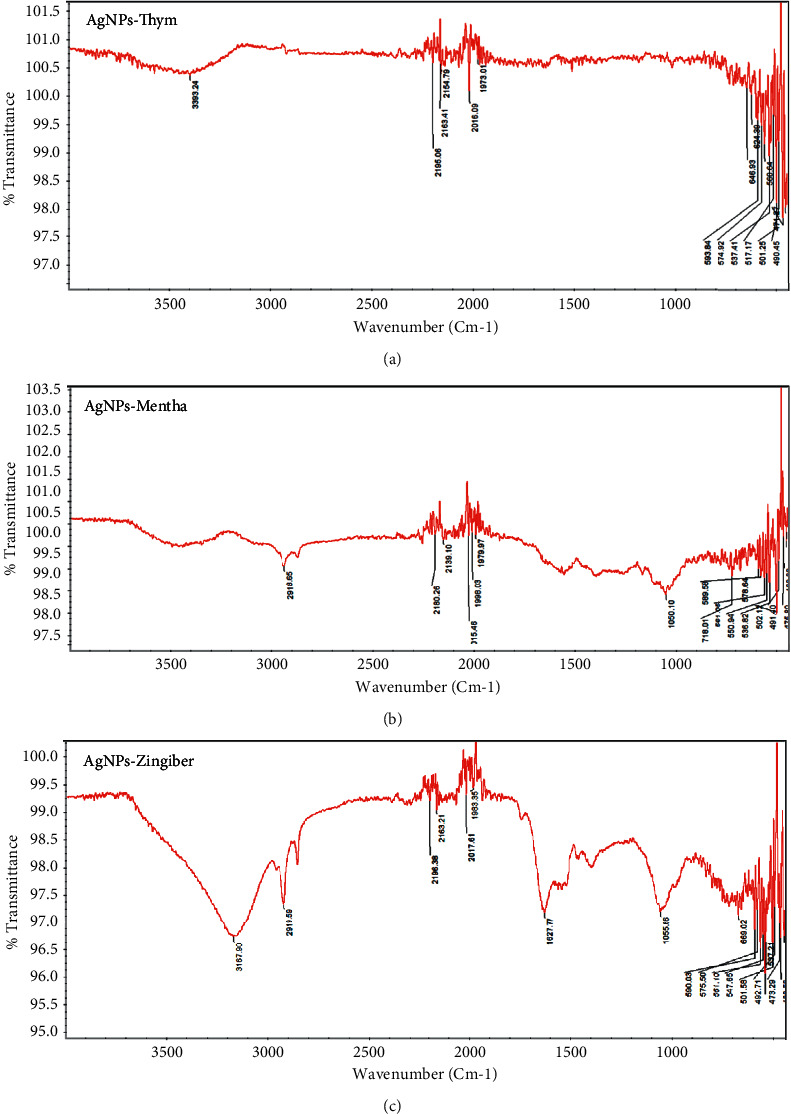
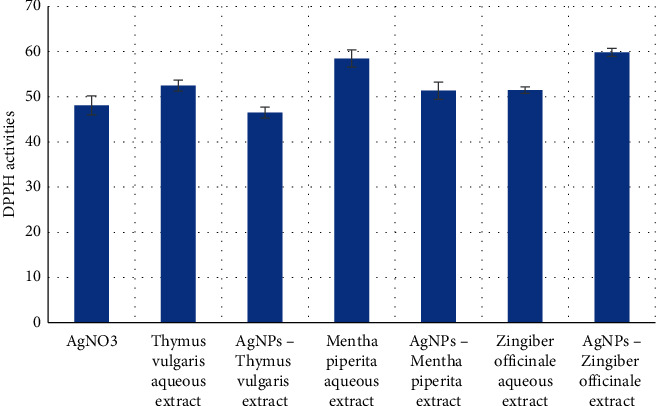
There is a need to synthesize eco-friendly nanoparticles with more effective and potent antibacterial activities. A green and cost-effective method for the synthesis of silver nanoparticles (AgNPs) using , , and extracts was developed. The analytical instrumentation, namely, UV/Vis, absorption spectroscopy, FTIR, and scanning electron microscopy (SEM), was used to determine the developed AgNPs, confirming the functional groups involved in their reduction. Acidic molybdate, DPPH, and FRAP regents were reacted with AgNPs extract to evaluate their antioxidant, scavenging, and oxidative activities. The agar well diffusion method was used to determine the antibacterial potential of AgNPs extracts using clinical isolates. The developed AgNPs showed peaks at 25 cum\Diff, 50 cum\Diff, and 75 cum\Diff, respectively, of 16.59 ± 0.78, 45.94 ± 1.07, and 81.04 ± 0.98 nm, for , , and . SEM revealed uniform prepared and encapsulated AgNPs by plant extracts matrix. The FTIR shows the involvement of amide (-CO-NH), carbonyl (-CO), and hydroxyl (-OH), which resulted in the reduction of AgNPs. The AgNPs extract showed significantly higher TAA, DPPH, and FRAP values than free AgNPs and plant extract ( < 0.05). Antibacterial of AgNPs extracts revealed various degrees of inhibition zones against , , and . The developed AgNPs extract showed acceptable antioxidant activities and noticeable antibacterial potential. The prepared green synthesized AgNPs showed a promising antibacterial activity against four multidrug-resistant clinical isolates, , , and . Further, fractionated extracts other than crude extracts will be utilized in the preparation of AgNPs to get more efficient antibacterial activities for future work.
需要合成具有更有效和强大抗菌活性的环保型纳米颗粒。开发了一种使用[植物名称1]、[植物名称2]和[植物名称3]提取物合成银纳米颗粒(AgNPs)的绿色且经济高效的方法。使用分析仪器,即紫外可见吸收光谱、傅里叶变换红外光谱(FTIR)和扫描电子显微镜(SEM)来测定所制备的AgNPs,确认参与其还原的官能团。酸性钼酸盐、二苯基苦味酰基自由基(DPPH)和铁离子还原抗氧化能力(FRAP)试剂与AgNPs提取物反应,以评估其抗氧化、清除和氧化活性。采用琼脂扩散法使用临床分离株测定AgNPs提取物的抗菌潜力。所制备的AgNPs在[植物名称1]、[植物名称2]和[植物名称3]的25 cum\Diff、50 cum\Diff和75 cum\Diff处分别显示出峰值,粒径分别为16.59 ± 0.78、45.94 ± 1.07和81.04 ± 0.98 nm。SEM显示植物提取物基质均匀制备并包裹了AgNPs。FTIR表明酰胺基(-CO-NH)、羰基(-CO)和羟基(-OH)参与其中,导致了AgNPs的还原。AgNPs提取物的总抗氧化能力(TAA)、DPPH和FRAP值显著高于游离AgNPs和植物提取物(P < 0.05)。AgNPs提取物的抗菌活性显示出对[细菌名称1]、[细菌名称2]和[细菌名称3]的不同程度的抑菌圈。所制备的AgNPs提取物显示出可接受的抗氧化活性和显著的抗菌潜力。所制备的绿色合成AgNPs对四种多重耐药临床分离株[细菌名称1]、[细菌名称2]、[细菌名称3]和[细菌名称4]显示出有前景的抗菌活性。此外,除了粗提物之外,分级提取物将用于制备AgNPs,以便在未来的工作中获得更高效的抗菌活性。