Beale Sarah, Patel Parth, Rodger Alison, Braithwaite Isobel, Byrne Thomas, Fong Wing Lam Erica, Fragaszy Ellen, Geismar Cyril, Kovar Jana, Navaratnam Annalan, Nguyen Vincent, Shrotri Madhumita, Aryee Anna, Aldridge Robert, Hayward Andrew
UCL Institute of Epidemiology and Health Care, University College London, London, UK
UCL Institute of Health Informatics, University College London, London, UK.
Occup Environ Med. 2022 Apr 21;79(11):729-35. doi: 10.1136/oemed-2021-107920.
Risk of SARS-CoV-2 infection varies across occupations; however, investigation into factors underlying differential risk is limited. We aimed to estimate the total effect of occupation on SARS-CoV-2 serological status, whether this is mediated by workplace close contact, and how exposure to poorly ventilated workplaces varied across occupations.
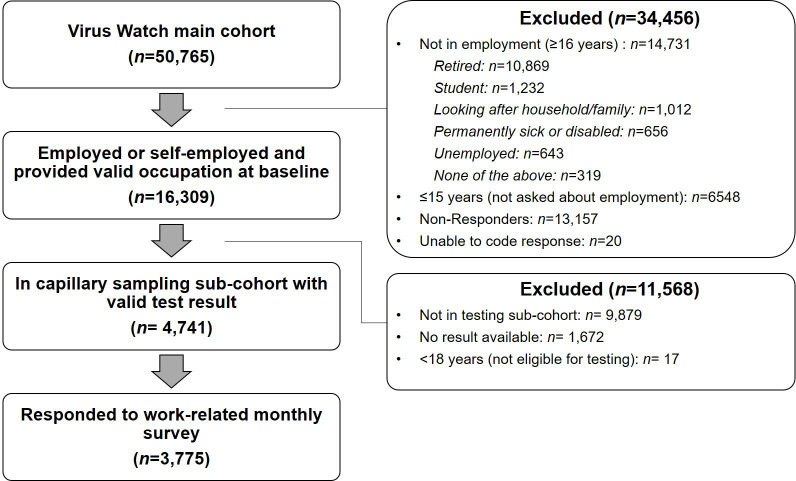
We used data from a subcohort (n=3775) of adults in the UK-based Virus Watch cohort study who were tested for SARS-CoV-2 anti-nucleocapsid antibodies (indicating natural infection). We used logistic decomposition to investigate the relationship between occupation, contact and seropositivity, and logistic regression to investigate exposure to poorly ventilated workplaces.
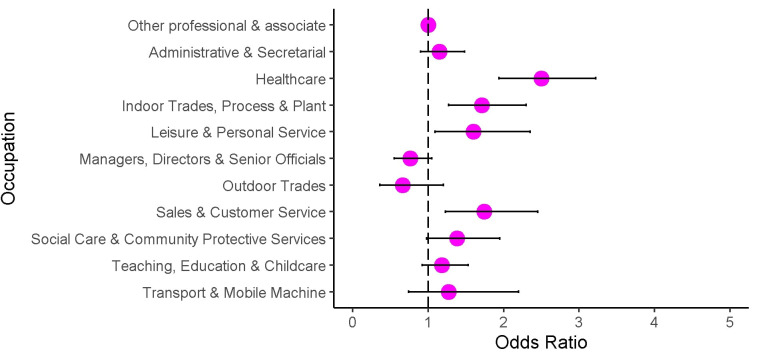
Seropositivity was 17.1% among workers with daily close contact vs 10.0% for those with no work-related close contact. Compared with other professional occupations, healthcare, indoor trade/process/plant, leisure/personal service, and transport/mobile machine workers had elevated adjusted total odds of seropositivity (1.80 (1.03 to 3.14) - 2.46 (1.82 to 3.33)). Work-related contact accounted for a variable part of increased odds across occupations (1.04 (1.01 to 1.08) - 1.23 (1.09 to 1.40)). Occupations with raised odds of infection after accounting for work-related contact also had greater exposure to poorly ventilated workplaces.
Work-related close contact appears to contribute to occupational variation in seropositivity. Reducing contact in workplaces is an important COVID-19 control measure.
严重急性呼吸综合征冠状病毒2(SARS-CoV-2)感染风险因职业而异;然而,对不同风险背后因素的调查有限。我们旨在估计职业对SARS-CoV-2血清学状态的总体影响,这是否由工作场所的密切接触介导,以及不同职业在通风不良工作场所的暴露情况如何。
我们使用了英国病毒观察队列研究中一个亚队列(n = 3775)的成年人数据,这些人接受了SARS-CoV-2抗核衣壳抗体检测(表明自然感染)。我们使用逻辑分解来研究职业、接触和血清阳性之间的关系,并使用逻辑回归来研究在通风不良工作场所的暴露情况。
每日有密切接触的工人血清阳性率为17.1%,而无工作相关密切接触的工人为10.0%。与其他专业职业相比,医疗保健、室内贸易/加工/工厂、休闲/个人服务以及运输/移动机械工人的血清阳性调整后总比值升高(1.80(1.03至3.14)-2.46(1.82至3.33))。工作相关接触在不同职业的比值增加中占可变部分(1.04(1.01至1.08)-1.23(1.09至1.40))。在考虑工作相关接触后感染几率增加的职业,在通风不良工作场所的暴露也更多。
工作相关密切接触似乎导致了血清阳性的职业差异。减少工作场所的接触是一项重要的新冠疫情防控措施。