Kim Haeran, Kim Boyoung
Department of Nursing, College of Medicine, Chosun University, Gwangju 61452, Korea.
College of Nursing, Chonnam National University, Gwangju 61469, Korea.
Healthcare (Basel). 2022 Mar 30;10(4):644. doi: 10.3390/healthcare10040644.
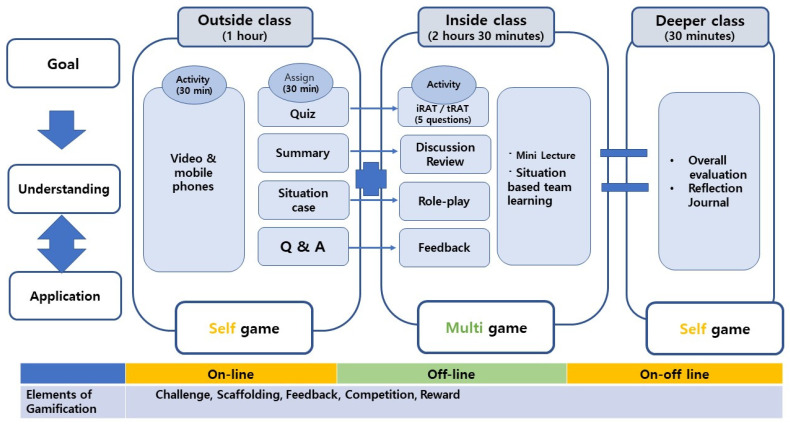
In psychiatric nursing courses, students learn about patients with mental illnesses or types of distress that may not be common in their daily lives. Consequently, some students experience difficulties interacting with patients. Therefore, new learning models that depart from the traditional one-way learning methods, engage students in clinical settings, and increase their motivation are needed. Situation-based flipped learning combined with gamification can improve nursing students' care for patients with mental health problems. A total of 102 nursing students from a university in G Metropolitan City, Korea were randomly and equally divided into experimental and control groups. The experimental group participated in an eight-week psychiatric nursing program that included situation-based flipped learning combined with gamification. The control group participated in the traditional team-based lectures. After the program, both groups' learning attitudes, problem-solving abilities, and empathetic responses were measured. The experimental group showed improved problem-solving (F = 4.012, = 0.048) and empathetic abilities (t = -2.014, 0.047) after participating in situation-based flipped learning combined with gamification. The program was effective in helping students empathize with their patients and improve their problem-solving skills. Future curricula should be developed to incorporate flipped learning to nurture the practical competencies required for medical professionals, particularly in psychiatric nursing education.
在精神科护理课程中,学生学习有关精神疾病患者或他们日常生活中可能不常见的痛苦类型的知识。因此,一些学生在与患者互动时会遇到困难。所以,需要有别于传统单向学习方法、让学生参与临床环境并提高其积极性的新学习模式。基于情境的翻转学习与游戏化相结合可以改善护理专业学生对有心理健康问题患者的护理。韩国G大城市一所大学的102名护理专业学生被随机且平均分为实验组和对照组。实验组参加了一个为期八周的精神科护理项目,该项目包括基于情境的翻转学习与游戏化相结合。对照组参加传统的团队授课。项目结束后,测量了两组学生的学习态度、解决问题的能力和共情反应。实验组在参加基于情境的翻转学习与游戏化相结合的项目后,解决问题的能力(F = 4.012,P = 0.048)和共情能力(t = -2.014,P = 0.047)有所提高。该项目有效地帮助学生对患者产生共情并提高他们解决问题的技能。未来的课程应进行开发,纳入翻转学习,以培养医学专业人员所需的实践能力,特别是在精神科护理教育方面。