Park Hyung-Joon, Hong Hyunsik, Thangam Ramar, Song Min-Gyo, Kim Ju-Eun, Jo Eun-Hae, Jang Yun-Jeong, Choi Won-Hyoung, Lee Min-Young, Kang Heemin, Lee Kyu-Back
Department of Interdisciplinary Biomicrosystem Technology, College of Engineering, Korea University, Seoul 02841, Korea.
Department of Materials Science and Engineering, College of Engineering, Korea University, Seoul 02841, Korea.
Nanomaterials (Basel). 2022 Apr 17;12(8):1377. doi: 10.3390/nano12081377.
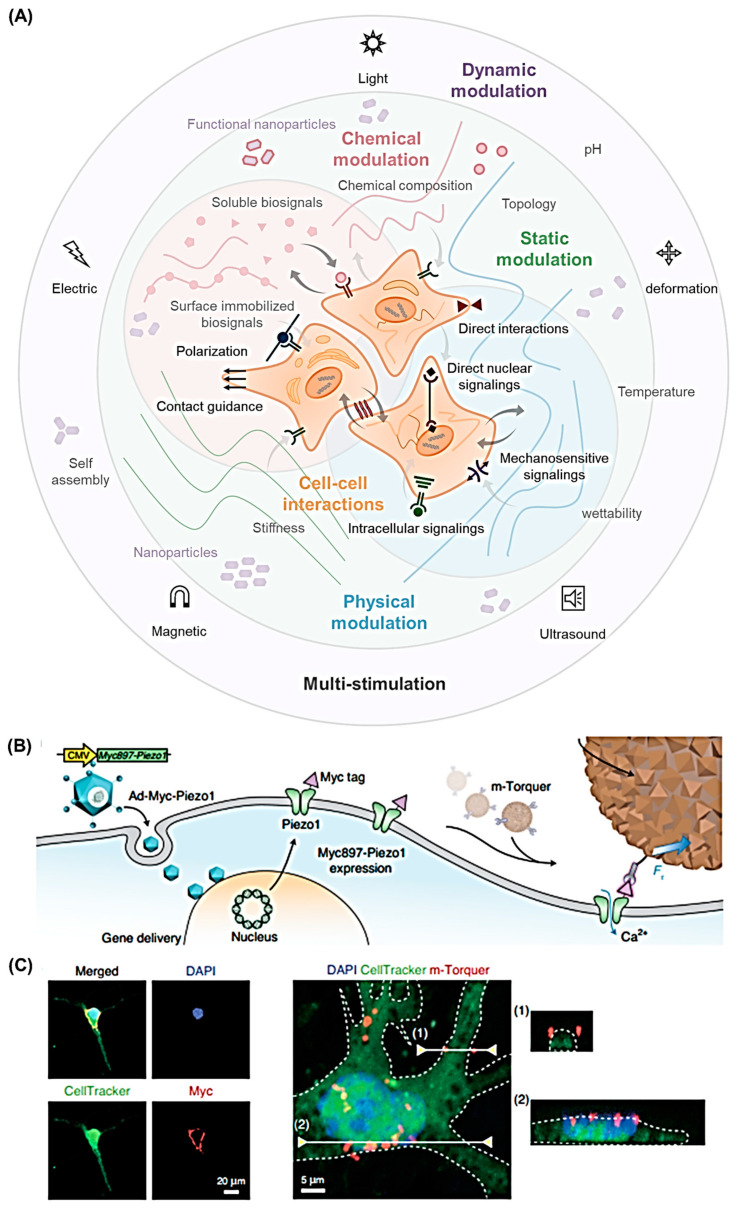
In the biological microenvironment, cells are surrounded by an extracellular matrix (ECM), with which they dynamically interact during various biological processes. Specifically, the physical and chemical properties of the ECM work cooperatively to influence the behavior and fate of cells directly and indirectly, which invokes various physiological responses in the body. Hence, efficient strategies to modulate cellular responses for a specific purpose have become important for various scientific fields such as biology, pharmacy, and medicine. Among many approaches, the utilization of biomaterials has been studied the most because they can be meticulously engineered to mimic cellular modulatory behavior. For such careful engineering, studies on physical modulation (e.g., ECM topography, stiffness, and wettability) and chemical manipulation (e.g., composition and soluble and surface biosignals) have been actively conducted. At present, the scope of research is being shifted from static (considering only the initial environment and the effects of each element) to biomimetic dynamic (including the concepts of time and gradient) modulation in both physical and chemical manipulations. This review provides an overall perspective on how the static and dynamic biomaterials are actively engineered to modulate targeted cellular responses while highlighting the importance and advance from static modulation to biomimetic dynamic modulation for biomedical applications.
在生物微环境中,细胞被细胞外基质(ECM)所包围,在各种生物过程中,细胞与细胞外基质动态相互作用。具体而言,细胞外基质的物理和化学性质协同作用,直接或间接地影响细胞的行为和命运,进而引发体内各种生理反应。因此,为实现特定目的而调控细胞反应的有效策略,对于生物学、药学和医学等多个科学领域而言变得至关重要。在众多方法中,生物材料的应用研究最为广泛,因为它们可以经过精心设计来模拟细胞调节行为。为了进行这种精细的设计,人们积极开展了关于物理调节(如细胞外基质的拓扑结构、硬度和润湿性)和化学调控(如组成以及可溶性和表面生物信号)的研究。目前,研究范围正在从静态(仅考虑初始环境和各元素的影响)转向物理和化学操作中的仿生动态(包括时间和梯度概念)调节。本综述全面阐述了如何积极设计静态和动态生物材料以调节靶向细胞反应,同时强调了从静态调节到生物医学应用中的仿生动态调节的重要性和进展。