Department of Neurosurgery, The First Affiliated Hospital of Sun Yat-sen University, Guangzhou, China.
Education Department, The First Affiliated Hospital of Sun Yat-sen University, Guangzhou, China.
Front Public Health. 2022 Apr 7;10:876298. doi: 10.3389/fpubh.2022.876298. eCollection 2022.
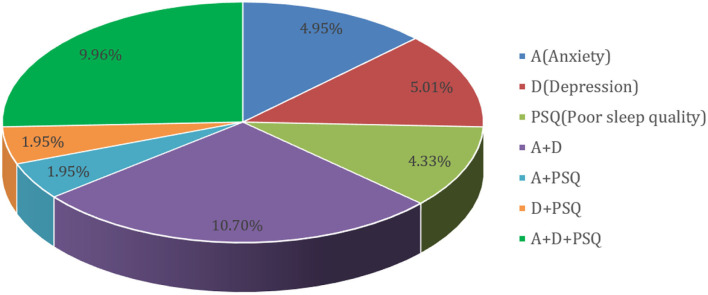
Recently, a COVID-19 virus variant spread rapidly in Guangzhou, China, causing public panic. This study aimed to understand the psychological and sleep-related consequences of the secondary outbreak of the pandemic on medical students. In this cross-sectional survey-based study, participants anonymously completed structured questionnaires online from June 8-22, 2021. We collected participants' demographic and general information. Anxiety, depression, and sleep quality were measured using the Zung Self-Rating Anxiety Scale (SAS), Self-Rating Depression Scale (SDS), and Pittsburgh Sleep Quality Index (PSQI), respectively. Protective factors were assessed using the Coping Style Questionnaire (CSQ). Uni- and multivariate logistic regression analyses were performed examining factors associated with mental health and sleep quality problems. During the second wave of the pandemic in local outbreak areas in Guangzhou, China, more than one-third of medical students' mental health and sleep quality were affected. The prevalence of anxiety, depression, and poor sleep quality were 27.54%, 27.58%, and 18.19%, respectively. Students belonging to the Class of 2019, aged over 29 years, those with siblings, and those whose hometowns were in other provinces were more prone to the three health problems. Factors associated with an increased risk of mental health problems were vaccination status (adjusted odds ratio 1.603-1.839) and diet status (adjusted odds ratio 1.62-1.929). Positive coping styles served as protective factors ( < 0.05). We discovered that completed vaccination status, good diet, and positive coping styles were related to good mental health and sleep quality.
最近,一种 COVID-19 病毒变种在中国广州迅速传播,引起了公众恐慌。本研究旨在了解疫情二次爆发对医学生的心理和睡眠相关影响。在这项基于横断面调查的研究中,参与者于 2021 年 6 月 8 日至 22 日匿名在线完成了结构化问卷。我们收集了参与者的人口统计学和一般信息。焦虑、抑郁和睡眠质量分别使用 Zung 自评焦虑量表 (SAS)、自评抑郁量表 (SDS) 和匹兹堡睡眠质量指数 (PSQI) 进行测量。使用应对方式问卷 (CSQ) 评估保护因素。采用单因素和多因素逻辑回归分析,研究与心理健康和睡眠质量问题相关的因素。在中国广州局部爆发地区疫情二次爆发期间,超过三分之一的医学生的心理健康和睡眠质量受到影响。焦虑、抑郁和睡眠质量差的发生率分别为 27.54%、27.58%和 18.19%。2019 级学生、年龄在 29 岁以上、有兄弟姐妹和家乡在其他省份的学生更容易出现这三种健康问题。与心理健康问题风险增加相关的因素是疫苗接种状况 (调整后的优势比 1.603-1.839) 和饮食状况 (调整后的优势比 1.62-1.929)。积极的应对方式是保护因素 (<0.05)。我们发现,完全接种疫苗、良好的饮食和积极的应对方式与良好的心理健康和睡眠质量有关。