Wang Lijia, Chen Liping, Wang Xianyuan, Liu Kaiyuan, Li Ting, Yu Yue, Han Jian, Xing Shuai, Xu Jiaxin, Tian Dean, Seidler Ursula, Xiao Fang
Department of Gastroenterology, Tongji Hospital, Tongji Medical College, Huazhong University of Science and Technology, Wuhan, China.
Wuhan United Imaging Healthcare Surgical Technology Co., Ltd., Wuhan, China.
Front Med (Lausanne). 2022 Apr 8;9:789862. doi: 10.3389/fmed.2022.789862. eCollection 2022.
Evaluation of the endoscopic features of Crohn's disease (CD) and ulcerative colitis (UC) is the key diagnostic approach in distinguishing these two diseases. However, making diagnostic differentiation of endoscopic images requires precise interpretation by experienced clinicians, which remains a challenge to date. Therefore, this study aimed to establish a convolutional neural network (CNN)-based model to facilitate the diagnostic classification among CD, UC, and healthy controls based on colonoscopy images.
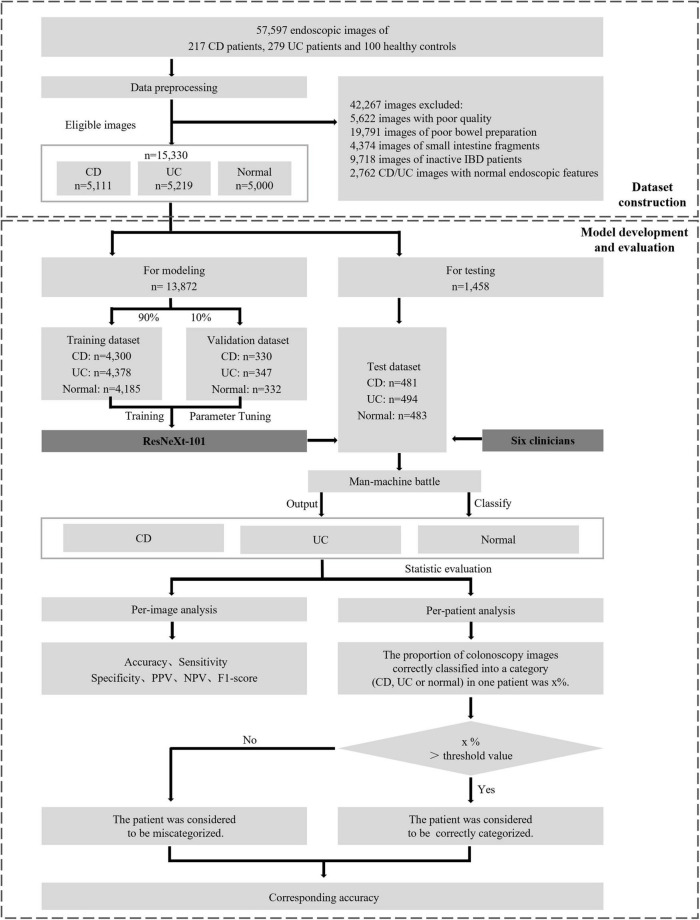
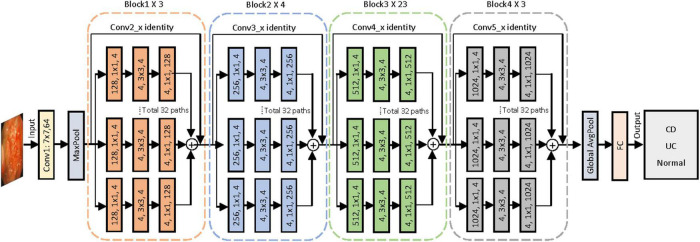
A total of 15,330 eligible colonoscopy images from 217 CD patients, 279 UC patients, and 100 healthy subjects recorded in the endoscopic database of Tongji Hospital were retrospectively collected. After selecting the ResNeXt-101 network, it was trained to classify endoscopic images either as CD, UC, or normal. We assessed its performance by comparing the per-image and per-patient parameters of the classification task with that of the six clinicians of different seniority.
In per-image analysis, ResNeXt-101 achieved an overall accuracy of 92.04% for the three-category classification task, which was higher than that of the six clinicians (90.67, 78.33, 86.08, 73.66, 58.30, and 86.21%, respectively). ResNeXt-101 also showed higher differential diagnosis accuracy compared with the best performing clinician (CD 92.39 vs. 91.70%; UC 93.35 vs. 92.39%; normal 98.35 vs. 97.26%). In per-patient analysis, the overall accuracy of the CNN model was 90.91%, compared with 93.94, 78.79, 83.33, 59.09, 56.06, and 90.91% of the clinicians, respectively.
The ResNeXt-101 model, established in our study, performed superior to most clinicians in classifying the colonoscopy images as CD, UC, or healthy subjects, suggesting its potential applications in clinical settings.
评估克罗恩病(CD)和溃疡性结肠炎(UC)的内镜特征是区分这两种疾病的关键诊断方法。然而,对内镜图像进行诊断鉴别需要经验丰富的临床医生进行精确解读,迄今为止这仍是一项挑战。因此,本研究旨在建立一种基于卷积神经网络(CNN)的模型,以促进基于结肠镜检查图像对CD、UC和健康对照进行诊断分类。
回顾性收集了来自同济医院内镜数据库的217例CD患者、279例UC患者和100名健康受试者的总共15330张合格的结肠镜检查图像。选择ResNeXt-101网络后,对其进行训练,以将内镜图像分类为CD、UC或正常。我们通过将分类任务的每张图像和每位患者的参数与六位不同资历的临床医生的参数进行比较,评估了其性能。
在每张图像分析中,ResNeXt-101在三类分类任务中的总体准确率达到92.04%,高于六位临床医生的准确率(分别为90.67%、78.33%、86.08%、73.66%、58.30%和86.21%)。与表现最佳的临床医生相比,ResNeXt-101在鉴别诊断准确性方面也更高(CD为92.39%对91.70%;UC为93.35%对92.39%;正常为98.35%对97.26%)。在每位患者分析中,CNN模型的总体准确率为90.91%,而临床医生的准确率分别为93.94%、78.79%、83.33%、59.09%、56.06%和90.91%。
我们研究中建立的ResNeXt-101模型在将结肠镜检查图像分类为CD、UC或健康受试者方面的表现优于大多数临床医生,表明其在临床环境中的潜在应用价值。