Institute for Risk Assessment Sciences, Faculty of Veterinary Medicine, Utrecht University, Utrecht, The Netherlands.
Außenstelle für Epidemiologie, Tierärztliche Hochschule Hannover, Hannover, Germany.
J Antimicrob Chemother. 2022 Jun 29;77(7):1883-1893. doi: 10.1093/jac/dkac133.
Real-time quantitative PCR (qPCR) is an affordable method to quantify antimicrobial resistance gene (ARG) targets, allowing comparisons of ARG abundance along animal production chains.
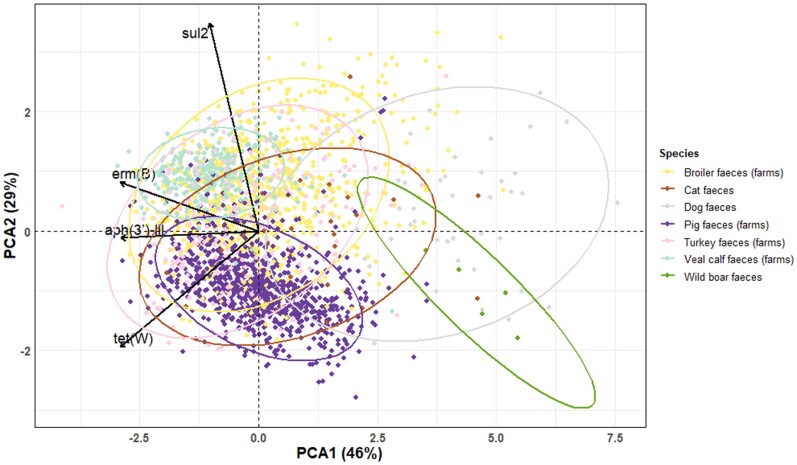
We present a comparison of ARG abundance across various animal species, production environments and humans in Europe. AMR variation sources were quantified. The correlation of ARG abundance between qPCR data and previously published metagenomic data was assessed.
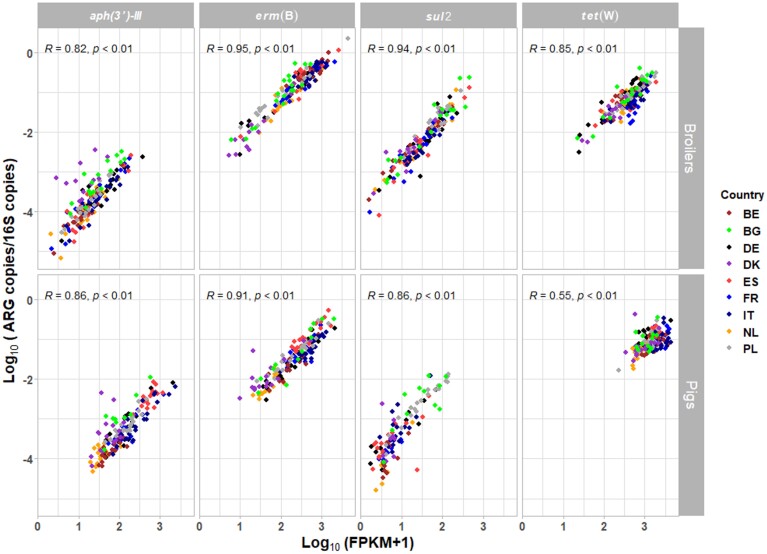
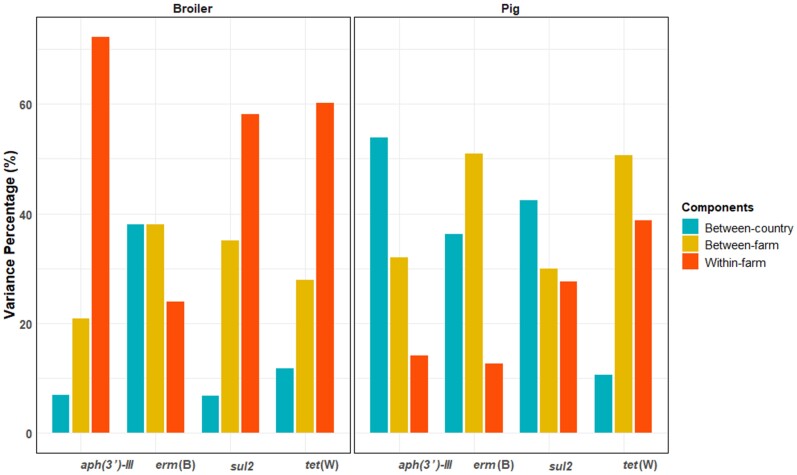
A cross-sectional study was conducted in nine European countries, comprising 9572 samples. qPCR was used to quantify abundance of ARGs [aph(3')-III, erm(B), sul2, tet(W)] and 16S rRNA. Variance component analysis was conducted to explore AMR variation sources. Spearman's rank correlation of ARG abundance values was evaluated between pooled qPCR data and earlier published pooled metagenomic data.
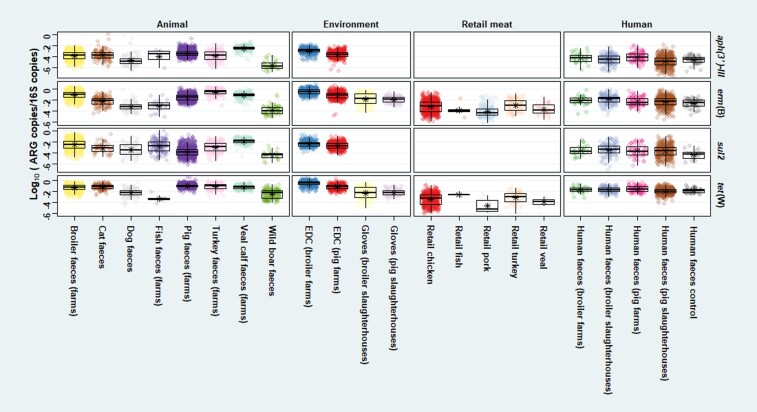
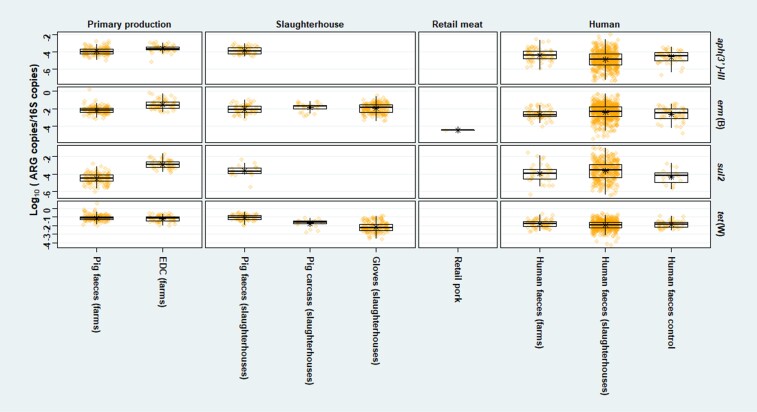
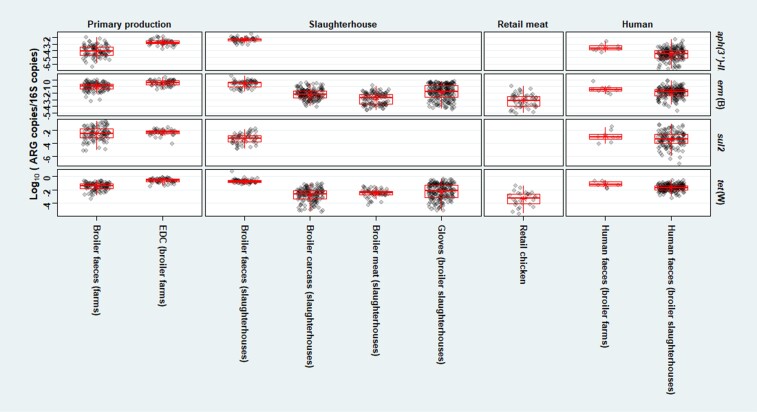
ARG abundance varied strongly among animal species, environments and humans. This variation was dominated by between-farm variation (pigs) or within-farm variation (broilers, veal calves and turkeys). A decrease in ARG abundance along pig and broiler production chains ('farm to fork') was observed. ARG abundance was higher in farmers than in slaughterhouse workers, and lowest in control subjects. ARG abundance showed a high correlation (Spearman's ρ > 0.7) between qPCR data and metagenomic data of pooled samples.
qPCR analysis is a valuable tool to assess ARG abundance in a large collection of livestock-associated samples. The between-country and between-farm variation of ARG abundance could partially be explained by antimicrobial use and farm biosecurity levels. ARG abundance in human faeces was related to livestock antimicrobial resistance exposure.
实时定量聚合酶链反应(qPCR)是一种经济实惠的方法,可用于量化抗菌药物耐药基因(ARG)靶标,从而能够比较动物生产链中 ARG 的丰度。
我们展示了欧洲不同动物物种、生产环境和人类中 ARG 丰度的比较。量化了 AMR 变异来源。评估了 qPCR 数据与先前发表的宏基因组数据之间 ARG 丰度的相关性。
在欧洲的九个国家进行了一项横断面研究,共纳入 9572 个样本。使用 qPCR 来定量 ARG [aph(3')-III、erm(B)、sul2、tet(W)]和 16S rRNA 的丰度。进行方差成分分析以探索 AMR 变异来源。评估了 pooled qPCR 数据与先前发表的 pooled 宏基因组数据之间 ARG 丰度值的 Spearman 秩相关。
ARG 丰度在动物物种、环境和人类之间差异很大。这种变异主要由农场间变异(猪)或农场内变异(肉鸡、犊牛和火鸡)引起。在猪和肉鸡生产链(“从农场到餐桌”)中观察到 ARG 丰度的下降。农民的 ARG 丰度高于屠宰场工人,而控制组的 ARG 丰度最低。qPCR 数据与 pooled 样本的宏基因组数据之间具有很高的相关性(Spearman's ρ>0.7)。
qPCR 分析是评估大量与牲畜相关样本中 ARG 丰度的有价值的工具。ARG 丰度的国家间和农场间变异部分可以通过抗菌药物使用和农场生物安全水平来解释。人类粪便中的 ARG 丰度与牲畜抗菌药物耐药性暴露有关。