Zhang Dan-Dan, Dai Xiao-Feng, Klosterman Steven J, Subbarao Krishna V, Chen Jie-Yin
State Key Laboratory for Biology of Plant Diseases and Insect Pests, Institute of Plant Protection, Chinese Academy of Agricultural Sciences, Beijing, 100193, China.
United States Department of Agriculture, Agricultural Research Service, Crop Improvement and Protection Research Unit, Salinas, CA, 93905, USA.
Biol Rev Camb Philos Soc. 2022 Oct;97(5):1810-1822. doi: 10.1111/brv.12863. Epub 2022 Apr 27.
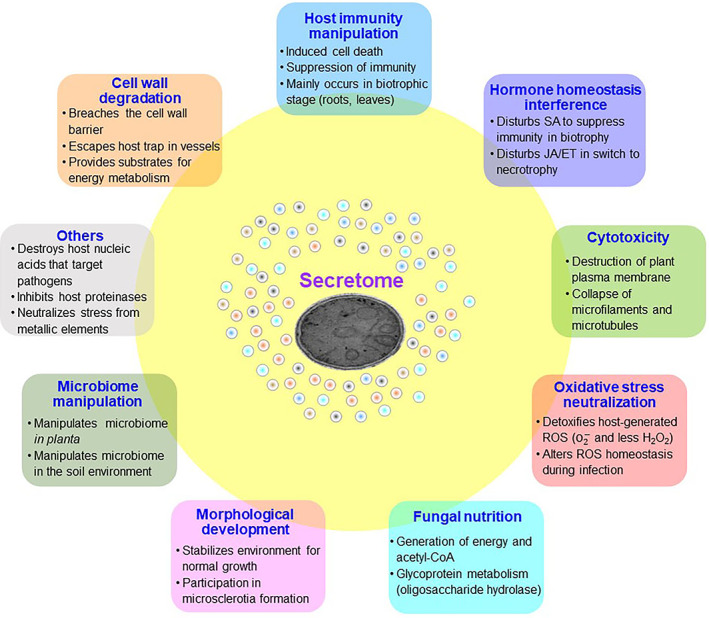
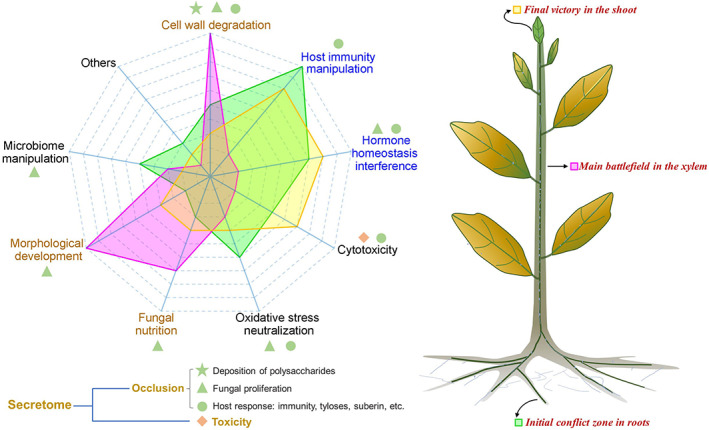
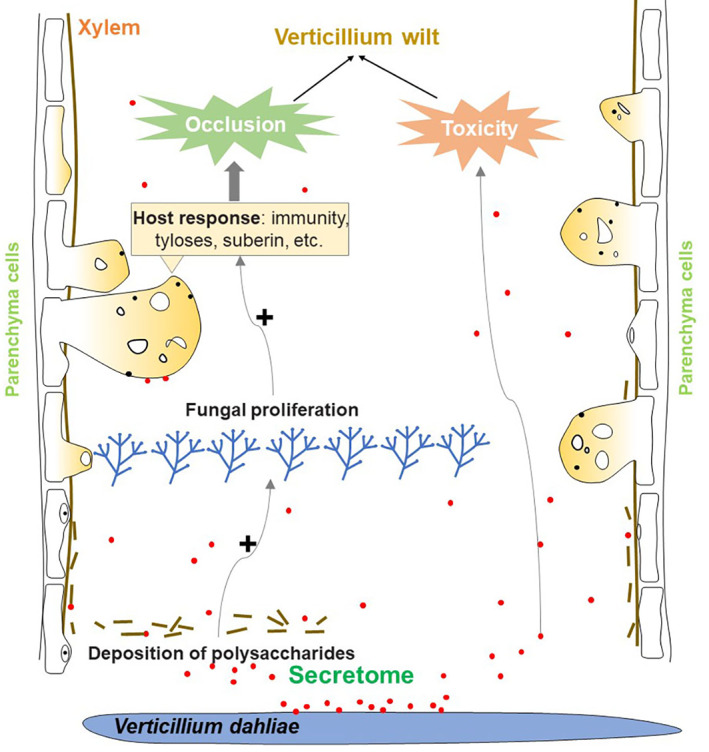
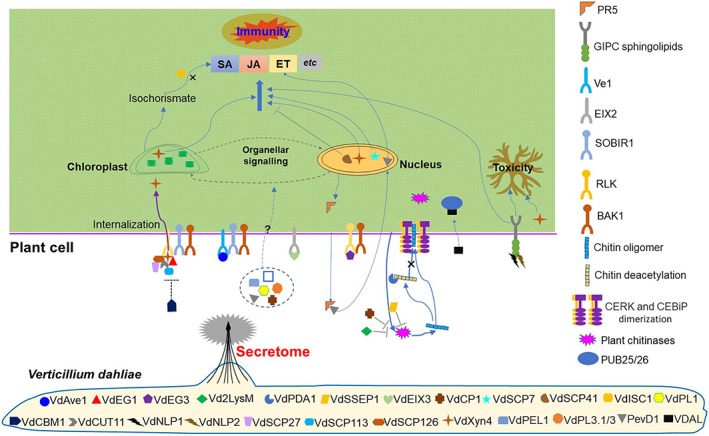
Verticillium dahliae is a notorious soil-borne pathogen that enters hosts through the roots and proliferates in the plant water-conducting elements to cause Verticillium wilt. Historically, Verticillium wilt symptoms have been explained by vascular occlusion, due to the accumulation of mycelia and plant biomacromolecule aggregation, and also by phytotoxicity caused by pathogen-secreted toxins. Beyond the direct cytotoxicity of some members of the secretome, this review systematically discusses the roles of the V. dahliae secretome in vascular occlusion, including the deposition of polysaccharides as an outcome of plant cell wall destruction, the accumulation of fungal mycelia, and modulation of plant defence responses. By modulating plant defences and hormone levels, the secretome manipulates the vascular environment to induce Verticillium wilt. Thus, the secretome of V. dahliae colludes with plant defence responses to modulate Verticillium wilt symptoms, and thereby bridges the historical concepts of both toxin production by the pathogen and vascular occlusion as the cause of wilting symptoms.
大丽轮枝菌是一种臭名昭著的土传病原菌,它通过根部进入宿主,并在植物的导水组织中增殖,从而引发黄萎病。从历史上看,黄萎病症状一直被解释为由于菌丝体的积累和植物生物大分子聚集导致的维管束堵塞,以及病原体分泌的毒素引起的植物毒性。除了分泌组中某些成员的直接细胞毒性外,本综述系统地讨论了大丽轮枝菌分泌组在维管束堵塞中的作用,包括作为植物细胞壁破坏结果的多糖沉积、真菌菌丝体的积累以及对植物防御反应的调节。通过调节植物防御和激素水平,分泌组操纵维管束环境以诱发黄萎病。因此,大丽轮枝菌的分泌组与植物防御反应相互作用,调节黄萎病症状,从而将病原体产生毒素和维管束堵塞作为萎蔫症状原因这两个历史概念联系起来。