Chen Haitian, Li Hailin, Cao Yinli, Qi Hongbo, Ma Yuyan, Bai Xiaoxia, Zhao Yangyu, Wu Li, Liu Caixia, Wei Jun, Wang Hong, Jin Yan, Wang Zilian, Zhu Yanna
Department of Obstetrics and Gynecology of the First Affiliated Hospital, Sun Yat-sen University, Guangzhou, China.
Department of Maternal and Child Health, School of Public Health, Sun Yat-sen University, Guangzhou, China.
Front Nutr. 2022 Apr 5;9:853565. doi: 10.3389/fnut.2022.853565. eCollection 2022.
Between January and April 2020, China implemented differentiated prevention and control strategies across the country, based on the severity of the COVID-19 epidemic/pandemic in different regions. These strategies included lockdowns, social distancing, and the closure of public places. These measures may have affected dietary intake to varying degrees. This study aimed to assess variations in food intake and diet quality among pregnant women according to regional severity and related control measures during the most severe period of COVID-19 restrictions in 2020.
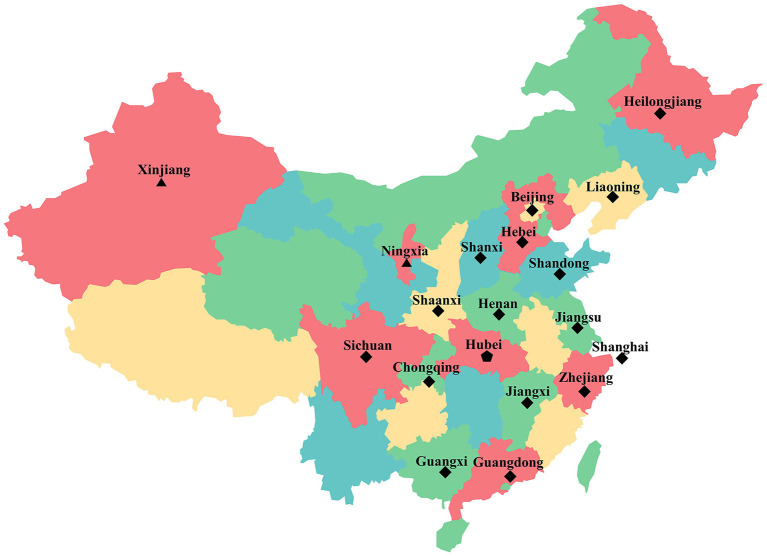
A total of 3,678 pregnant women from 19 provinces/municipalities in mainland China were analyzed in this nationwide, multi-center study. Food intake data were obtained and assessed using a validated food frequency questionnaire (FFQ). Diet quality was quantified using the Diet Balance Index for Pregnancy (DBI-P), which included high bound score (HBS, excessive dietary intake), low bound score (LBS, insufficient dietary intake), and diet quality distance (DQD, dietary imbalance). Linear trend tests and multivariable regression analyses were performed to examine the association between food intake, DBI-P and the severity of pandemic.
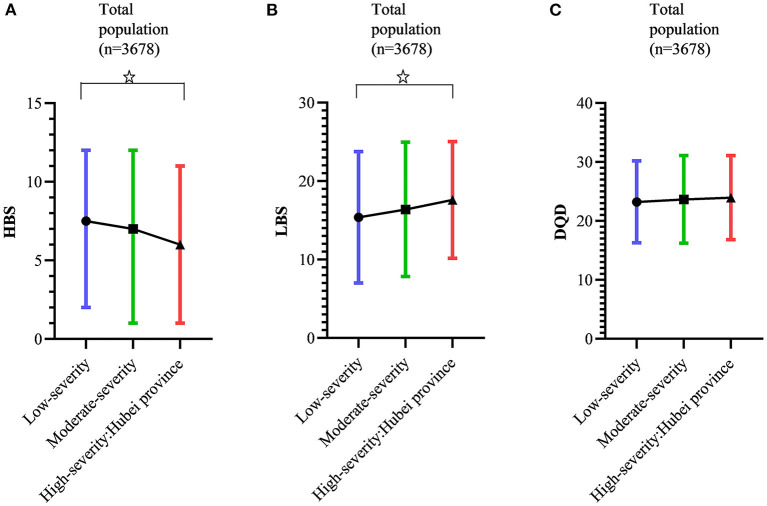
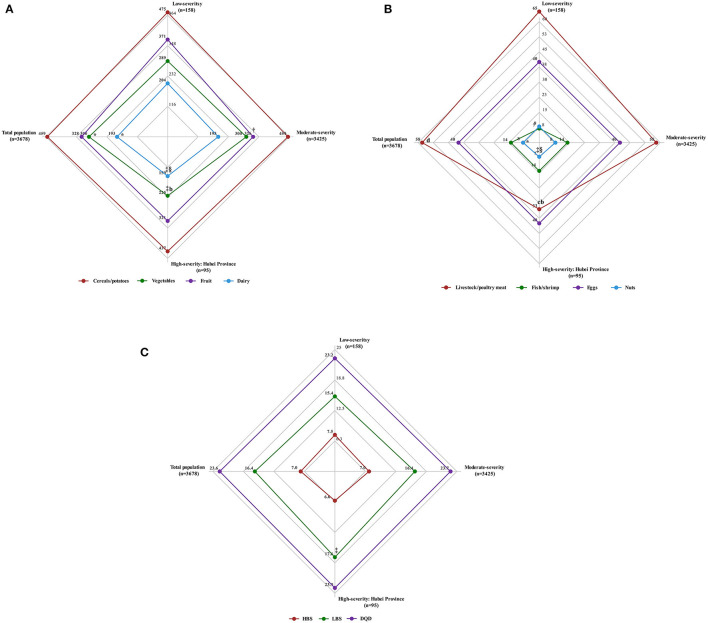
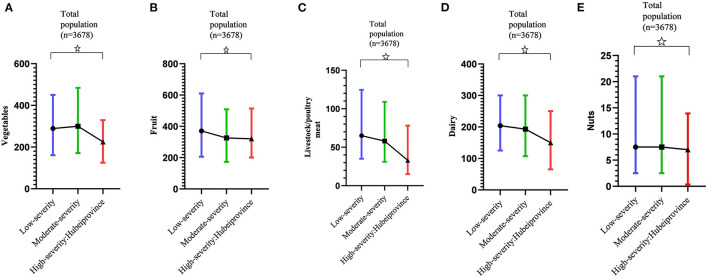
The median daily intake of vegetables, fruit, livestock/poultry meat, dairy, and nuts decreased ( < 0.05) according to low, moderate, and high severity of the pandemic, while no significant differences in cereals/potatoes, eggs, and fish/shrimp intake. The median daily intake of cereals/potatoes exceeded the recommended ranges, and the daily intake of eggs and fish/shrimp was below recommended ranges regardless of the pandemic severity ( < 0.05). Regarding diet quality, HBS decreased (lower excessive consumption) ( = 0.047) and LBS increased (greater insufficient consumption) ( = 0.046) with increased severity of the pandemic. On multivariable analyses, moderate and high pandemic severity were related to lower HBS risk (OR = 0.687, OR = 0.537) and higher LBS risk (β = 1.517, β = 3.020) when compared to low pandemic severity.
Under more severe COVID-19 pandemic conditions, pregnant women consumed less quality food, characterized by reduced consumption of vegetables, fruit, livestock/poultry meat, dairy and nuts, while the quality of the foods that pregnant women consumed in excess tended to improve, but the overconsumption of cereals/potatoes was a problem.
2020年1月至4月期间,中国根据不同地区新冠疫情的严重程度在全国实施了差异化防控策略。这些策略包括封锁、社交距离措施以及关闭公共场所。这些措施可能在不同程度上影响了饮食摄入。本研究旨在评估2020年新冠疫情限制最严格时期,不同地区严重程度及相关防控措施下孕妇的食物摄入量和饮食质量变化。
在这项全国性多中心研究中,分析了来自中国大陆19个省/直辖市的3678名孕妇。使用经过验证的食物频率问卷(FFQ)获取并评估食物摄入数据。饮食质量通过孕期饮食平衡指数(DBI-P)进行量化,该指数包括高限得分(HBS,饮食摄入过量)、低限得分(LBS,饮食摄入不足)和饮食质量差距(DQD,饮食不均衡)。进行线性趋势检验和多变量回归分析,以检验食物摄入量、DBI-P与疫情严重程度之间的关联。
根据疫情低、中、高严重程度,蔬菜、水果、畜禽肉、奶制品和坚果的每日摄入量中位数下降(P<0.05),而谷类/土豆、蛋类和鱼虾类摄入量无显著差异。无论疫情严重程度如何,谷类/土豆的每日摄入量中位数均超过推荐范围,蛋类和鱼虾类的每日摄入量低于推荐范围(P<0.05)。在饮食质量方面,随着疫情严重程度增加,HBS下降(过量消费减少)(P = 0.047),LBS上升(摄入不足增加)(P = 0.046)。多变量分析显示,与低疫情严重程度相比,中、高疫情严重程度与较低的HBS风险(OR = 0.687,OR = 0.537)和较高的LBS风险相关(β = 1.517,β = 3.020)。
在新冠疫情更严重的情况下,孕妇食用的优质食物减少,表现为蔬菜、水果、畜禽肉、奶制品和坚果的摄入量减少,而孕妇过量食用的食物质量趋于改善,但谷类/土豆的过量摄入是个问题。