Division of Cancer Control and Population Sciences, National Cancer Institute, Rockville, MD, USA.
Office of Workforce Planning and Development, National Cancer Institute, Rockville, MD, USA.
Metabolomics. 2022 Apr 30;18(5):29. doi: 10.1007/s11306-022-01878-8.
Through the systematic large-scale profiling of metabolites, metabolomics provides a tool for biomarker discovery and improving disease monitoring, diagnosis, prognosis, and treatment response, as well as for delineating disease mechanisms and etiology. As a downstream product of the genome and epigenome, transcriptome, and proteome activity, the metabolome can be considered as being the most proximal correlate to the phenotype. Integration of metabolomics data with other -omics data in multi-omics analyses has the potential to advance understanding of human disease development and treatment.
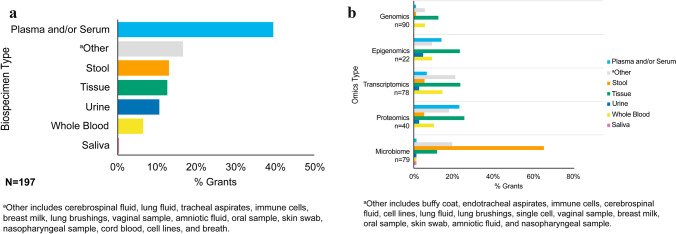
To understand the current funding and potential research opportunities for when metabolomics is used in human multi-omics studies, we cross-sectionally evaluated National Institutes of Health (NIH)-funded grants to examine the use of metabolomics data when collected with at least one other -omics data type. First, we aimed to determine what types of multi-omics studies included metabolomics data collection. Then, we looked at those multi-omics studies to examine how often grants employed an integrative analysis approach using metabolomics data.
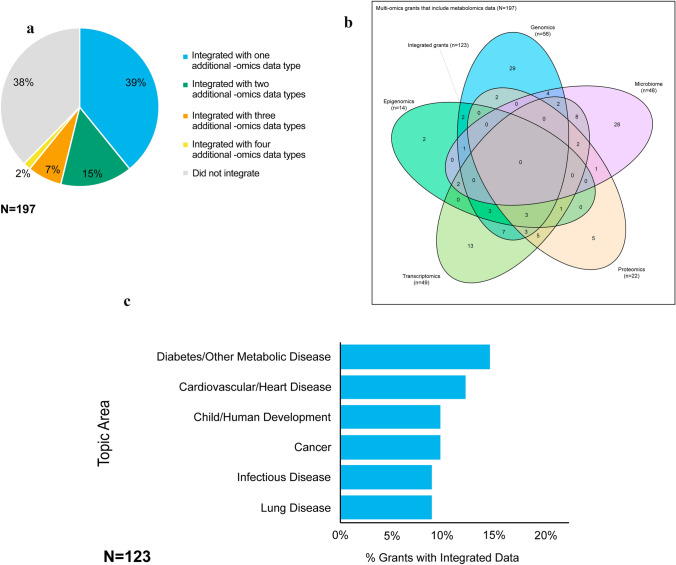
We observed that the majority of NIH-funded multi-omics studies that include metabolomics data performed integration, but to a limited extent, with integration primarily incorporating only one other -omics data type. Some opportunities to improve data integration may include increasing confidence in metabolite identification, as well as addressing variability between -omics approach requirements and -omics data incompatibility.
通过对代谢物进行系统的大规模分析,代谢组学为发现生物标志物以及改善疾病监测、诊断、预后和治疗反应提供了一种工具,同时也为描绘疾病机制和病因提供了一种工具。作为基因组和表观基因组、转录组和蛋白质组活性的下游产物,代谢组可以被认为是与表型最接近的相关物。将代谢组学数据与多组学分析中的其他组学数据进行整合,有可能增进对人类疾病发展和治疗的理解。
为了了解代谢组学用于人类多组学研究时的当前资助情况和潜在研究机会,我们对美国国立卫生研究院(NIH)资助的项目进行了横断面评估,以检查在至少收集一种其他组学数据类型时使用代谢组学数据的情况。首先,我们旨在确定包含代谢组学数据收集的多组学研究的类型。然后,我们观察这些多组学研究,以检查使用代谢组学数据进行综合分析的频率。
我们观察到,大多数包含代谢组学数据的 NIH 资助的多组学研究都进行了整合,但程度有限,整合主要只整合了一种其他组学数据类型。改善数据整合的一些机会可能包括提高对代谢物鉴定的信心,以及解决组学方法要求和组学数据不兼容之间的变异性。