Feng Long, Chu Zhixiang, Quan Xiaojiao, Zhang Yujie, Yuan Weixiu, Yao Yao, Zhao Yali, Fu Shihui
Department of Anesthesiology, Hainan Hospital of Chinese People's Liberation Army General Hospital, Sanya, China.
Emergency Department, Hainan Hospital of Chinese People's Liberation Army General Hospital, Sanya, China.
EClinicalMedicine. 2022 Apr 21;47:101336. doi: 10.1016/j.eclinm.2022.101336. eCollection 2022 May.
Cognitive decline is a growing public health concern. However, presently, only a few large-scale studies are available on the prevalence of cognitive decline worldwide, and the relationship between nutrition and cognitive decline remains unclear and requires further investigation, especially among Chinese centenarians and oldest-old adults. This study aimed to assess the prevalence of cognitive decline among Chinese centenarians and oldest-old adults, its associated factors, and explore a possible connection with nutrition, to provide new directions for the prevention of cognitive decline in Chinese centenarians and oldest-old adults.
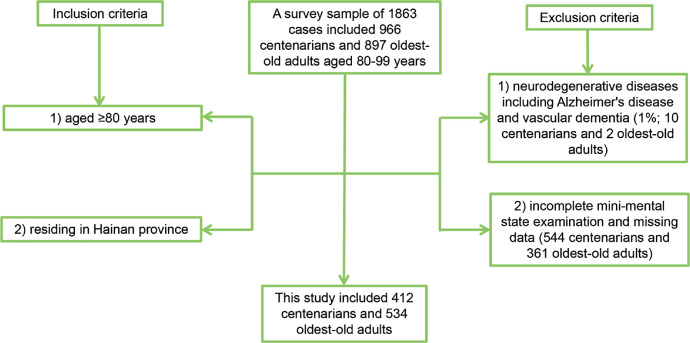
Based on the China Hainan Centenarian Cohort Study (CHCCS), a household survey was conducted among all the centenarians and oldest-old adults residing in 16 cities and counties of Hainan province from June 2014 to June 2016. This study included 946 centenarians and oldest-old adults (412 and 534, respectively). Cognitive function was measured using the mini-mental state examination (MMSE).
The total prevalence of cognitive decline was 76·6% (725 participants). Centenarians had a significantly higher prevalence of cognitive decline compared to oldest-old adults [359 centenarians (87·1%) vs. 366 oldest-old adults (68·5%)]. Centenarians and oldest-old adults with cognitive decline had significantly lower prognostic nutritional index (PNI) and mini nutrition assessment-short form (MNA-SF) than those without cognitive decline ( < 0·05). Multivariate logistic regression analyses showed that participants with higher PNI and MNA-SF were less likely to have cognitive decline. Multivariate linear regression analyses showed that PNI and MNA-SF were positively associated with MMSE ( < 0·05).
Malnutrition was positively associated with cognitive decline among Chinese centenarians and oldest-old adults. It is therefore important for clinicians and community health workers to pay attention to malnutrition in these populations and provide supplemental nutrients to prevent cognitive decline.
This work was supported by grants from the National Natural Science Foundation of China (81900357, 81903392, 81941021, 81901252, 82001476, 81802804, 81801251), the Military Medical Science and Technology Youth Incubation Program (20QNPY110, 19QNP060), the Excellent Youth Incubation Program of Chinese People's Liberation Army General Hospital (2020-YQPY-007), the Military Medicine Youth Program of Chinese People's Liberation Army General Hospital (QNF19069, QNF19068), the National Key R&D Program of China (2018YFC2000400), the National S&D Resource Sharing Service Platform Project of China (YCZYPT[2018]07), the Innovation Platform for Academinicians of Hainan Province, the Hainan Major Scientific and Technological Cooperation Project (2016KJHZ0039), the China Postdoctoral Science Foundation funded project (2019M650359, 2020M682816, 2021T140298), the Medical Big Data R&D Project of Chinese People's Liberation Army General Hospital (MBD2018030), the National Geriatric Disease Clinical Medicine Research centre Project (NCRCG-PLAGH-2017-014), the Central Health Care Scientific Research Project (W2017BJ12), the Hainan Medical and Health Research Project (16A200057), the Sanya Medical and Health Science and Technology Innovation Project (2016YW21, 2017YW22, 2018YW11), and the Clinical Scientific Research Supporting Fund of Chinese People's Liberation Army General Hospital (2017FC-CXYY-3009).
认知功能衰退是一个日益受到关注的公共卫生问题。然而,目前关于全球认知功能衰退患病率的大规模研究较少,营养与认知功能衰退之间的关系仍不明确,需要进一步研究,尤其是在中国百岁老人和高龄老人中。本研究旨在评估中国百岁老人和高龄老人认知功能衰退的患病率、相关因素,并探讨其与营养的可能联系,为预防中国百岁老人和高龄老人认知功能衰退提供新方向。
基于中国海南百岁老人队列研究(CHCCS),2014年6月至2016年6月对海南省16个市县的所有百岁老人和高龄老人进行了家庭调查。本研究纳入了946名百岁老人和高龄老人(分别为412名和534名)。使用简易精神状态检查表(MMSE)测量认知功能。
认知功能衰退的总患病率为76.6%(725名参与者)。与高龄老人相比,百岁老人认知功能衰退的患病率显著更高[359名百岁老人(87.1%)对366名高龄老人(68.5%)]。认知功能衰退的百岁老人和高龄老人的预后营养指数(PNI)和简易营养评估简表(MNA-SF)显著低于无认知功能衰退者(P<0.05)。多因素逻辑回归分析显示PNI和MNA-SF较高的参与者认知功能衰退的可能性较小。多因素线性回归分析显示PNI和MNA-SF与MMSE呈正相关(P<0.05)。
营养不良与中国百岁老人和高龄老人的认知功能衰退呈正相关。因此,临床医生和社区卫生工作者关注这些人群的营养不良并提供补充营养以预防认知功能衰退很重要。
本研究得到了中国国家自然科学基金(81900357、8190