Kim Yangmoon, Park Youngbin, Kim Minkwan, Lee Jimin, Kim Ki Jae, Choi Jang Wook
School of Chemical and Biological Engineering and Institute of Chemical Processes, Seoul National University, 1 Gwanak-ro, Gwanak-gu, Seoul, 08826, Republic of Korea.
Department of Energy Engineering, Konkuk University, Neungdong-ro 120, Gwangjin-gu, Seoul, 05029, Republic of Korea.
Nat Commun. 2022 May 2;13(1):2371. doi: 10.1038/s41467-022-29987-x.
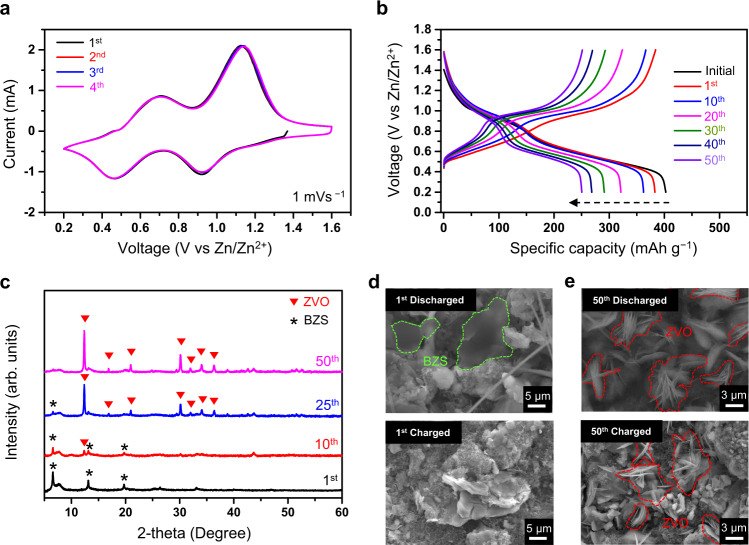
Aqueous zinc ion batteries are receiving increasing attention for large-scale energy storage systems owing to their attractive features with respect to safety, cost, and scalability. Although vanadium oxides with various compositions have been demonstrated to store zinc ions reversibly, their limited cyclability especially at low current densities and their poor calendar life impede their widespread practical adoption. Herein, we reveal that the electrochemically inactive zinc pyrovanadate (ZVO) phase formed on the cathode surface is the main cause of the limited sustainability. Moreover, the formation of ZVO is closely related to the corrosion of the zinc metal counter electrode by perturbing the pH of the electrolyte. Thus, the dissolution of VO(OH), the source of the vanadium in the ZVO, is no longer prevented. The proposed amalgamated Zn anode improves the cyclability drastically by blocking the corrosion at the anode, verifying the importance of pH control and the interplay between both electrodes.
水系锌离子电池因其在安全性、成本和可扩展性方面的诱人特性,在大规模储能系统中受到越来越多的关注。尽管已证明具有各种组成的钒氧化物可可逆地存储锌离子,但其有限的循环稳定性,尤其是在低电流密度下,以及较差的日历寿命阻碍了它们的广泛实际应用。在此,我们揭示了在阴极表面形成的电化学惰性焦钒酸锌(ZVO)相是可持续性受限的主要原因。此外,ZVO的形成与锌金属对电极的腐蚀密切相关,这是通过扰乱电解质的pH值实现的。因此,不再能阻止ZVO中钒的来源VO(OH)的溶解。所提出的汞齐化锌阳极通过阻止阳极腐蚀极大地提高了循环稳定性,证实了pH控制以及两个电极之间相互作用的重要性。