Centre for Hyperpolarisation in Magnetic Resonance, Department of Chemistry, University of York, Heslington, York YO10 5DD, U.K.
Department of Engineering and Technology, University of Huddersfield, Queensgate, Huddersfield, West Yorkshire HD1 3DH, U.K.
J Am Chem Soc. 2022 May 18;144(19):8756-8769. doi: 10.1021/jacs.2c02619. Epub 2022 May 4.
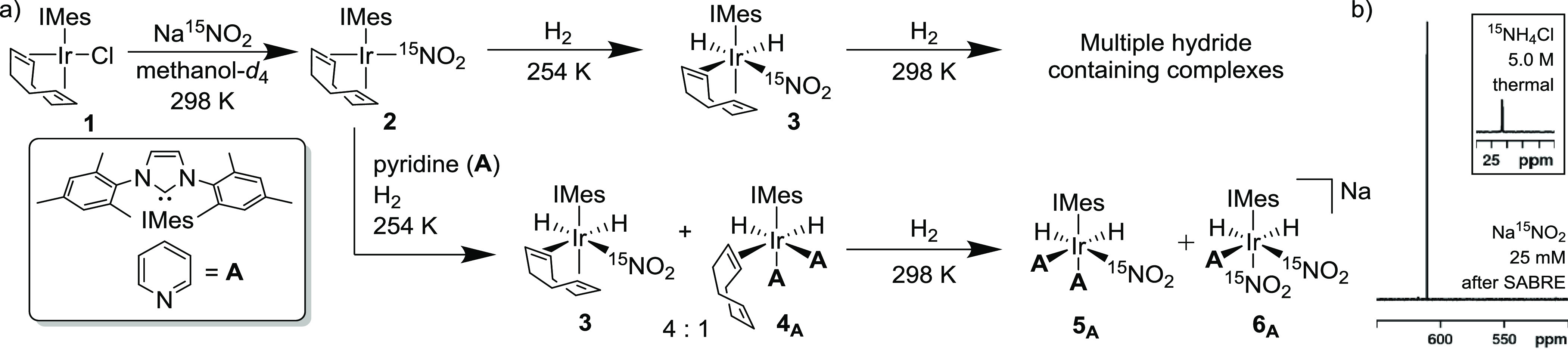
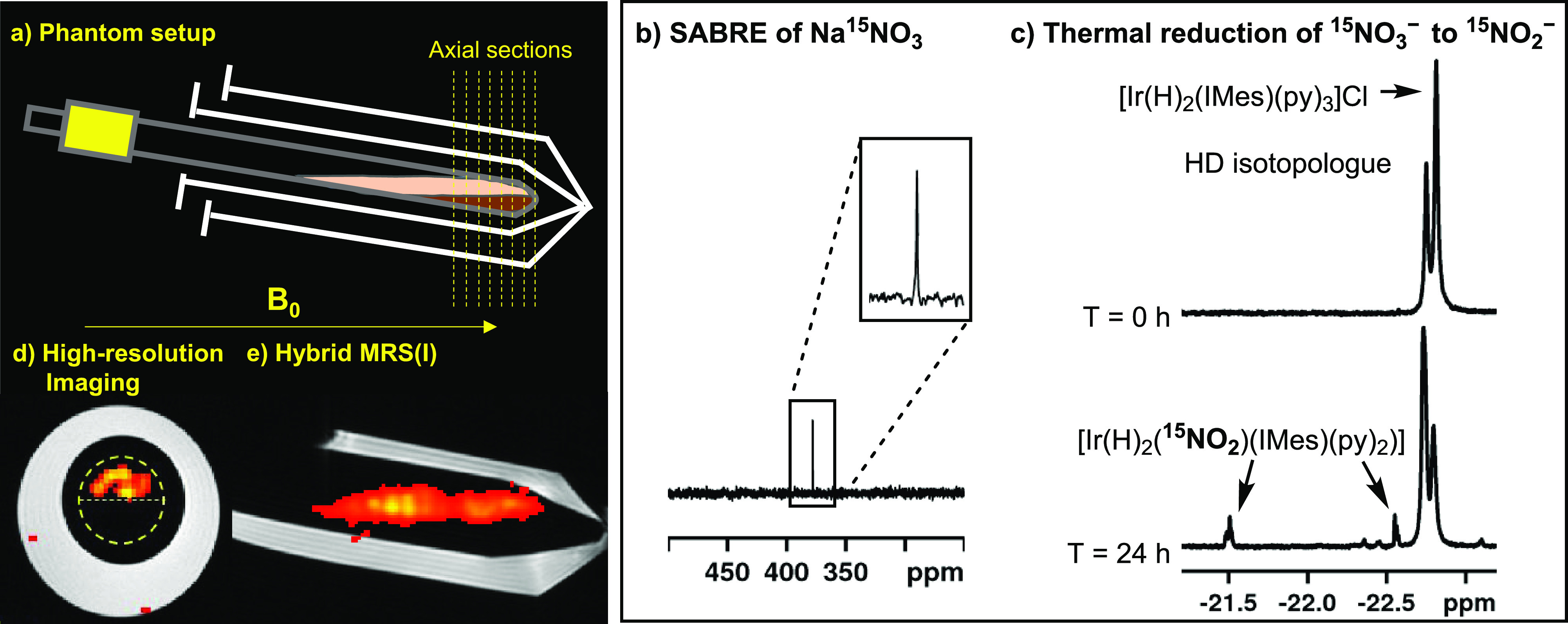
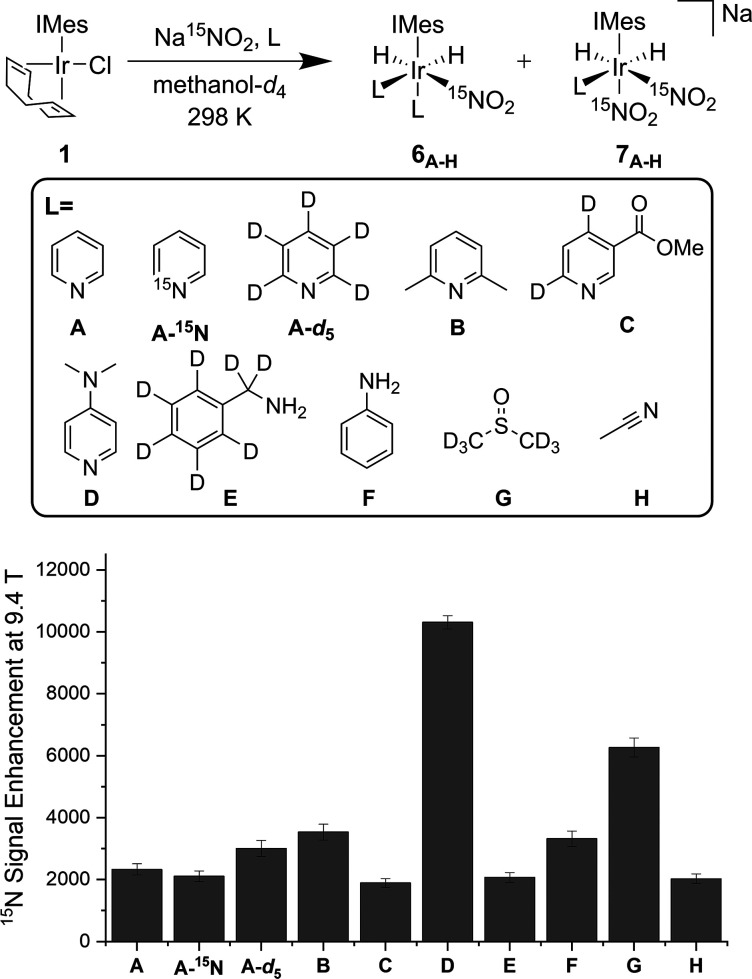
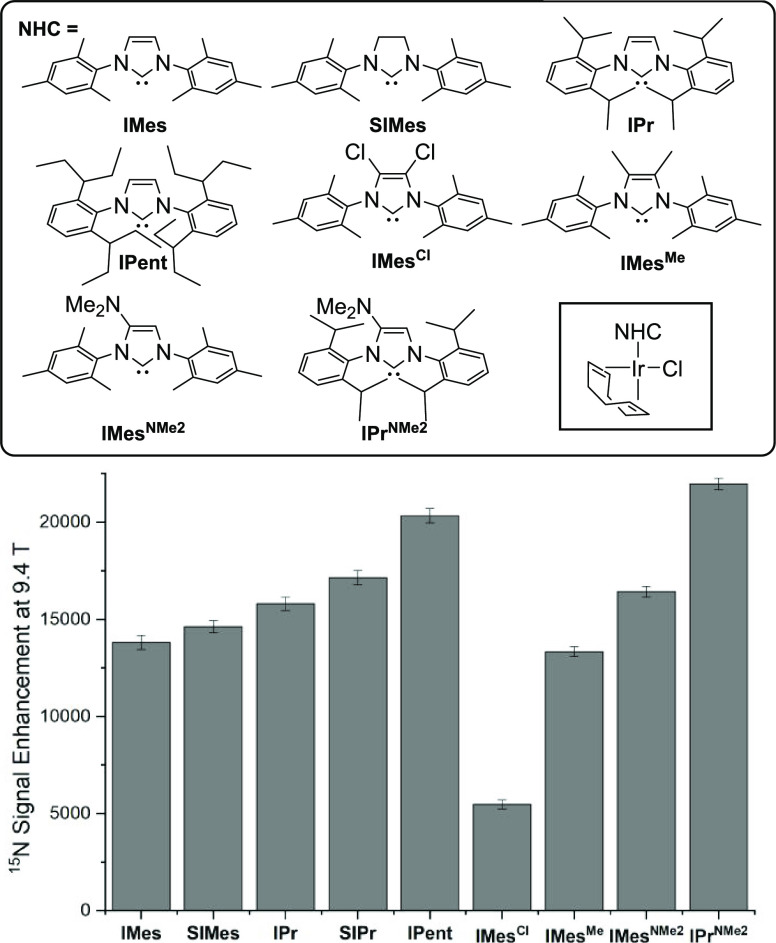
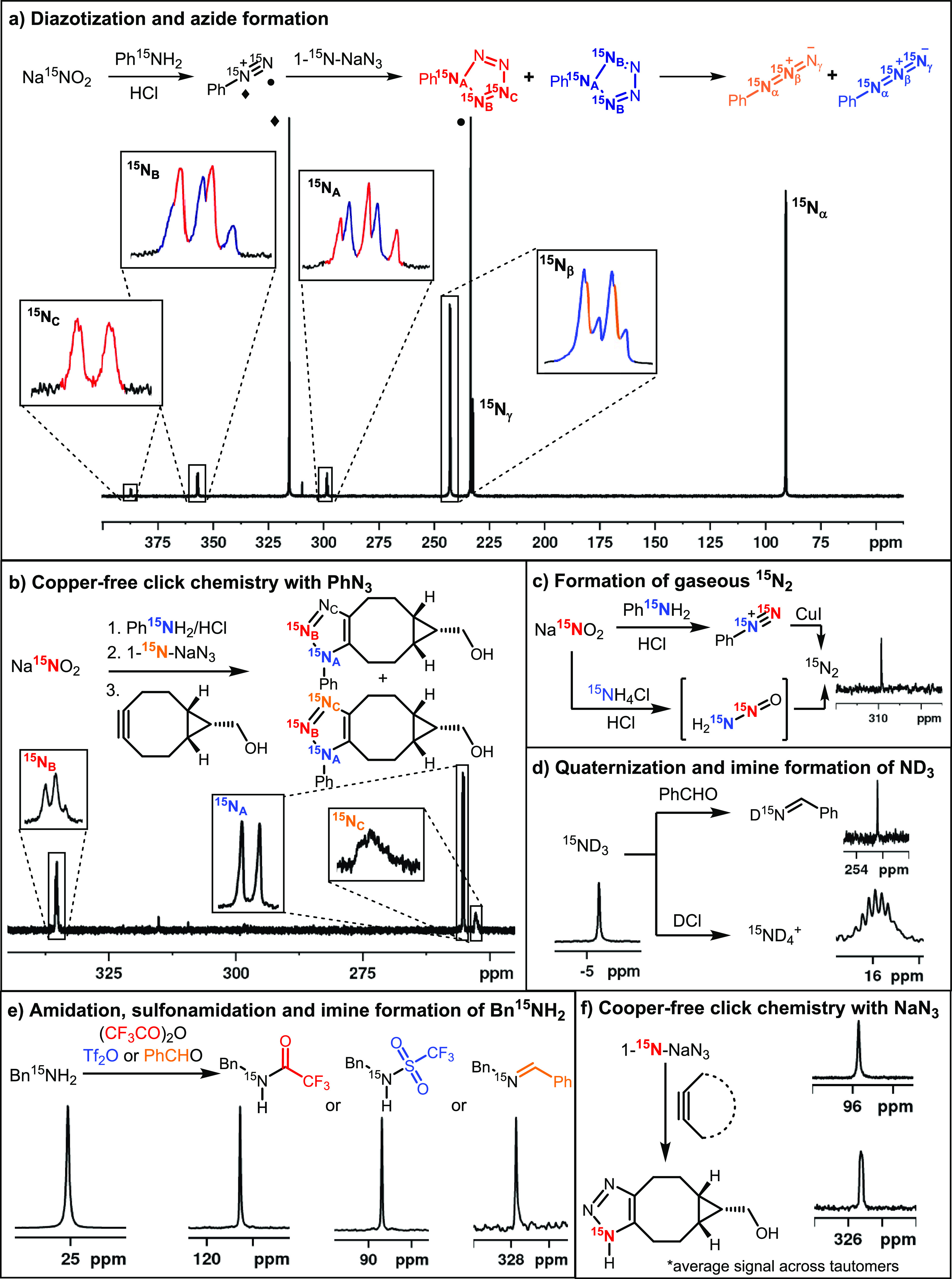
Here, we show how signal amplification by reversible exchange hyperpolarization of a range of N-containing synthons can be used to enable studies of their reactivity by N nuclear magnetic resonance (NO (28% polarization), ND (3%), PhCHNH (5%), NaN (3%), and NO (0.1%)). A range of iridium-based spin-polarization transfer catalysts are used, which for NO work optimally as an amino-derived carbene-containing complex with a DMAP- coligand. We harness long N spin-order lifetimes to probe in situ reactivity out to 3 × . In the case of NO ( 17.7 s at 9.4 T), we monitor PhNH diazotization in acidic solution. The resulting diazonium salt (N- 38 s) forms within 30 s, and its subsequent reaction with NaN leads to the detection of hyperpolarized PhN ( 192 s) in a second step via the formation of an identified cyclic pentazole intermediate. The role of PhN and NaN in copper-free click chemistry is exemplified for hyperpolarized triazole ( < 10 s) formation when they react with a strained alkyne. We also demonstrate simple routes to hyperpolarized N in addition to showing how utilization of N-polarized PhCHNH enables the probing of amidation, sulfonamidation, and imine formation. Hyperpolarized ND is used to probe imine and ND ( 33.6 s) formation. Furthermore, for NO, we also demonstrate how the N-magnetic resonance imaging monitoring of biphasic catalysis confirms the successful preparation of an aqueous bolus of hyperpolarized NO in seconds with 8% polarization. Hence, we create a versatile tool to probe organic transformations that has significant relevance for the synthesis of future hyperpolarized pharmaceuticals.
在这里,我们展示了如何通过可逆交换极化来放大一系列含氮合成物的信号,从而通过氮核磁共振(NO(28%极化)、ND(3%)、PhCHNH(5%)、NaN(3%)和 NO(0.1%))来研究它们的反应性。我们使用了一系列基于铱的自旋极化转移催化剂,其中对于 NO,最优的催化剂是一种含有氨基衍生的卡宾和 DMAP 配体的配合物。我们利用长的 N 自旋序寿命来探测到 3 × 的原位反应性。在 NO 的情况下(在 9.4 T 下为 17.7 s),我们在酸性溶液中监测 PhNH 的重氮化反应。生成的重氮盐(N- 38 s)在 30 s 内形成,随后其与 NaN 反应导致通过形成已鉴定的环状戊唑中间体,在第二步中检测到超极化的 PhN( 192 s)。PhN 和 NaN 在无铜点击化学中的作用通过它们与应变炔烃反应生成超极化三唑(< 10 s)得到例证。我们还展示了除了展示如何利用极化的 PhCHNH 来探测酰胺化、磺酰胺化和亚胺形成之外,如何获得超极化 N 的简单途径。超极化 ND 用于探测亚胺和 ND( 33.6 s)的形成。此外,对于 NO,我们还展示了如何通过 N 磁共振成像监测两相催化来确认在几秒钟内成功制备了具有 8%极化度的超极化 NO 的水溶液弹丸。因此,我们创建了一个多功能工具来探测有机转化,这对于未来超极化药物的合成具有重要意义。